MicroStrategy purchased $264.1 million worth of BTC from January 20-25 by issuing stock financing. mNAV has fallen to 0.94, a 6% discount, with only a 0.38% increase in BTC per share. Dilution rate is 5.36%, catching up with the cumulative rate of 5.77%, and issuing at a discount damages shareholder value.
mNAV Breaks Below 1.0, Dilution Effect Consumes Value
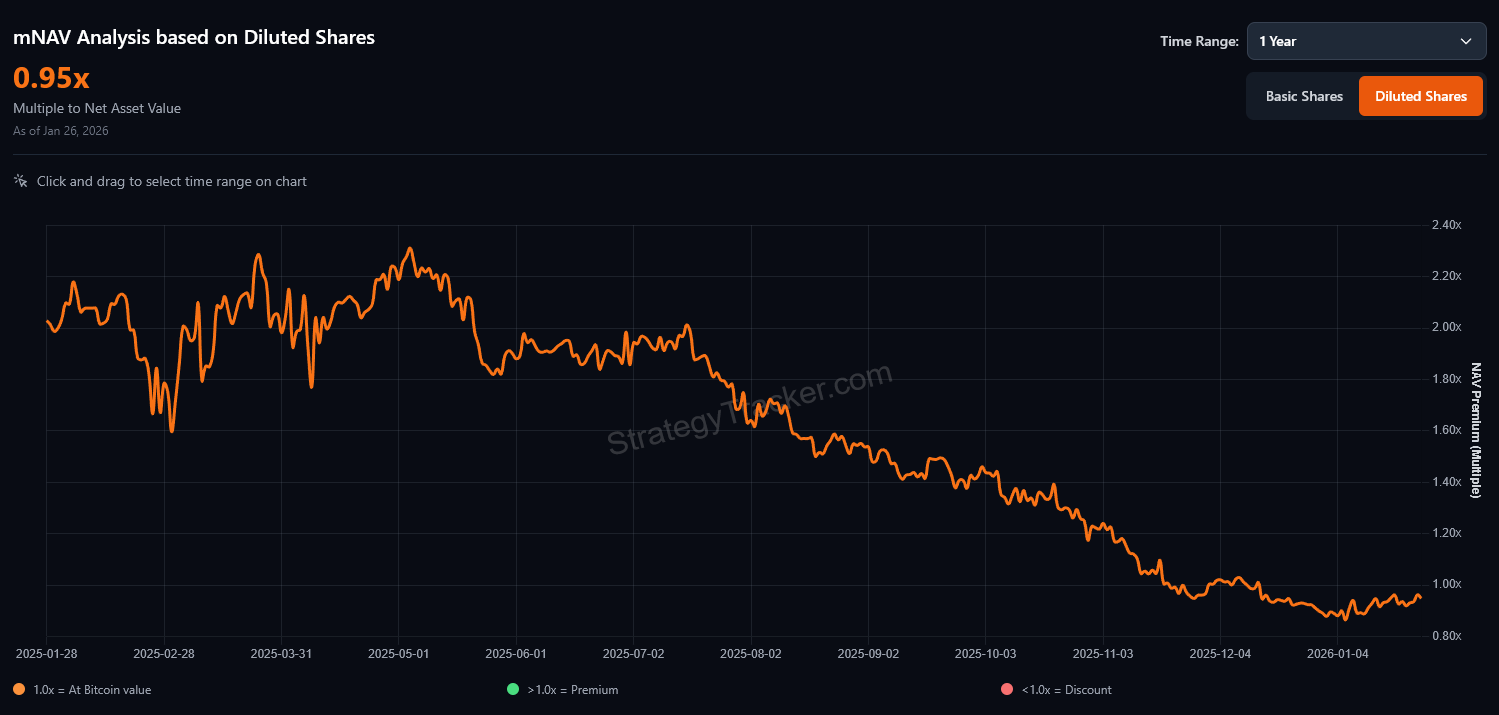
(Source: SaylorTracker)
The most important structural indicator for MicroStrategy is its net asset value multiple (mNAV), which measures the trading of its stock relative to the value of Bitcoin held per share. As of January 26, MicroStrategy’s post-dilution mNAV is approximately 0.94, meaning the stock trades at a 6% discount to the Bitcoin backing per share. This is critical because MicroStrategy’s strategy relies on issuing stock at a price above net asset value. When shares trade at a discount, new issuance not only fails to create shareholder value but actually erodes it.
This mechanism can be explained with simple math. Suppose each share of MicroStrategy corresponds to 0.002 BTC, with BTC priced at $90,000, giving an intrinsic value of $180 per share. If the stock trades at $200 (mNAV = 1.11), issuing new shares to raise $200 can buy 2.22 USD worth of BTC (200/90,000 = 0.00222 BTC). The BTC per share increases from 0.002 to slightly above 0.002, benefiting shareholders. But if the stock trades at $170 (mNAV = 0.94), issuing new shares to raise $170 can only buy 0.00189 BTC, which dilutes the original shareholders’ BTC holdings.
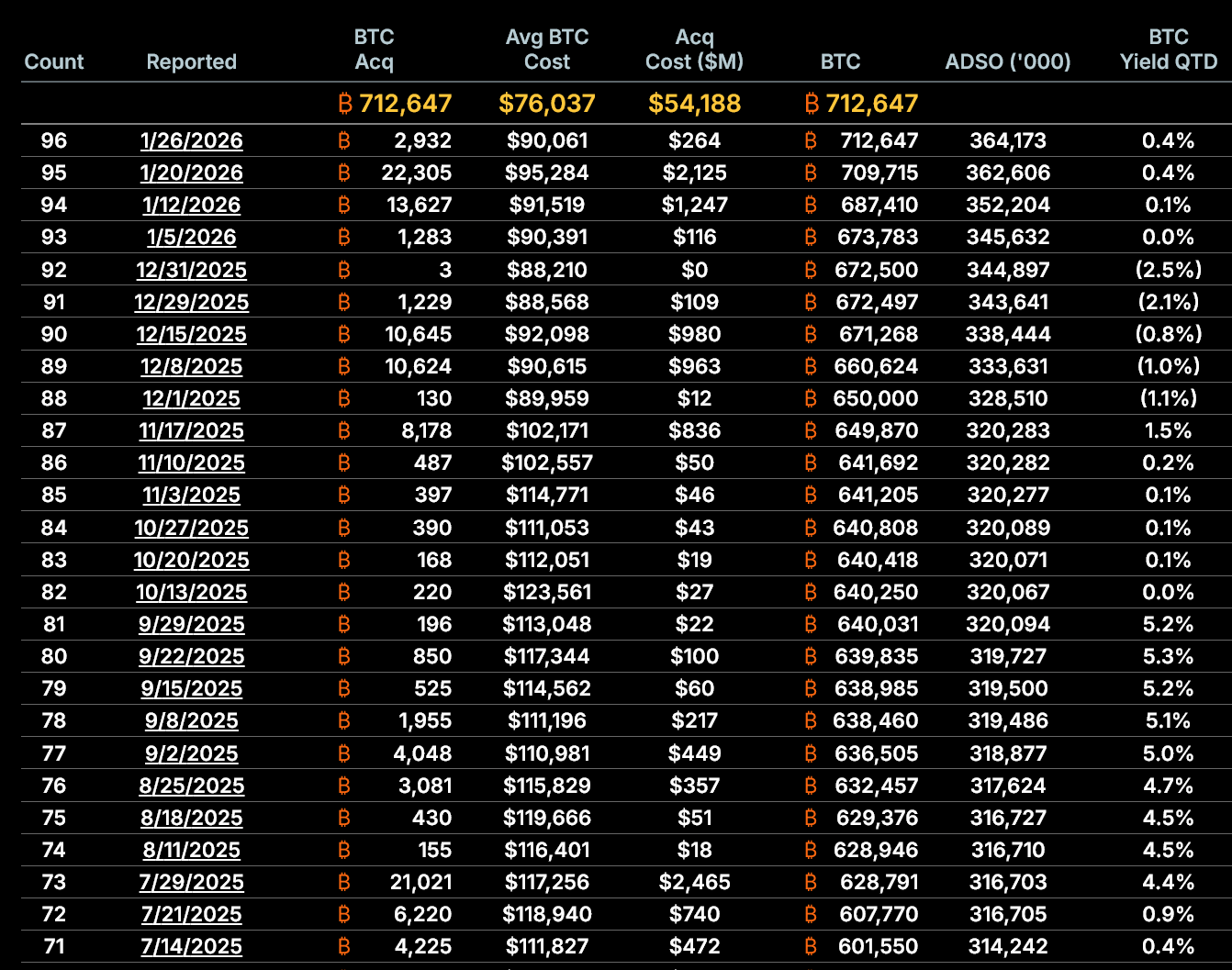
Historically, MicroStrategy has justified issuing stock by increasing the per-share Bitcoin value. But this growth effect is now waning. According to company data, as of January 5, MicroStrategy held 673,783 BTC, equivalent to 345.6 million diluted shares, or 0.001949 BTC per share. By January 26, holdings increased to 712,647 BTC, but diluted shares rose to 364.2 million, with each share valued at 0.001957 BTC. That’s only a 0.38% increase from the previous month.
More importantly, from January 20 to January 26, the BTC per share remained nearly unchanged. This indicates that recent stock issuances no longer meaningfully increase the proportion of Bitcoin held by shareholders. Bitcoin price growth can no longer offset the increasing dilution effect.
Dilution Rate Accelerates to Catch Up with Cumulative Growth
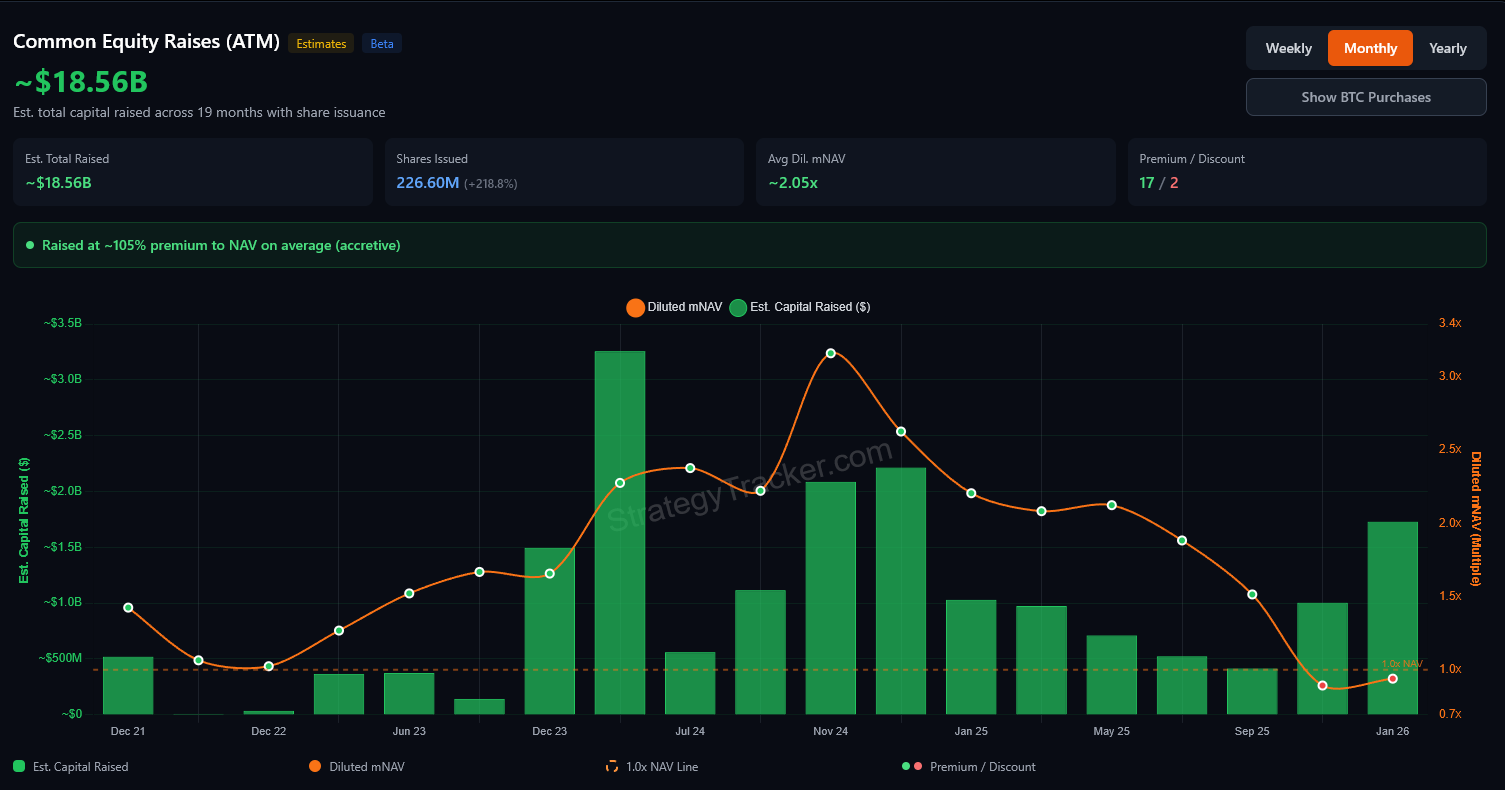
(Source: SaylorTracker)
The dilution rate is accelerating. From January 5 to January 26: the number of diluted shares increased by 5.36%, while Bitcoin holdings increased by 5.77%. Although the total holdings remain slightly above the dilution amount, the gap has narrowed sharply in the past week. This widening gap coincides with the decline in mNAV, indicating the model’s efficiency is decreasing. If the stock price continues below net asset value, further issuance mathematically reduces the Bitcoin exposure per share.
If this trend persists, it will fundamentally change MicroStrategy’s investment logic. Investors buy MicroStrategy stock mainly for leverage and appreciation potential that surpasses direct Bitcoin ownership. If the BTC per share stops growing or even declines, MicroStrategy loses its advantage over direct BTC holdings. Investors may then prefer to buy BTC directly or via BTC ETFs, avoiding company risk and stock volatility.
This Bitcoin strategy still relies entirely on capital market access. Over the past 19 months, the company has raised approximately $18.56 billion through common stock issuance, issuing about 22.66 million shares. This latest acquisition continues that trend, further diluting equity amid a weak market. The company is increasingly relying on preferred stock, which grants shareholders priority over common stockholders with fixed claims. While issuing preferred stock can sustain Bitcoin purchases during market downturns, it also increases long-term debt and complicates the balance sheet.
Preferred Stock Increases Structural Risk
(Source: MicroStrategy)
MicroStrategy’s multi-layer preferred stock products such as STRC, STRK, STRF, STRD offer high dividends of 8-11%, attracting income-focused investors. These preferred stock issuances provide an alternative financing channel when stock prices are weak. However, preferred stocks are inherently debt-like financing instruments requiring regular dividend payments. MicroStrategy does not pay these dividends from operational profits but continues to issue new securities to fund them, creating a cycle dependency.
This cyclical financing works in a rising market but faces huge risks in a declining market. If BTC prices remain low, MicroStrategy’s stock could fall further, increasing the discount on mNAV, and making new share issuance more dilutive. Meanwhile, to pay preferred dividends, the company must keep issuing securities, further exacerbating dilution. Once this vicious cycle starts, it could lead to a spiral decline in shareholder value.
The recent issue with MicroStrategy’s Bitcoin purchases is not about scale or timing but about its structure. With mNAV below 1.0, the appreciation of Bitcoin per share is near zero, equity dilution accelerates, dependence on capital markets deepens, and the company’s core strategy faces unprecedented challenges. Unless the stock premium returns, continuous accumulation of Bitcoin may shift from appreciation to dilution. Even if Bitcoin prices rebound, this shift will fundamentally alter shareholder risk profiles.
Current data shows MicroStrategy can still buy Bitcoin, but the question is whether it can continue doing so without damaging shareholder value. The increasingly likely answer is no.
Disclaimer: The information on this page may come from third parties and does not represent the views or opinions of Gate. The content displayed on this page is for reference only and does not constitute any financial, investment, or legal advice. Gate does not guarantee the accuracy or completeness of the information and shall not be liable for any losses arising from the use of this information. Virtual asset investments carry high risks and are subject to significant price volatility. You may lose all of your invested principal. Please fully understand the relevant risks and make prudent decisions based on your own financial situation and risk tolerance. For details, please refer to
Disclaimer.
Related Articles
Trump's Ultimatum to Iran Fails to Materialize, BTC Stabilizes After Breaking Below $70,000 Over the Weekend
QCP Group points out that Trump's ultimatum to Iran failed to materialize, and the market stabilized briefly. Despite BTC breaking below 70,000, its resilience has strengthened. With U.S. national debt exceeding 3.9 trillion, stagflation concerns intensify, and central banks face policy dilemmas. Iran proposed settling transit fees in yuan, and the market should monitor shifts in BTC.
GateNews4m ago
Analyst Claims Bittensor (TAO) Could Outvalue Bitcoin (BTC): Here’s Why
Debate around Bitcoin and newer AI-driven crypto projects picked up again this week after fresh commentary compared Bittensor directly with BTC, raising questions about whether value in crypto is starting to move beyond simple store of value narratives.
Crypto analyst Tanaka shared a
CaptainAltcoin5m ago
OpenClaw Gateway: When Consumers Transform into Intelligent Agents
Author Jordi Visser explores the profound impact of ChatGPT and OpenClaw on the economy and labor markets, clarifying that the rise of intelligent agents will enable trillions of intelligent agents to become consumers and disrupt economic transaction patterns and traditional financial systems, emphasizing the foundational infrastructure role of programmable money and digital assets in the future economy.
金色财经_42m ago
Gold slides as traders eye sub-$50K BTC: Five things to know in Bitcoin this week
Bitcoin (BTC) starts a new week facing fresh macro risks as gold plummets and traders wait for $50,000.
BTC price action ends the week below a key trend line, and traders see little more than an early-week bounce for bulls.
Price looks more and more like it is repeating January’s be
Cointelegraph46m ago
Gold, Bonds, and Bitcoin: The Three Major Truth Revealers of Financial Markets
The article analyzes the recent performance of gold, bonds, and Bitcoin in current financial markets and the reasons behind it. Recently, rising bond yields, falling gold prices, and rising Bitcoin have demonstrated the market's reaction to uncertainty. Particularly in the Iran conflict, a liquidity crisis led to gold selloffs, while Bitcoin, as a non-sovereign asset, has gained favor. Looking ahead, oil prices are expected to continue rising, putting pressure on bonds and gold, with Bitcoin outperforming other assets. Financial markets will be significantly influenced by geopolitical factors.
金色财经_46m ago


