In the first week of December 2025, the Bitcoin market will face a decisive test, as four major U.S. macroeconomic events will take place, potentially reshaping expectations for monetary policy and market liquidity. On December 1, Fed Chairman Powell will deliver a speech, and on the same day, the Fed will officially end quantitative tightening, setting the tone for a shift in liquidity in the market. Subsequently, ADP employment, initial unemployment claims, and core PCE inflation data will be released in succession, with market expectations for a rate cut at the Fed meeting on December 10 reaching as high as 87.6%. This series of events will collectively determine whether Bitcoin will make a strong comeback or continue its downward trend.
Liquidity Turning Point: Powell's Speech and the Finale of QT
December 1st (Monday) will mark a significant moment in this macro cycle. Fed Chairman Jerome Powell will deliver an important speech at 8 PM Eastern Time, coinciding with the official end date of the Fed's quantitative tightening policy. As clearly stated in the Fed's October 29th announcement, “the Committee has decided to end its reduction of the total amount of securities holdings on December 1st,” the liquidity withdrawal actions that have lasted for several years will officially come to a close. Powell's speech, taking place just before the “quiet period” ahead of the December policy meeting, may lead to over-interpretation of his every word by the market, potentially triggering significant volatility.
The end of QT itself is a strong policy signal, marking the Fed's shift from shrinking its balance sheet to a neutral or even potentially expansionary stance. This transition is expected to “unlock” liquidity of up to tens of billions of dollars each month for the financial system, theoretically providing macro-level support for all risk assets, including Bitcoin. However, the current market concerns revolve around whether this positive news has been fully priced in, and what the pace and magnitude of the Fed's future “easing” will be. Powell's speech will become a key window for the market to glimpse these issues.
In addition, another layer of uncertainty looming over the market is the potential changes in the leadership of the Fed. Reports suggest that President Trump has selected Powell's successor, and although it has not been officially announced, the rumor alone is enough to intensify market speculation and volatility. If the new chairman is widely perceived as a more aggressive proponent of interest rate cuts, the market may trade in anticipation of a more accommodative monetary outlook, injecting a short-term boost into Bitcoin; conversely, any concerns about policy continuity could suppress risk appetite. Therefore, Monday night will be a complex moment interwoven with liquidity expectations and political uncertainty.
Key Macroeconomic Events Timeline and Impact This Week
| Event |
Time (ET) |
Core Focus Points |
Potential Impact on Bitcoin |
| 1. Powell's Speech & End of QT |
December 1, 20:00 |
Policy shift signals, future interest rate path, rumors of leadership changes |
Extremely High. Sets the tone for the entire week, any dovish/hawkish hints will directly impact the market. |
| 2. ADP Employment Data |
December 3, 08:15 |
Health of private sector employment, a leading indicator for non-farm data |
High. Strong data is bearish (dampening rate cut expectations), while weak data is bullish (strengthening easing expectations). |
| 3. Initial Jobless Claims |
December 4, 08:30 |
Real-time thermometer of the labor market, reflecting economic resilience |
Medium to High. A sustained increase indicates economic weakness or enhances expectations for easing, which is beneficial for risk assets. |
| 4. Core PCE Inflation |
December 5, 08:30 |
The Fed's preferred inflation indicator, determining the urgency of interest rate cuts |
Very High. If inflation continues to cool, it will reinforce expectations for a rate cut in December; if it rebounds, it may trigger panic. |
Employment Market “Thermometer”: ADP and Non-Farm Payrolls' Preliminary Battle
Immediately following Powell's speech, the market's attention will quickly turn to the specific performance of the U.S. labor market. The ADP private sector employment data released on Wednesday (December 3) serves as an important leading indicator for the official non-farm payroll report, and its influence should not be underestimated. Looking back at the weak data from October, where ADP only added 42,000 jobs, this had once reinforced the market's expectations of an economic slowdown. If the November data again falls below expectations, it will greatly strengthen the market's judgment that the Fed must take action soon to stimulate the economy, thereby increasing the probability of interest rate cuts, which traditionally is favorable for risk assets like Bitcoin.
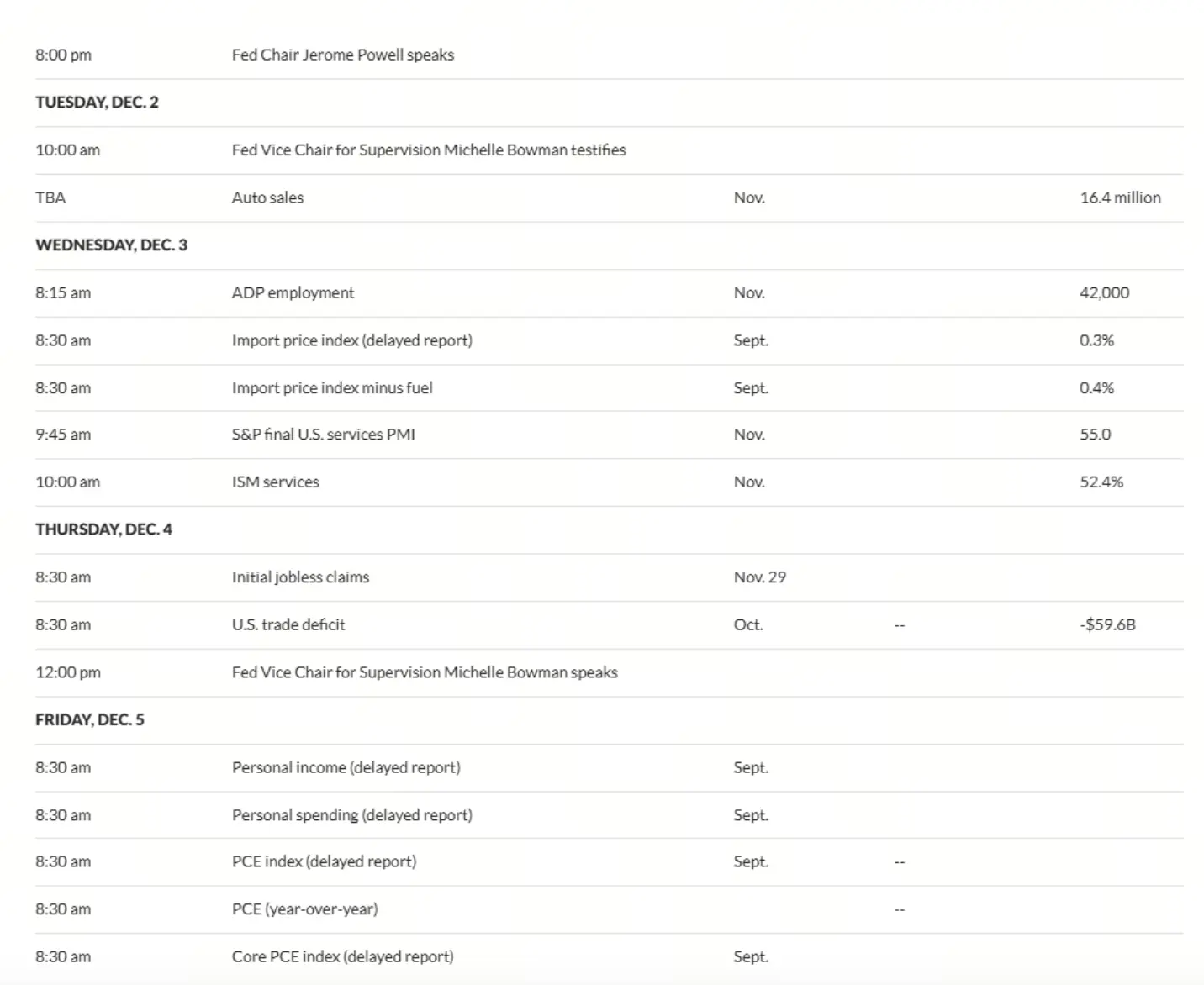
(Source: Market Watch)
Fed rate cuts
The initial jobless claims data on Thursday (December 4) will provide another high-frequency, real-time perspective on the job market. This data directly reflects the state of layoffs in businesses and is a sensitive indicator of the economy's immediate momentum. If initial jobless claims continue to rise, it will be seen as a clear signal that the economy is heading toward the brink of recession, which may force the Fed to adopt more decisive easing measures. Historical experience shows that in the early stages of increased economic uncertainty, Bitcoin sometimes declines in tandem with U.S. stocks (due to the sell-off of risk assets); however, once the market is convinced that the Fed will initiate a large-scale easing cycle, Bitcoin tends to lead the rebound, as its “anti-inflation” and “scarcity” narratives regain attention.
The Ultimate Judgment of Inflation: Core PCE Data Determines the Outcome
The highlight of this week's macro events is undoubtedly the personal consumption expenditure price index to be released on Friday (December 5), especially the core PCE data excluding food and energy. This is the inflation indicator that the Fed relies on most when formulating policy, and its trajectory directly concerns whether the central bank can confidently initiate a rate-cutting cycle. Current market pricing shows that traders believe the probability of a 25 basis point rate cut at the December 10 meeting has soared to 87.6%, a radical expectation largely based on the judgment that inflation will continue to decline.
Therefore, the upcoming PCE data will become a “touchstone” for this expectation. If the core PCE month-on-month growth rate further slows down and the year-on-year data continues to approach the 2% target, it will almost “lock in” a rate cut in December and open up possibilities for more cuts in 2026. In this scenario, the expectation of improved dollar liquidity will reach a peak, likely providing strong upward momentum for Bitcoin. Conversely, if the data shows inflation stickiness beyond expectations or even signs of rebound, the market will suffer a heavy blow, and the rate cut probability of up to 87.6% will quickly collapse, triggering a comprehensive sell-off akin to “failed expectations,” making it difficult for Bitcoin to remain unscathed.
Alongside the PCE data, personal income and spending data were also released, which together paint a picture of the overall health of American consumers. If the data shows that while inflation is slowing, consumer spending remains robust, it would constitute the so-called “Goldilocks” scenario (the economy is neither too hot nor too cold), which is most favorable for risk assets. The consumer confidence index, released at 10 AM, is also not to be overlooked; if consumers feel pessimistic about the economic outlook, it could signal a future contraction in spending, further reinforcing the Fed's reasons for supporting the economy. All of this means that in the few hours on Friday morning, the market may experience one of the most significant fluctuations of the year.
Trader's Guide: How to Position Yourself During the Macroeconomic Storm Week?
In the face of such a dense and significant macro event “bombing week”, cryptocurrency traders need a set of survival and profit strategies that go beyond technical analysis. The primary principle is to manage positions and leverage. Before major data releases, market volatility usually contracts due to uncertainty (volatility decreases), but at the moment the data is released, volatility can spike sharply. Therefore, on the eve of key events (especially Powell's speech and PCE data), actively reducing leverage and even converting some positions to stablecoins is the most effective way to control the risk of “liquidation”.
Secondly, formulating contingency plans is more important than predicting specific outcomes. Traders should simulate several possible scenarios in advance: 1) fully dovish (Powell hints at easing + weak employment + moderate PCE): This is the most favorable scenario for Bitcoin, consider buying on dips or increasing positions after data confirmation. 2) conflicting data (for example, strong employment but weak inflation): The market may become volatile, and we need to wait for the Fed to provide a clearer direction amid the conflicting data. 3) fully hawkish (all data stronger than expected): This is the most dangerous scenario, and we need to decisively reduce positions to hedge. Pre-setting response actions for each scenario can help you maintain discipline in an emotional market.
Finally, pay attention to cross-market linkage. Bitcoin is no longer an isolated asset; its correlation with U.S. stocks (especially tech stocks), the U.S. Dollar Index, gold, and even U.S. Treasury yields is increasingly strengthening. When data is released, it is important to not only observe Bitcoin's own reaction but also the movements of these traditional markets. For example, if PCE data is favorable, but the U.S. Dollar Index rises instead of falling, and U.S. stocks open high but end up low, this may indicate a complex sentiment of “good news already priced in” or concerns about future growth, making it difficult for Bitcoin's standalone rise to sustain. Learning to interpret the “harmony” between these macro signals, rather than individual “notes”, is key to improving the probability of success in a complex environment.
Disclaimer: The information on this page may come from third parties and does not represent the views or opinions of Gate. The content displayed on this page is for reference only and does not constitute any financial, investment, or legal advice. Gate does not guarantee the accuracy or completeness of the information and shall not be liable for any losses arising from the use of this information. Virtual asset investments carry high risks and are subject to significant price volatility. You may lose all of your invested principal. Please fully understand the relevant risks and make prudent decisions based on your own financial situation and risk tolerance. For details, please refer to
Disclaimer.
Related Articles
Trading Time: Crypto Regulation Welcomes Major Positive News, Bitcoin May "Sell Off First Then Rally" After Rate Decision Meeting
# Daily Market Highlights and Trend Analysis, Produced by PANews
## Macro Market
The US-Israel strike against Iran has entered its 19th day, with Trump claiming to have "completely destroyed Iran's military forces" and stating no NATO ally assistance is needed. Iran has announced the 61st wave of attacks under "True Promise-4" operation in retaliation for the death of Larijanis, secretary of Iran's Supreme Security Council. Analysis suggests that Larijani's death will have far greater impact on Iran's regime operations than Khamenei.
On Tuesday, US stocks continued their rebound trend, with the three major indices posting marginal gains. However, the sell-off triggered by the US-Iran war is far from bottoming. Bank of America strategist Michael Hartnett warns that Middle East conflicts and private credit concerns have shattered the "bubble bull market," but current sentiment reading of 5.6 and Put/Call sell signal of 8.5 indicate the market has yet to reach historically extreme pessimism.
Ahead of the FOMC meeting early Thursday morning, Chicago...
PANews7m ago
Will U.S. Treasury debt breaking through $39 trillion prompt investors to bet on bitcoin and other safe-haven assets?
On March 18, U.S. national debt surpassed $39 trillion, drawing market attention. Rising debt is driven by persistent deficits and increased interest burdens, with investors showing growing interest in decentralized assets such as Bitcoin. Policymakers face trade-offs between debt servicing and funding new initiatives, with rising debt potentially impacting infrastructure investment and long-term economic growth. Markets should monitor how debt developments influence investment strategies.
GateNews38m ago
A certain CEX's trading volume reached $1.443 billion in the past 24 hours, with XRP, BTC, and ETH ranking in the top three.
According to Gate News, on March 18th, a certain CEX's trading volume was $1.443 billion, down 42.67%. The top five tokens were XRP, BTC, ETH, POLYX, and BTT, with trading volume shares of 12.90%, 7.95%, 6.91%, 6.10%, and 4.90% respectively.
GateNews53m ago
Federal Reserve March 2026 Interest Rate Decision Set to Be Revealed Soon, Powell's Stance Will Influence Bitcoin and Market Trends
The Federal Reserve will maintain interest rates at 3.5%-3.75% on March 18. Market attention will be on Powell's comments regarding inflation and future policy. Rising core PCE and oil price pressures limit the room for rate cuts, with only a 30% chance of easing this year. Political factors influencing Powell's tenure have led to noticeable market reactions, and risk assets as well as cryptocurrency prices are expected to be affected.
GateNews54m ago
Whale Frenzy: $2 Billion Bitcoin Purchase as Market Watches Powell Speech for Potential BTC Breakthrough Above $75,000
Bitcoin price has fallen back to $74,000, with the market paying close attention to Fed Chair Powell's speech. Ongoing whale buying and ETF inflows demonstrate long-term demand, but short-term selling pressure should be watched carefully. Market sentiment is improving, and volatility could increase.
GateNews57m ago
Institutional Capital Inflows, Bitcoin ETF Records Five-Month Longest Consecutive Net Inflows
On March 18th, US Bitcoin ETFs experienced continued capital inflows, recording the longest streak in five months, with net inflows reaching $199.4 million, signaling a return of institutional investor confidence in Bitcoin. Spot Ethereum ETFs also saw consecutive net inflows. US regulatory authorities released guidance documents to enhance market transparency, promote cryptocurrency ETF development, and drive overall market activity.
GateNews1h ago


