 Trusted Editorial content, reviewed by leading industry experts and seasoned editors. Ad Disclosure
Bitcoin open-source engineer Matt Corallo pushed back on claims that Bitcoin developers are “sleepwalking” on quantum risk, arguing instead that a practical post-quantum roadmap is already taking shape and may be simpler than critics suggest. Speaking on the Unchained podcast episode published Feb. 22, Corallo said the key work can be framed in two main steps: enable post-quantum key commitments first, then decide later when to disable vulnerable legacy spend paths.
Trusted Editorial content, reviewed by leading industry experts and seasoned editors. Ad Disclosure
Bitcoin open-source engineer Matt Corallo pushed back on claims that Bitcoin developers are “sleepwalking” on quantum risk, arguing instead that a practical post-quantum roadmap is already taking shape and may be simpler than critics suggest. Speaking on the Unchained podcast episode published Feb. 22, Corallo said the key work can be framed in two main steps: enable post-quantum key commitments first, then decide later when to disable vulnerable legacy spend paths.
Corallo’s appearance was a direct response to criticism popularized by Castle Island Ventures’ Nick Carter, who has argued Bitcoin developers are not treating the quantum threat with sufficient urgency. Corallo said that characterization misses both the amount of ongoing work and an important technical point about how many Bitcoin wallets already function.
He argued that most wallets using seed phrases already have a quantum-safe anchor at the wallet-derivation layer, even if the on-chain public key and signature scheme remain vulnerable to a future cryptographically relevant quantum computer. In his telling, that meaningfully changes the migration problem and could reduce how much disruption is required if the threat becomes urgent.
Corallo’s 2-Step Roadmap For Bitcoin
Corallo repeatedly returned to what he called the core sequence for Bitcoin’s quantum preparation. “There are only two steps,” he said. “The first relevant step is just adding the ability to commit to a postquantum public key. I think that should be done soon.”
Related Reading: Bitcoin’s Quantum Risk Steals Spotlight At Ethereum GatheringHe added that this first phase is increasingly converging around hash-based signatures, with current discussion focused less on whether to do it and more on exact implementation details. Corallo said he sees “pretty strong consensus” around hash-based approaches and pointed to work tied to BIP 360, while also noting debate continues on the precise format.
The second step, in his framing, is the politically harder one: deciding when legacy, quantum-vulnerable spend paths should no longer be accepted. That is the point where old coins that have not migrated — including lost or abandoned coins — become part of a market-driven fork decision, in his view.
Corallo’s argument for moving early on the first step but delaying the enforcement switch rests on cost and wallet behavior. He said wallets can start committing to post-quantum public keys now without immediately paying the size and fee overhead of using large post-quantum signatures on-chain.
Related Reading: Bitcoin Whale Exchange Ratio Climbs To Highest Level In 11 Years — Data“You really want an upgrade path that is free for now,” Corallo said. “The wallets know how to spend it. They know how to build these keys, how to sign with these keys. They just don’t have to use it yet.”
He argued this avoids a scenario where wallets postpone upgrades because post-quantum transactions are larger and more expensive, while still preparing the system for a future enforcement moment.
The ‘Nobody Is Working On It’ Narrative
Corallo also disputed the idea that Bitcoin development circles are ignoring the issue. He pointed to research and engineering work at organizations including Blockstream Research and Chaincode Labs, cited Ethan Heilman and co-authors working on BIP 360, and said post-quantum discussion on the Bitcoin developer mailing list has grown steadily.
At one point, he said mailing-list discussion has risen to “30 or 40%” of posts, describing that as evidence of sustained attention rather than neglect.
Corallo did not argue the problem is trivial. He acknowledged migration of active wallets could take years and said critics are right that the social and market consequences of disabling insecure spend paths would be contentious. But his central claim was narrower: Bitcoin does not need a fully finalized end-state today to begin meaningful preparation now.
At press time, BTC traded at $65,953.
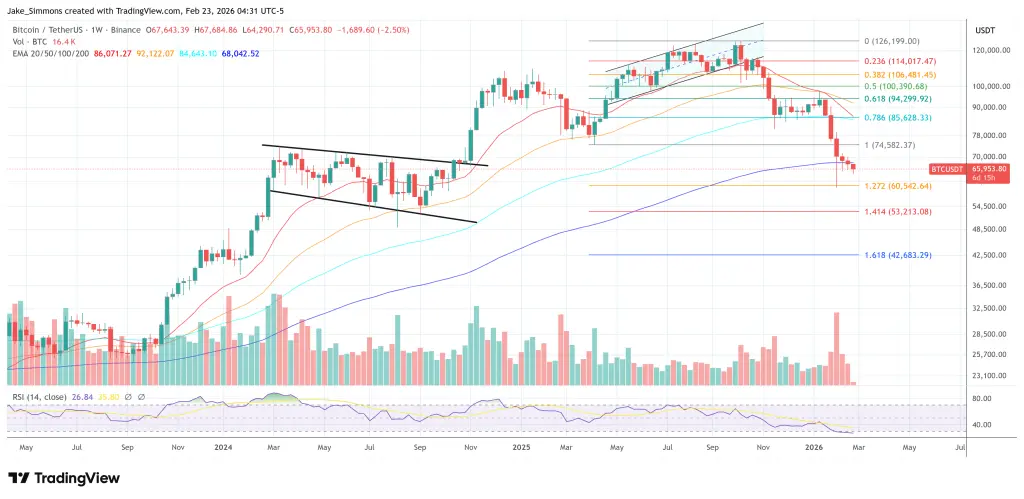 Bitcoin must reclaim the 200-week EMA, 1-week chart | Source: BTCUSDT on TradingView.comFeatured image created with DALL.E, chart from TradingView.com
![]() Editorial Process for bitcoinist is centered on delivering thoroughly researched, accurate, and unbiased content. We uphold strict sourcing standards, and each page undergoes diligent review by our team of top technology experts and seasoned editors. This process ensures the integrity, relevance, and value of our content for our readers.
Editorial Process for bitcoinist is centered on delivering thoroughly researched, accurate, and unbiased content. We uphold strict sourcing standards, and each page undergoes diligent review by our team of top technology experts and seasoned editors. This process ensures the integrity, relevance, and value of our content for our readers.
Disclaimer: The information on this page may come from third parties and does not represent the views or opinions of Gate. The content displayed on this page is for reference only and does not constitute any financial, investment, or legal advice. Gate does not guarantee the accuracy or completeness of the information and shall not be liable for any losses arising from the use of this information. Virtual asset investments carry high risks and are subject to significant price volatility. You may lose all of your invested principal. Please fully understand the relevant risks and make prudent decisions based on your own financial situation and risk tolerance. For details, please refer to
Disclaimer.


