A new on chain poll has started to attract attention across the Proof of Work crypto community. The vote asks a simple question. Which Proof of Work cryptocurrency stands out as the favorite among participants today? Early results show Kaspa (KAS) taking the lead over several well known names such as Bitcoin and Monero.
The poll appears on Hoosat Vote, a decentralized governance platform built for the Hoosat Network. Crypto analyst observers have pointed to the vote as an interesting snapshot of community preference inside the Proof of Work ecosystem. The poll remains active and will continue collecting responses until March 31, which means the current standings may still change before the final result appears.
The poll runs on Hoosat Vote, a decentralized voting system launched in late 2025 for the Hoosat Network (HTN). Hoosat Vote records each poll and vote directly on a GhostDAG-based blockchain. This structure removes the need for centralized polling tools that store results outside the blockchain environment.
Hoosat Vote allows users to create community questions and record responses in a transparent way. Votes become permanent blockchain entries, which creates a verifiable history of community decisions and sentiment. The system operates with fast confirmation speeds and low network costs. These features make the platform suitable for frequent community governance activities.
The current poll asks users to select their favorite Proof of Work crypto among several well known assets. Options include Bitcoin, Dogecoin, Bitcoin Cash, Monero, Litecoin, Ethereum Classic, Zcash, Dash, Bitcoin SV, and Kaspa.
Source: Hoosat Vote
Early Voting Results Show Kaspa (KAS) Leading The Proof Of Work Poll
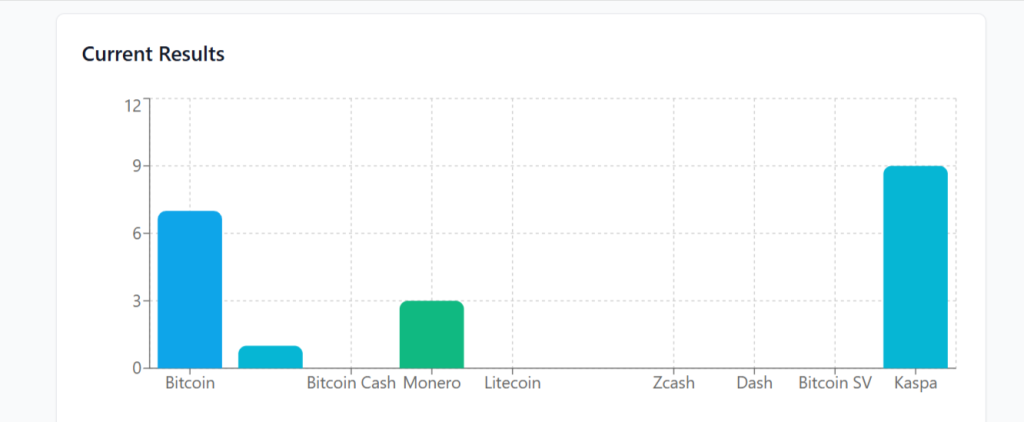
The results displayed in the poll interface reveal an early advantage for Kaspa (KAS). The latest snapshot shows Kaspa holding 9 votes, which represents about 45% of the total responses recorded so far.
Bitcoin follows in second place with 7 votes, which equals 35% of the poll. Monero holds the third position with 3 votes, representing 15% of the total responses. Dogecoin currently sits behind the top three with 1 vote.
Several other Proof of Work assets such as Litecoin, Zcash, Dash, Bitcoin Cash, Ethereum Classic, and Bitcoin SV have not yet recorded votes in this poll snapshot.
A visual chart of the results reinforces this ranking. Kaspa appears clearly ahead of the other candidates in the current stage of voting. Bitcoin remains the closest competitor based on the latest numbers.
Kaspa Popularity Reflects Interest In New Proof Of Work Architecture
Kaspa has gained attention inside Proof of Work circles because of its unique blockchain design. The network uses a GhostDAG protocol, which allows blocks to exist in parallel rather than following a single chain structure. This design allows faster confirmation speeds without abandoning the Proof of Work model.
The Kaspa network therefore combines traditional mining security with higher throughput than older Proof of Work chains. Supporters believe this structure could keep the network competitive as blockchain infrastructure evolves.
Top Analyst Reveals Bitcoin (BTC) Roadmap and Key Price Levels For the Next 2 Years_**
Bitcoin and Monero continue to represent established pillars of the Proof of Work ecosystem. Kaspa, however, represents a newer generation of networks that attempt to expand the capabilities of the mining model.
The Hoosat Vote poll remains open for another 16 days, which means the ranking may still evolve as more users participate. The final outcome will become clear once voting closes on March 31. Until then, the poll offers an interesting view into which Proof of Work projects attract attention among early participants in this on chain governance experiment.
Disclaimer: The information on this page may come from third parties and does not represent the views or opinions of Gate. The content displayed on this page is for reference only and does not constitute any financial, investment, or legal advice. Gate does not guarantee the accuracy or completeness of the information and shall not be liable for any losses arising from the use of this information. Virtual asset investments carry high risks and are subject to significant price volatility. You may lose all of your invested principal. Please fully understand the relevant risks and make prudent decisions based on your own financial situation and risk tolerance. For details, please refer to
Disclaimer.
Verwandte Artikel
Mt. Gox erwacht nach vier Monaten Stille zu Leben, kleine Bitcoin-Transfers lösen Spekulationen über Milliarden-Dollar-Verkaufsdrück aus
Am 24. März verlagerte die Kryptoplattform Mt. Gox einen Bitcoin im Wert von etwa 500 US-Dollar, was trotz des geringen Betrags die Aufmerksamkeit des Marktes erregte. Mt. Gox hält derzeit noch Bitcoin-Vermögenswerte im Wert von 2 Milliarden US-Dollar, und die Transaktion wurde als potenzielles Rückzahlungssignal interpretiert. Der Markt reagiert sehr sensibel auf seine Aktivitäten, was möglicherweise Anlegererwartungen und Marktvolatilität beeinflussen könnte. Analysten zufolge hat jede Aktion von Mt. Gox wichtige Marktbedeutung, und zukünftige Verlagerungen werden Veränderungen auf der Bitcoin-Angebotsseite beeinflussen.
GateNews2M her
Russell 2000 springt um 2% an und signalisiert Rückfluss von Kapital zu Bitcoin und Altcoins
Am 24. März stieg der US-amerikanische Russell 2000 Index um etwa 2%, was die Stimmung auf dem Kryptomarkt verbesserte und Anleger ihre Rezessionserwartungen neu bewerteten. Die Rückführung von Mitteln in Small-Cap-Aktien und die Veränderung der Aktienmarktstruktur erhöhten die Risikobereitschaft, wodurch Bitcoin und Altcoins gestützt wurden. Analysen zeigen, dass wenn sich die Risikobereitschaft am Aktienmarkt weiter verbessert, könnte der Kryptomarkt seine Erholung fortsetzen.
GateNews4M her
Strategie ergänzt Kapitalplanungen, was potenzielle Bitcoin-Kaufkraft auf $42 Milliarden zurückbringt
Strategy (MSTR) startete ein $42 -Milliarden-ATM-Eigenkapitalprogramm, aufgeteilt zwischen Klasse-A-Stammaktien und Vorzugsaktien, und führte ein neues 2,1-Milliarden-Dollar-ATM für seine Vorzugsaktien ein. Das Verkaufssyndikat des Unternehmens erweiterte sich auf 19 Firmen, um Anteile schrittweise zu verkaufen. Die Bitcoin-Bestände von MSTR stiegen auf 762.099 Münzen.
CoinDesk8M her
Warum ist Bitcoin seit dem Konflikt im Nahen Osten nicht gefallen, sondern sogar gestiegen?
Der Geopolitische Konflikt im Nahen Osten verschärft sich, und auf den globalen Finanzmärkten zeigt sich eine Differenzierung der Vermögenswerte. In letzter Zeit ist der Goldpreis deutlich zurückgegangen, während Bitcoin entgegen dem Trend um 7% gestiegen ist, was seine Eigenschaften als aufstrebendes Schutzinvestment demonstriert. Gold verursacht in einem Umfeld hoher Zinssätze höhere Haltungskosten, weshalb Anleger sich dem liquideren Bitcoin zuwenden – ein Zeichen für einen Wandel im Konsens über traditionelle Schutzinvestitionen. Bitcoin ist zu einem wichtigen Instrument zur Risikominderung geworden und könnte Schutzinvestitionen neu definieren.
金色财经_15M her


