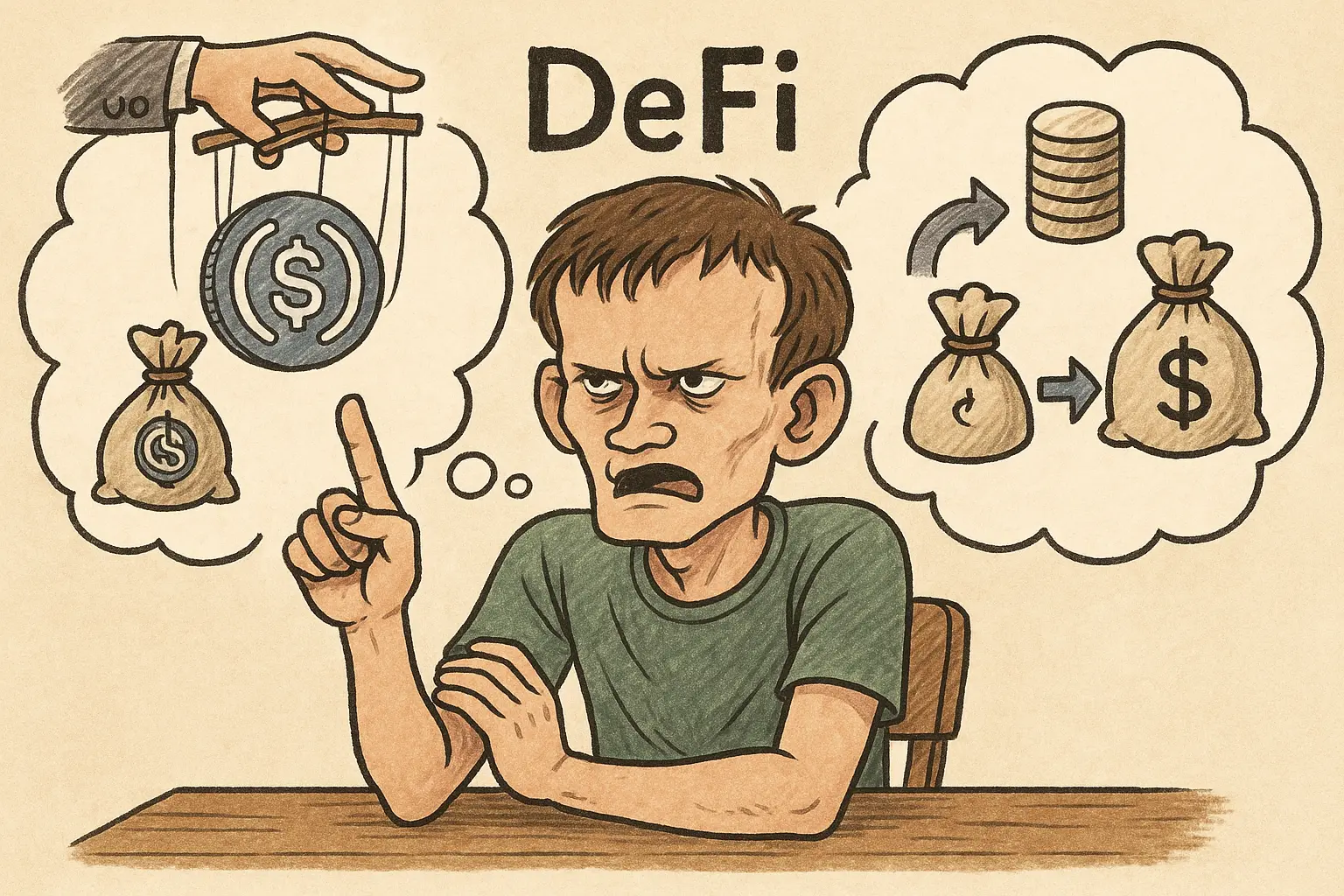
Vitalik and c-node discuss the essence of DeFi, with c-node criticizing USDC lending as “cargo cult” superficiality. Vitalik believes that algorithmic stablecoins backed by over-collateralization are true DeFi, emphasizing the need to diversify counterparty risk. The USDC lending strategy is seen as merely transferring centralized token holdings into protocols, calling for a shift away from USD towards decentralized accounting.
Vitalik Criticizes Cargo Cult Fake DeFi
Ethereum co-founder Vitalik Buterin and crypto analyst c-node reignited the debate about the true purpose of decentralized finance (DeFi). Both industry experts are calling for a reassessment of priorities within this thriving sector. They argue that the core issue is that much of today’s DeFi hype is superficial, catering to speculative interests rather than genuinely advancing DeFi infrastructure.
c-node wrote: “Unless you hold long positions in cryptocurrencies and want to access financial services while maintaining self-custody of your funds, there’s no reason to use DeFi.” They dismiss common yield-generating strategies (such as depositing USDC into lending protocols) as “cargo cult,” criticizing these approaches for mimicking DeFi’s success without embodying its original spirit.
“Cargo cult” is an anthropological term describing behaviors where primitive tribes imitate the outward forms of modern civilization without understanding the underlying logic. c-node uses this term to critique current DeFi projects, which employ smart contracts, liquidity pools, governance tokens, and other outward forms of DeFi, yet rely on centralized stablecoins and custodial mechanisms—fundamentally contradicting the decentralized ethos.
The analyst further emphasizes that non-Ethereum chains may struggle to replicate Ethereum’s DeFi boom, noting that early Ethereum participants prioritized self-custody and autonomy. Meanwhile, emerging ecosystems are mainly driven by venture capital funds that rely on institutional custody. This contrast reveals divergent development paths: Ethereum maintains its decentralization purity, while other chains compromise on decentralization to attract institutional capital.
Vitalik’s Three Major Criticisms of Current DeFi
USDC Lending as Fake DeFi: Centralized stablecoins deposited into protocols are just yield optimization, not risk diversification
Cargo Cult Phenomenon: Imitating DeFi forms but losing self-custody and decentralization essence
Chain Compromises: Non-Ethereum chains dominated by VC and institutional custody, with impure ideals
This discussion highlights deeper ideological divides in the crypto space. On one side, DeFi is seen as a tool to improve capital efficiency for speculation, leveraging leverage and earning yields without sacrificing custody. On the other, it’s viewed as a foundational financial system capable of reshaping the global monetary sector through decentralization and risk spreading.
Vitalik: Algorithmic Stablecoins Are True DeFi
Buterin’s response offers a different perspective and a broader framework for what constitutes “real” DeFi. The Russian-Canadian innovator argues that algorithmic stablecoins—especially those that are over-collateralized or designed to diversify counterparty risk—are genuinely decentralized. He wrote: “Even if 99% of liquidity is supported by holders of negative algorithmic dollars and positive dollars elsewhere, the ability to transfer counterparty risk to market makers remains a significant feature.”
Vitalik states that true DeFi must diversify counterparty risk, not just optimize yields. Relying on USDC-based lending strategies violates core DeFi principles of self-custody and decentralization. The Ethereum co-founder also criticizes popular USDC-based approaches, noting that simply depositing centralized stablecoins into lending protocols does not meet DeFi standards.
The logic behind this critique is that USDC, issued by Circle, depends on USD reserves held by Circle and the stability of the US financial system. When you deposit USDC into protocols like Aave or Compound, you are using smart contracts, but still exposed to Circle’s counterparty risk (bankruptcy or regulatory freeze) and systemic risks of the dollar economy (collapse of USD). This structure does not truly decentralize; it merely moves centralized assets within decentralized protocols.
Over-collateralized algorithmic stablecoins define the future of genuine decentralized finance. Beyond technical definitions, Vitalik envisions a long-term shift away from USD-pegged systems toward diversified accounting units supported by decentralized collateral structures. This vision aligns with his earlier proposals on the “three challenges of decentralized stablecoins”: reducing USD dependence, ensuring oracle security, and resolving staking yield conflicts.
Ideological Divides and Future Directions in DeFi
Follow-up responses in the discussion further intensify these tensions. Some believe that combining DeFi with centralized assets can still reduce intermediaries and systemic risks. Others support c-node’s purist stance, predicting that market forces will favor self-custody driven protocols over hybrid or fiat-backed systems.
This debate may shape the next phase of crypto innovation. Ethereum’s dominance in DeFi owes much to early adopters committed to decentralization, contrasting sharply with other blockchains where VC-backed investors prioritize convenience over decentralization. Meanwhile, Vitalik’s push for over-collateralized algorithmic stablecoins and diversified indices suggests a future beyond current USD-pegged models.
As DeFi approaches its second decade, these discussions indicate that the industry is shifting focus from mere yields and liquidity to principles: custody, decentralization, and risk diversification. This raises questions: Can DeFi truly replace traditional finance, or is it still just a complex tool for crypto speculators?
Market realities show that USDC-based protocols dominate market share and trading volume. Leading protocols like Aave, Compound, and Curve have TVLs heavily weighted toward centralized stablecoins like USDC and USDT, far surpassing algorithmic stablecoins. This market vote indicates users prioritize convenience and yields over pure decentralization. While Vitalik’s criticisms are theoretically sound, reversing market trends requires offering truly competitive decentralized alternatives.
The collapse of Terra/UST remains the biggest shadow over algorithmic stablecoins. Although Vitalik emphasizes “over-collateralized” algorithmic stablecoins (like DAI) versus Terra’s under-collateralized model, the term “algorithmic stablecoin” has already become traumatized in the market. Restoring trust in this direction may take years and multiple successful case studies.
For DeFi practitioners, Vitalik’s critique serves as a wake-up call. When founders begin questioning the current path, the industry must reflect seriously. Should it continue catering to market demand with USDC-based convenience, or return to its decentralized roots risking user loss? This choice will determine DeFi’s positioning in the next decade: as an efficiency tool for traditional finance or as a truly disruptive alternative financial system.
Disclaimer: The information on this page may come from third parties and does not represent the views or opinions of Gate. The content displayed on this page is for reference only and does not constitute any financial, investment, or legal advice. Gate does not guarantee the accuracy or completeness of the information and shall not be liable for any losses arising from the use of this information. Virtual asset investments carry high risks and are subject to significant price volatility. You may lose all of your invested principal. Please fully understand the relevant risks and make prudent decisions based on your own financial situation and risk tolerance. For details, please refer to
Disclaimer.


