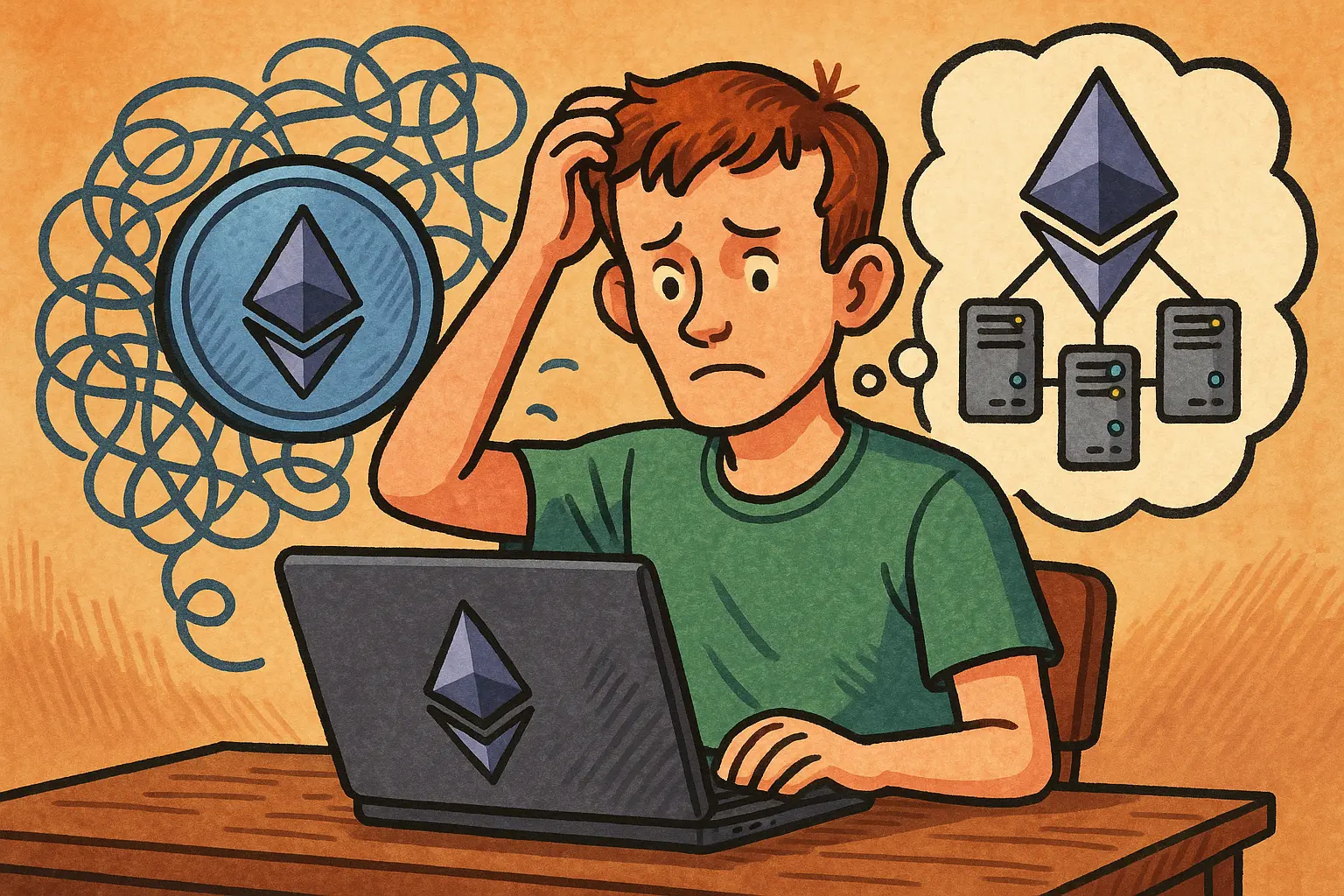
Vitalik Buterin proposes incorporating Distributed Validator Technology (DVT) into Ethereum staking to address the single-node slashing risk. DVT allows multiple nodes to use the same key, with two honest nodes out of three being sufficient for operation. The “Native DVT” solution supports up to 16 virtual identities, simplifying setup and enhancing decentralization.
Current Pain Points in Ethereum Staking: Single Point of Failure and Slashing Risks
Currently, Ethereum validators operate only one node to maintain blockchain security. If that node goes offline, it may be penalized. This single point of failure is one of the biggest pain points in Ethereum staking. Causes of node downtime include hardware failures, network interruptions, software bugs, or human errors. If a node is offline for too long, the validator faces slashing, losing part of its staked ETH.
While this penalty mechanism is designed to ensure network security and activity, it creates significant pressure for stakers. Professional staking entities can invest heavily in redundancy, 24/7 monitoring, and emergency response systems. However, individual stakers often find these costs prohibitive. As a result, many ETH holders delegate their tokens to staking providers like Lido, Coinbase, sacrificing decentralization for convenience and security.
This centralization trend runs counter to Ethereum’s decentralization ideals. If most ETH is staked with a few providers, they gain excessive control over the network, potentially threatening censorship resistance and security. Buterin’s DVT proposal aims to solve this structural issue: enabling individual stakers to enjoy fault tolerance similar to institutional setups, encouraging more people to stake independently rather than delegate.
Economically, staking service providers typically charge management fees of 5% to 10%. For stakers, this is a significant cost. If DVT can greatly reduce the technical barriers and risks of solo staking, stakers can save on these fees, increasing their net returns. This economic incentive, aligned with decentralization principles, could drive a major shift in Ethereum’s staking structure.
DVT Technical Principles: Key Sharing and Threshold Signatures
Using DVT means validators can help secure the network by operating across multiple nodes with their keys, reducing the risk of slashing. Buterin explains: “Keys are secretly shared among several nodes, and all signatures are threshold signatures.” He adds that as long as more than two of three nodes are honest, “the node can guarantee proper operation.”
This mechanism draws from cryptographic threshold signature schemes. Simply put, a validator’s private key is split into multiple fragments stored on different nodes. When signing transactions or validating blocks, only the required threshold number of nodes need to participate, without all nodes being online.
For example, in a 2-of-3 setup, the validator’s private key is split into three parts, each deployed on a different node. As long as any two nodes are online and functioning correctly, validation can proceed. Even if one node crashes, is attacked, or malfunctions, the remaining two can ensure the validator is not penalized for being offline. This fault tolerance significantly reduces operational risks in Ethereum staking.
Buterin states that some protocols use DVT, noting that “DVT does not achieve full consensus within each validator, so its guarantees are slightly weaker, but it is much simpler.” This trade-off is acceptable in practical applications. Although DVT’s security guarantees are theoretically slightly lower than full consensus mechanisms, its fault tolerance is sufficient for most staking scenarios, and implementation complexity is greatly reduced.
Core Advantages of DVT Technology
Fault Tolerance: Multi-node setups allow some nodes to fail without affecting overall operation
Reduced Slashing Risk: Single node downtime no longer results in ETH penalties
Threshold Signatures: Keys are distributed, and signatures can be completed once the threshold is reached
Flexible Configurations: Supports different fault tolerance levels like 2-of-3, 3-of-5, etc.
Buterin Proposes Native DVT: Up to 16 Virtual Identities
Buterin states that although DVT solutions require complex setups, he offers an “unexpectedly simple alternative: we incorporate DVT into the core protocol.” His design allows validators to create up to 16 keys, or “virtual identities,” which operate independently but are treated as a single entity on the blockchain.
This so-called “group identity” is only considered active after a majority of the virtual identities agree, for actions like initiating a slash or block proposal, with rewards or penalties based on the majority’s actions. “From a user perspective, this design is very simple,” he says, because DVT staking becomes akin to running multiple client nodes.
The “native” aspect means this functionality will be built into the Ethereum protocol layer, not relying on third-party solutions. Currently, projects like SSV Network and Obol Network offer DVT services as overlays on the protocol, but Buterin suggests integrating DVT directly into Ethereum’s core protocol to make it a standard feature rather than an optional plugin.
The design of 16 virtual identities balances flexibility and complexity. In theory, more identities mean higher fault tolerance, but also increase coordination overhead and network load. Sixteen identities are sufficient to support highly decentralized configurations (e.g., 9-of-16 or 11-of-16) while remaining within Ethereum’s efficient processing range.
Buterin adds that this also helps large ETH holders who prioritize security to stake in a safer environment, without relying on a single node. Stakers can more easily stake their tokens independently, increasing Ethereum’s overall decentralization. This is especially important for whales holding thousands or tens of thousands of ETH, who face higher single point of failure risks and potential losses.
The Profound Impact of Native DVT on Ethereum Staking Ecosystem
Buterin’s proposal follows other ideas aimed at making Ethereum more user-friendly, but it still requires further community discussion before integration. From proposal to deployment, it may undergo multiple rounds of community debate, technical standardization, testnet validation, and mainnet upgrades. Major protocol upgrades on Ethereum typically take 1 to 2 years.
If native DVT is ultimately adopted, it will have a profound impact on the Ethereum staking ecosystem. First, the business models of staking providers may be affected. As individual stakers gain easy fault tolerance, the appeal of delegating to service providers diminishes. Providers will need to offer more value-added services (e.g., MEV optimization, tax reporting, insurance) to stay competitive.
Second, the decentralization of Ethereum staking will significantly improve. Currently, liquid staking protocols like Lido control over 30% of staked ETH, a concentration that has raised community concerns. Native DVT reduces the barrier to solo staking, potentially encouraging some funds to shift from providers back to individual stakers.
Third, network security could be enhanced. More dispersed individual stakers make coordinated large-scale attacks or censorship of specific transactions more difficult. This decentralization is not only an ideological goal but also a practical security enhancement.


