Amid a widespread liquidity crisis and shrinking trading volumes in the Solana ecosystem, the Memecoin project PIPPIN has staged a stunning rally, surging 556% over the past 30 days. However, this is not the result of retail frenzy—data shows it is driven by a precise manipulation involving massive derivatives trading and highly organized on-chain token accumulation. Over $3 billion in derivatives trading volume and coordinated acquisition of $19 million worth of tokens by 50 related wallets reveal how, in today’s crypto market, low-float assets can be easily swayed by sophisticated players leveraging derivatives and supply chain control. This fundamentals-defying surge serves as a vivid risk lesson for market participants.
How Did PIPPIN Stand Out Amid the Solana Memecoin Winter?
Currently, the speculative memecoin market on the entire Solana network is undergoing a brutal contraction, a sharp contrast to the “frenzy wave” at the beginning of the year. According to Blockworks Research, memecoins now account for less than 10% of daily trading volume on Solana’s decentralized exchanges, a cliff-like drop from over 70% dominance a year ago. The catalyst for this capital exodus has been the collapse of trust, following a string of high-profile “rug pull” scams such as the LIBRA and TRUMP token crashes, which have completely destroyed appetite for new project launches.
In this environment, liquidity has become fragmented, the number of active traders has sharply declined, and spot market depth has become thin, leaving the remaining participants highly cautious and reluctant to establish new positions. Yet PIPPIN has acted as a magnet, attracting this residual speculative liquidity. It has managed to break free from the sector-wide downturn and formed its own independent price action. This stark contrast is worth examining—it suggests that the forces driving PIPPIN’s price are not from broad community consensus or ecosystem development, but something else entirely.
A closer look reveals that this rally occurred as the overall market was gripped by “capitulation-style selling.” When most capital chooses to sit on the sidelines, the limited active capital left is more easily concentrated on the few assets still showing price momentum, creating a “siphon effect.” PIPPIN became that outlet, but its rally is fundamentally different from past memecoin bull runs driven by grassroots adoption and community virality—it is narrow and fragile.
The Leverage Game Behind $3 Billion in Derivatives Volume
To understand the anomaly behind PIPPIN’s rise, one must examine the makeup of its trading activity. Data shows that the main force behind the price surge is not simple spot market buying, but a massive expansion of leverage in the derivatives market. According to CoinGlass, on December 1 alone, PIPPIN-related derivatives trading volume exceeded $3.19 billion—a figure that dwarfs even many mid-cap utility tokens like HYPE and SUI.
Meanwhile, the token’s open interest doubled to $160 million, indicating traders are aggressively building exposure to this asset. High trading volumes combined with rapidly growing open interest create a self-reinforcing cycle: price increases attract more leveraged capital, which in turn pushes prices higher—all in an environment where spot liquidity is already scarce. This amplifies price sensitivity to flows in the derivatives market, drastically increasing volatility.
However, a rally supported solely by futures market mechanics is like building a castle on sand. It lacks the foundation of real, widespread user adoption. If market sentiment in the derivatives market flips, or leading capital chooses to take profits, prices can quickly experience a sharp reversal. This is fundamentally different from past memecoin rallies driven by community culture, network effects, or real use cases—here it’s pure financial engineering and momentum trading, whose sustainability is highly questionable.
Key On-Chain Data for PIPPIN
Surge Magnitude: Up 556% over the past 30 days
Key Derivatives Data: Single-day derivatives trading volume over $3.19 billion; open interest at $160 million
Organized Acquisition: 50 related wallets purchased $19 million worth of PIPPIN
Supply Chain Control: 26 addresses withdrew 44% of total supply (worth about $96 million) from Gate.io
Early Whale Profits: One address liquidated 24.8 million PIPPIN, realizing a 4,066% gain for about $3.74 million
50 Related Wallets and Nearly $100 Million in Token Accumulation
The most crucial piece of this rally comes from on-chain activity. PIPPIN is undergoing a “guard rotation” of ownership, with tokens shifting from early organic holders to what appears to be a syndicate-style cluster of wallets. The hallmark event was the exit of an early “whale.” Blockchain analytics platform Lookonchain reported that a wallet labeled 2Gc2Xg, which held tokens for over a year, recently liquidated its entire 24.8 million PIPPIN position. The trader originally spent just 450 SOL (about $90,000 at the time) and exited with $3.74 million, locking in a staggering 4,066% return.
(Source: BubbleMaps)
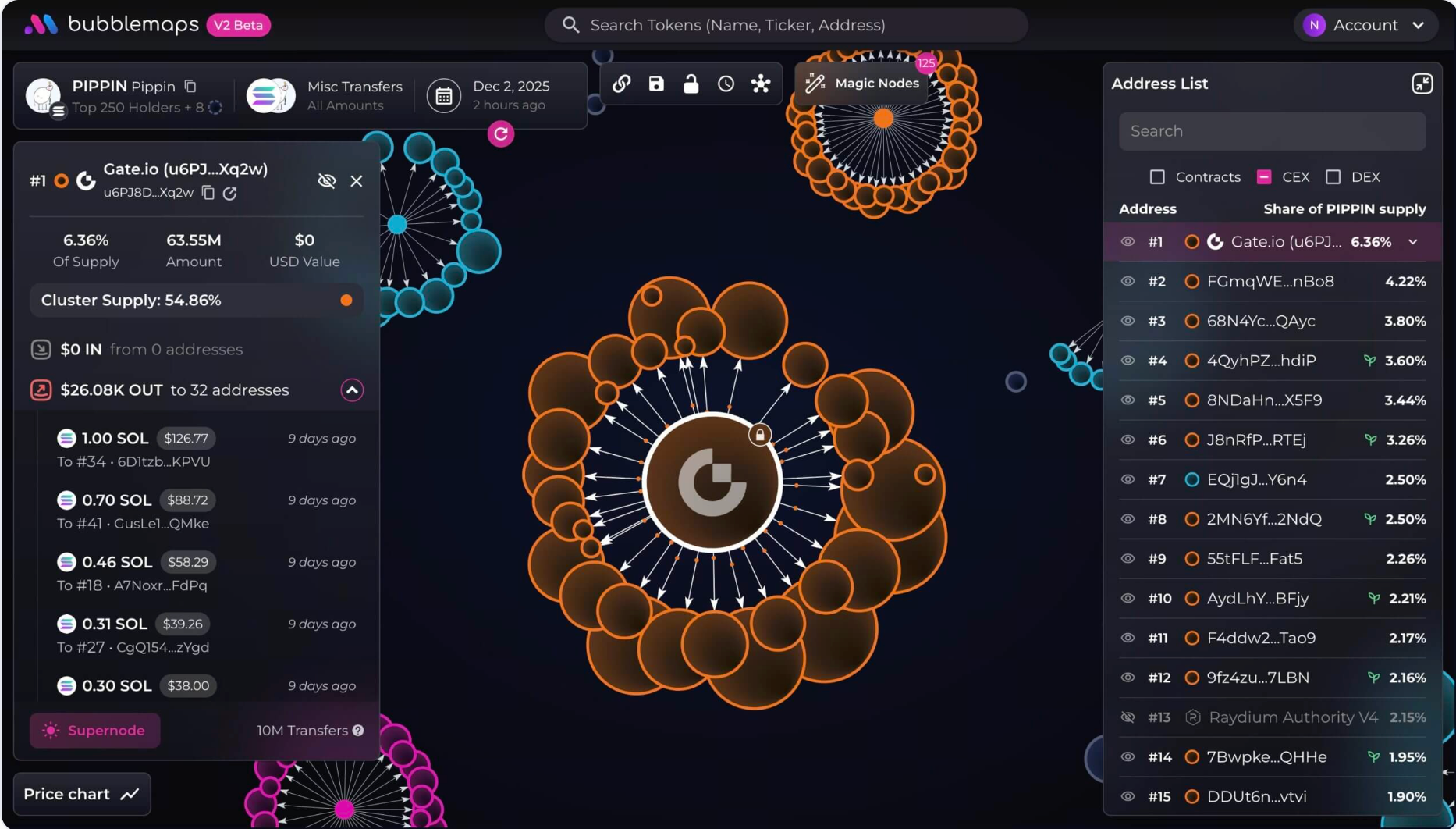
But the key question follows: who absorbed this massive sell-off? Analysis from on-chain analytics firm Bubblemaps provides the answer: the buyers were not dispersed retail investors, but a highly organized entity. The firm identified a cluster of 50 interrelated wallets that purchased $19 million worth of PIPPIN. These wallets exhibited clear non-organic behavior: they received funds from HTX within tightly synchronized time windows, received similar amounts of SOL for gas fees, and had no prior on-chain activity.
Additionally, Bubblemaps flagged another 26 addresses that, over two months, withdrew 44% of PIPPIN’s total supply from Gate.io. These withdrawals, worth about $96 million, were concentrated on certain dates (mainly between October 24 and November 23), clearly part of a deliberate strategy to remove liquidity from centralized exchanges, reduce circulating supply, and set the stage for subsequent price manipulation. When these actions are combined with the influx of aggressive new speculators, the picture becomes clear: PIPPIN’s floating supply is being rapidly concentrated and locked up.
Lessons from the PIPPIN Surge: Liquidity, Manipulation, and Risk
This rally, driven by supply chain concentration and derivatives leverage, exposes a fragile valuation paradox. On the surface, PIPPIN’s market cap briefly returned to the peak seen when founder Yohei Nakajima first endorsed its AI-generated concept—seemingly a unicorn. However, the token’s fundamentals remain barren. The project founder has issued no new updates, there’s no updated roadmap, and no technical progress to support the multi-million-dollar market cap recovery. Thus, the rally is essentially a “ghost ship” momentum play driven by market structure, not project substance.
For the new whales and collaborative wallet clusters entering the market, the real danger lies in how to exit. While some related accounts show millions in paper profits, realizing those gains in a market with thin spot depth is another challenge. More importantly, if this coordinated whale group tries to offload their $96 million position, the severe liquidity mismatch could trigger a rapid price reversal. This “easy in, hard out” dilemma is the ultimate problem for anyone trying to manipulate low-float assets.
Ultimately, PIPPIN serves as a mirror reflecting the current state of the crypto economy: a market distorted by leverage and dominated by savvy, institution-level players who can manipulate low-float assets. Its price action also demonstrates that extreme, isolated rallies can still occur, but they are increasingly the domain of whales and syndicates—not ordinary traders. For the broader investor community, the core takeaway is that when participating in assets lacking strong fundamentals and with highly concentrated liquidity, one must remain acutely aware that prices can be entirely controlled by a handful of players, and that dramatic surges may be hiding even greater crash risks.
Quick Look at PIPPIN’s Background and Market Risk Advisory
PIPPIN Project Background Overview
PIPPIN is not a typical community memecoin, but rather has an experimental origin. It was born in early 2024 from an AI experiment initiated by developer Yohei Nakajima. Initially, its appeal lay in the “AI-generated” narrative, attracting early attention amidst the hype around AI and blockchain integration. However, unlike many actively maintained projects, PIPPIN has seen little official update, no clear development roadmap, or substantial ecosystem building since the founder’s initial publicity wave, making its fundamental support extremely weak and leaving it more as a concept-stage asset.
Risk Advisory for Ordinary Investors
- Spot Manipulation Indicators: If a low-cap asset surges against the market while trading volume in derivatives soars and on-chain token holdings become rapidly concentrated, be highly alert to possible manipulation. Ordinary investors chasing the rally are likely to become “exit liquidity.”
- Pay Attention to Liquidity Depth: Always examine the spot liquidity depth before trading. For assets like PIPPIN, where liquidity has been deliberately withdrawn from exchanges, large trades face extreme slippage, prices can be drastically affected by small orders, and exit costs are huge.
- Return to Fundamentals: Especially in a bear market, assets lacking use cases, team, or ongoing community development are more likely to see price rallies driven by short-term financial engineering rather than value discovery. Participation in such trades should be regarded as high-risk speculation with strict position control.
PIPPIN’s case is by no means unique—it accurately portrays typical features of a particular phase in the crypto market cycle: when innovation narratives stall and new capital dries up, stockholder games breed ever more extreme capital plays. When “builders” temporarily exit the stage, “traders” and “manipulators” become the main actors. This reminds us that, when marveling at an asset’s miraculous surge, it’s even more important to look beyond the price chart to examine on-chain capital flows, token distribution, and liquidity structure—skills more vital for survival than chasing the latest trend. Every lesson the market teaches comes with a price tag, and this time, the tuition is again written in the risks of illiquidity and high concentration of control.


