
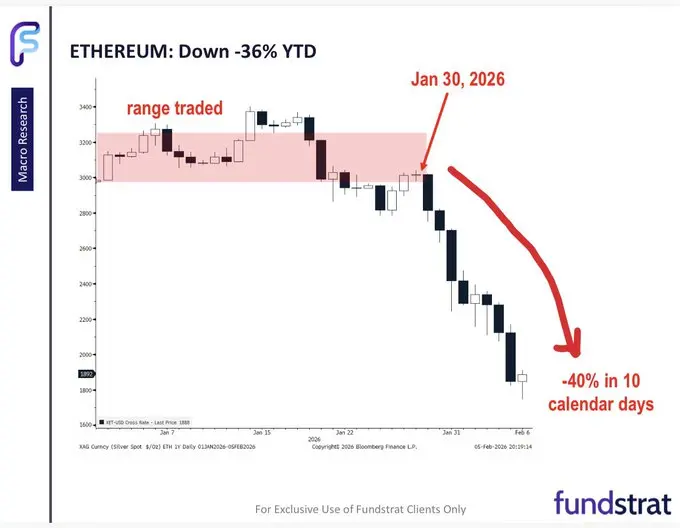
BitMine on February 7th aggressively purchased 20,000 ETH for $41.98 million, bringing the company’s Ethereum holdings to 42,900 ETH, achieving 70% of its market share target of 5%. ETH fell 31% in February to a low of $1,824. BitMine Chairman Tom Lee said volatility is a feature, staking 3 million ETH for returns, and investing in Mr Beast for diversification.
Extreme Strategy of Contrarian Buy with $42 Million
(Source: Fundstrat)
BitMine is the largest corporate holder of Ethereum, leveraging recent price fluctuations to expand its treasury holdings. On February 7th, blockchain analytics platform Lookonchain cited data from Arkham Intelligence to report this transaction. The company spent about $41.98 million to acquire approximately 20,000 ETH. Notably, this latest round of accumulation brings the company closer to its long-term goal of controlling 5% of Ethereum’s circulating supply.
Data from Strategic ETH Reserve shows the company holds 42,900 ETH, over 70% of that target. The 5% goal implies holding about 60,000 ETH (total supply around 120 million), meaning BitMine still needs to buy about 17,100 ETH to reach this ambitious goal. At the current price of $2,117, this would require an investment of roughly $360 million.
Meanwhile, BitMine’s latest ETH purchase coincides with extreme market fragility. Over the past 30 days, ETH price plunged about 31%, with the trading price at press time around $2,117. In the past week, the asset traded as low as $1,824, the lowest since May 2025. This contrarian accumulation during a price crash suggests either extreme confidence or high risk.
BitMine Holdings and Goals
Current Holdings: 42,900 ETH, worth about $91 million (at $2,117 per ETH)
Target Holdings: 60,000 ETH (5% of Ethereum supply)
Progress: Over 70%
Remaining to Purchase: About 17,100 ETH, requiring roughly $360 million
This large-scale accumulation occurs amid highly pessimistic market sentiment. The crypto Fear & Greed Index dropped to 12, indicating extreme fear. Most investors are on the sidelines or reducing positions, while BitMine is taking the opposite approach by buying heavily. If successful, this contrarian strategy could yield outsized gains when the market recovers. But if Ethereum continues to decline, BitMine’s unrealized losses will grow further.
Tom Lee’s Belief: Volatility Is a Feature, Not a Flaw
Despite this, BitMine remains committed to developing its crypto tokens. Chairman Tom Lee believes “Ethereum is the future of finance.” He dismisses concerns over increasing unrealized losses. Lee recently stated that current volatility is “a feature, not a flaw.” He notes that since 2018, Ethereum has experienced seven drops of 60% or more.
Tom Lee is a well-known bullish analyst on Wall Street, renowned for accurate stock market predictions. In 2020, he founded BitMine and began aggressively buying ETH, becoming a leading Ethereum maximalist. Similar to MicroStrategy’s bet on Bitcoin, Lee has placed his wager on Ethereum.
The argument that “volatility is a feature, not a flaw” has sparked debate in crypto circles. Supporters see it as a sign of strong conviction in long-term value, critics argue it’s a defense for massive unrealized losses. Since 2018, Ethereum has indeed experienced multiple 60%+ corrections, each rebounding to new highs. If history repeats, BitMine’s strategy could prove correct. But if this time is different, BitMine may face a similar predicament as MicroStrategy.
Therefore, despite Kevin Woor’s nomination as Federal Reserve Board member and geopolitical tensions after the Greenland incident fueling the “crypto winter” illusion, Ethereum’s on-chain fundamentals remain strong. Tom Lee’s logic is: short-term price swings do not alter Ethereum’s long-term value as a smart contract platform and DeFi infrastructure. As long as network activity, TVL, and developer engagement stay steady, prices will eventually reflect fundamentals.
Hedging High-Risk ETH Staking and Capital Deployment
Furthermore, BitMine has moved beyond a simple “buy and hold” bond strategy. To outperform cycles and mitigate the drag of spot price declines, the company is shifting toward so-called “value-added acquisitions” and high-risk capital deployment. Additionally, BitMine continues to leverage its large token reserves to generate yield, staking nearly 3 million ETH. These measures aim to offset the massive pressure from macro shifts toward risk aversion.
Staking 3 million ETH is an enormous scale. With current ETH staking yields around 3-4% annually, staking 3 million ETH yields 90,000 to 120,000 ETH per year, worth roughly $190 million to $254 million at current prices. This steady cash flow provides a buffer, allowing BitMine to sustain operations even if ETH prices remain stagnant.
This includes publicly disclosed “Moonshot” fund allocations, investing in smaller-cap tokens like Orbs, and media investments such as Mr Beast. This diversification shows BitMine is not content with merely holding ETH but seeks high-yield opportunities across the crypto ecosystem. Orbs is an infrastructure project within the Ethereum ecosystem; Mr Beast is the world’s largest YouTube creator. These investments span tech and media sectors.
However, this high-risk investment approach also raises questions. Small-cap tokens are far more volatile than ETH, with potentially sharper declines in bear markets. Media investments can boost brand exposure but are less directly related to core ETH holdings. Critics argue BitMine is “hedging for the sake of hedging,” and that diversification may weaken rather than strengthen risk resilience.
From a financial structure perspective, BitMine’s model is similar to MicroStrategy’s but more aggressive. MicroStrategy still has its software business providing cash flow, while BitMine relies almost entirely on ETH holdings and staking yields. If ETH prices stay low, BitMine could face financing difficulties, as no investors would want to fund a loss-making company in a bear market.
For the crypto market, BitMine’s contrarian accumulation offers an interesting case. When retail investors panic and sell, institutional whales are buying. This “smart money” flow often signals market bottoms. But it could also be “buying the dip halfway up the mountain,” and only time will tell whether Tom Lee’s conviction is foresight or stubbornness.
Disclaimer: The information on this page may come from third parties and does not represent the views or opinions of Gate. The content displayed on this page is for reference only and does not constitute any financial, investment, or legal advice. Gate does not guarantee the accuracy or completeness of the information and shall not be liable for any losses arising from the use of this information. Virtual asset investments carry high risks and are subject to significant price volatility. You may lose all of your invested principal. Please fully understand the relevant risks and make prudent decisions based on your own financial situation and risk tolerance. For details, please refer to
Disclaimer.
Related Articles
ETH Price Hits Critical Support Zone While Technical Indicators Signal a Major Trend Reversal
The crypto market of early 2026 is experiencing an unusual contrast between exhausted short-term price momentum and longer-term strength. While many retail traders have been shaken out by sideways price action, “smart money” on-chain metrics are beginning to flash an unusual signal. According to cry
BlockChainReporter3m ago
V God rare self-criticism: Ethereum should not attempt to dominate the world; its true mission is to create a "digital sanctuary"
Ethereum co-founder Vitalik Buterin reflects on the role of blockchain on the X platform, advocating that Ethereum should become a "sanctuary technology" to help people resist surveillance and technological degradation, and focusing on building a decentralized shared digital space. He calls on the community to identify users who truly need sanctuary technology and to dedicate efforts to addressing deeper social challenges, rather than pursuing the status of tech giants.
動區BlockTempo16m ago
Maji deposited 100,000 USDC into HyperLiquid to increase the ETH long position, currently with a floating profit of over $200,000.
Foresight News reports that, according to Onchain Lens monitoring, Magji deposited 100,000 USDC into HyperLiquid to increase its ETH long position (25x leverage), currently with an unrealized profit of over $200,000.
GateNews20m ago
ETH drops below 2100 USDT
Gate News bot message, Gate market display, ETH drops below 2100 USDT, current price 2098.23 USDT.
CryptoRadar23m ago
Data: Today, the US Bitcoin ETF saw a net inflow of 5,187 BTC, and the Ethereum ETF experienced a net inflow of 43,282 ETH.
ChainCatcher reports that, according to Lookonchain monitoring, today 10 Bitcoin ETFs had a net inflow of 5,187 BTC (worth $375.08 million), 9 Ethereum ETFs had a net inflow of 43,282 ETH (worth $91.76 million), and SOL ETFs had a net inflow of 205,711 SOL (worth $18.72 million).
GateNews44m ago
Citibank promotes "Bitcoin Banking": Striving to launch "Institutional-Grade Custody" and "Cross-Asset Collateral" services this year
Citigroup is pushing for the banking of Bitcoin, planning to deeply integrate it into the traditional financial system, with institutional-grade crypto custody services expected to launch in 2026. By simplifying Bitcoin transaction processes and reducing operational friction, Citigroup aims to attract more institutions to adopt digital assets further. Additionally, the bank is exploring the applications of stablecoins and blockchain deposit tokens, hoping to provide traditional financial institutions with more convenient ways to utilize capital.
区块客1h ago


