Today, the Polkadot (DOT) price recorded an impressive increase of about 12% in just one day, surprising many traders. The main driver comes from the major upgrade on Kusama – a network closely linked to Polkadot. This event has contributed to improving short-term sentiment across the entire Polkadot ecosystem.
However, overall, the long-term trend remains unclear. DOT has still decreased approximately 53.5% over the past three months. A strong rally cannot erase the prolonged downtrend that preceded it.
Investors are now asking a big question: Is this the start of a new trend, or just a technical rebound in a weak market?
Kusama Upgrade Brings New Momentum to Polkadot Market Sentiment
The price increase of DOT is driven by Kusama – Polkadot’s testnet, where improvements are tested before official implementation. This week, Kusama deployed a notable upgrade, reducing block processing time to under 2 seconds and enhancing smart contract support. Transactions are faster, and expanded development tools attract more community interest.
Although this upgrade occurred on Kusama, not directly on Polkadot, the two networks are closely connected. Therefore, improvements on Kusama often influence market sentiment and DOT’s price.
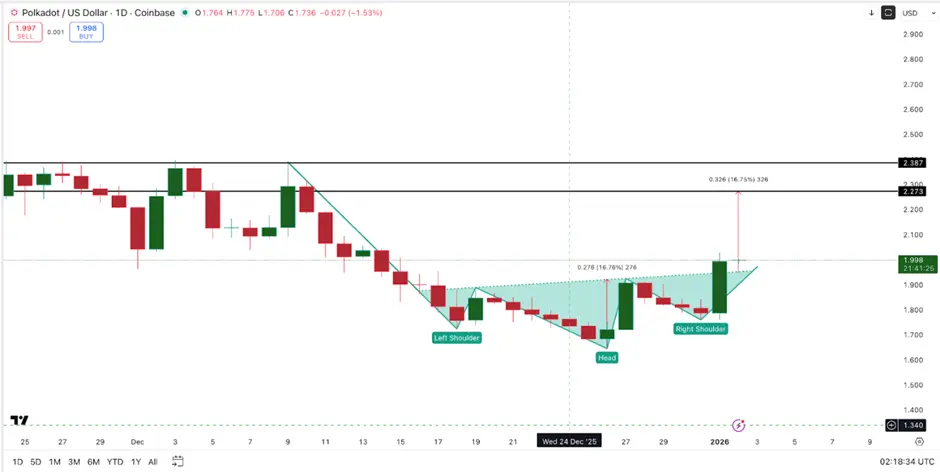 Polkadot DOT Price Surge | Source: TradingView Positive reactions from the cryptocurrency market to technical changes are common. An upgrade can create a “story” in the short term, attracting speculative capital and causing significant price volatility.
However, for a sustainable upward trend, real capital flow and demand must align. This remains a weak point in this rally.
DOT Chart Signals Breakout, but Buying Pressure Is Not Yet Strong Enough
From a technical analysis perspective, DOT recently broke the inverse head and shoulders pattern – often appearing at bottoms and signaling a potential trend reversal. If the rally continues, DOT could target the $2.27 level, representing an additional potential increase of about 13% from current levels. This is why DOT is back in the spotlight for many investors.
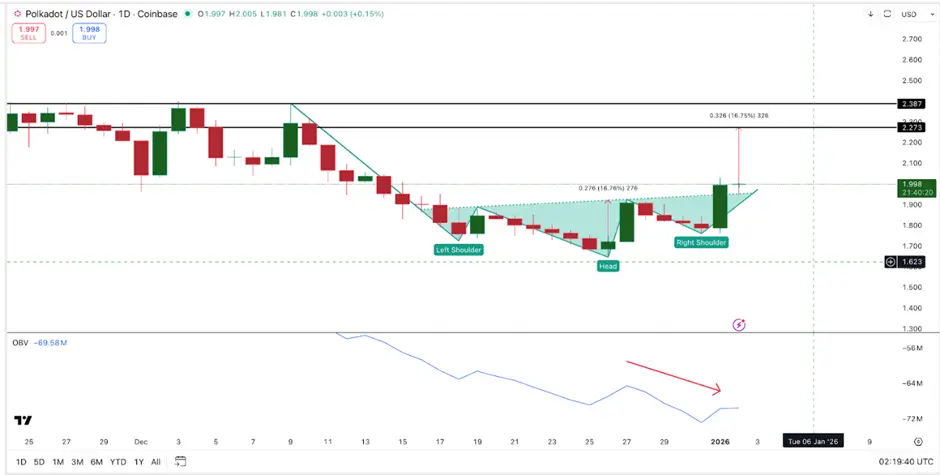 DOT Volume | Source: TradingView However, price patterns need to be confirmed by actual buying strength. The On-balance Volume (OBV) indicator – which tracks whether buyers or sellers control the trend – is still trending downward, indicating that trading volume has not fully aligned with the price. This often reflects uncertain market sentiment.
Similarly, the Chaikin Money Flow (CMF) indicator – measuring money flow into/out of the asset – remains below zero, suggesting large investors have not yet fully entered the market.
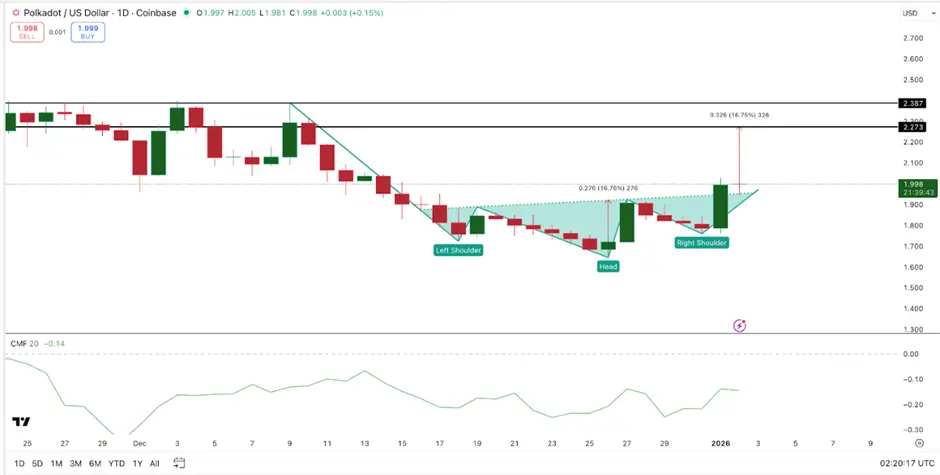 DOT CMF Indicator | Source: TradingView The DOT balance on exchanges has not changed significantly, reflecting that the recent price increase is mainly driven by short-term sentiment rather than strong capital inflows.
In summary, although technical charts show positive signals, the fundamental factors related to capital flow have not yet fully supported a sustained rally.
Important Price Levels of DOT to Watch
In the context of mixed indicators, identifying key price zones becomes more important than peripheral information.
If DOT stays above $2.02, the bullish outlook remains. This is a short-term support zone, maintaining the breakout structure.
Conversely, if DOT drops below $1.76, the technical pattern will weaken, buying pressure may retreat, and market confidence could decline rapidly.
If DOT breaks below $1.64, the recovery is likely to end, and the price could revert to a prolonged downtrend.
Currently, DOT’s movement remains uncertain. The Kusama upgrade provides upward momentum, and technical charts create trading opportunities, but what’s missing is confirmation from trading volume and capital flow. Without improvements in these factors, DOT’s rally may be only temporary.
Disclaimer: The information on this page may come from third parties and does not represent the views or opinions of Gate. The content displayed on this page is for reference only and does not constitute any financial, investment, or legal advice. Gate does not guarantee the accuracy or completeness of the information and shall not be liable for any losses arising from the use of this information. Virtual asset investments carry high risks and are subject to significant price volatility. You may lose all of your invested principal. Please fully understand the relevant risks and make prudent decisions based on your own financial situation and risk tolerance. For details, please refer to
Disclaimer.
Related Articles
Michael Saylor “Laser Eyes” post surpasses 1 million views, billionaires follow up by buying crypto
MicroStrategy Executive Chairman Saylor has restarted the laser eyes symbol, expressing his bullish conviction in Bitcoin, and contrasting it with the current market’s fear sentiment. MicroStrategy holds 761,068 Bitcoins and plans to increase that to 1,000,000 by 2026. Real estate billionaire Grant Cardone has also announced additional Bitcoin purchases, strengthening market confidence and signaling a long-term hold.
MarketWhisper38m ago
Hyperliquid whale puts on a short position in Bitcoin worth 53 million, the market is wary of downside risk
On the decentralized sustainable derivatives exchange Hyperliquid, a whale trader opened a leveraged short Bitcoin position worth $53.0 million, with a liquidation price of $80,630. At the same time, the trader also holds short positions in silver and multiple altcoins, as well as a long position in Brent crude oil, reflecting its bearish outlook on the current market. Geopolitics, regulatory uncertainty, and the upcoming employment data make up the threefold pressure weighing on this week’s market.
MarketWhisper56m ago
BTC 15-minute surge 0.80%: spot incremental buy orders and changes in the order book structure drive a price breakout
From 2026-03-31 01:15 to 2026-03-31 01:30 (UTC), BTC showed a clear breakout move. The candlestick data indicates a return rate of +0.80%, with the price ranging between 67,241.1 and 67,884.3 USDT, and a recorded amplitude of 0.96%. During this period, trading activity in the market was active, risk appetite rebounded, and short-term bullish sentiment dominated, driving the price to break through local resistance.
The main driving forces behind this breakout were the synchronized rise in trading volume across the spot and derivatives (futures/perpetual) markets, along with a significant net inflow of funds into exchanges. The spot trading volume surged sharply compared with the average value of the previous hour.
GateNews1h ago
Bitcoin (BTC) Stuck in a ‘No Trade Zone:’ When Is the Next Big Move Coming?
The primary cryptocurrency has experienced significant volatility lately, mainly due to the geopolitical tension caused by the war in the Middle East.
One popular analyst described the current price area as a “no-trade zone,” arguing that a clear move in either direction will depend on how BTC
CryptoPotato1h ago
Why is Bitcoin up today? Trump pauses strikes on Iranian energy facilities, and the Fed signals support for risk markets
Bitcoin rebounded to above $67,000 on March 31, mainly driven by signals from U.S.-Iran diplomacy and the Federal Reserve’s decision to keep interest rates unchanged. Market sentiment temporarily improved, but Iran’s Ministry of Foreign Affairs said that the lack of direct negotiations could limit the rebound. The potential impact of the Strait of Hormuz toll bill on supply chains is pushing up oil prices and putting pressure on the market; it’s important to closely monitor future price movements.
MarketWhisper1h ago
Today’s Crypto Fear and Greed Index rose to 11, and the market is in a state of extreme fear
Gate News, March 31, according to Alternative.me data, today the crypto Fear and Greed Index rose to 11, putting the market in extreme fear. Yesterday, the index was 8, also in extreme fear.
GateNews2h ago


