Individuals transacting cryptocurrency on offshore platforms or independently must now report their movements when the amount of crypto transacted surpasses $5,000 per year. Users must now deliver sensitive data, including the purpose of each transaction, hashes, and destination addresses.
Paraguay Ramps Up Crypto Reporting Requirements For VASPs and Individuals
The government of Paraguay is ramping up the scrutiny of the cryptocurrency market.
The National Directorate of Tax Revenue (DNIT), Paraguay’s tax watchdog, has issued a resolution creating a new figure, a sworn cryptoassets statement, to obtain a more granular control and oversight of the crypto movements in the country.
Resolution No. 47 establishes that both operators of virtual asset service providers (VASPs) and individuals making crypto transactions with volumes going over $5,000 per year, even if transacting using offshore accounts or outside exchange platforms, must issue this detailed statement.
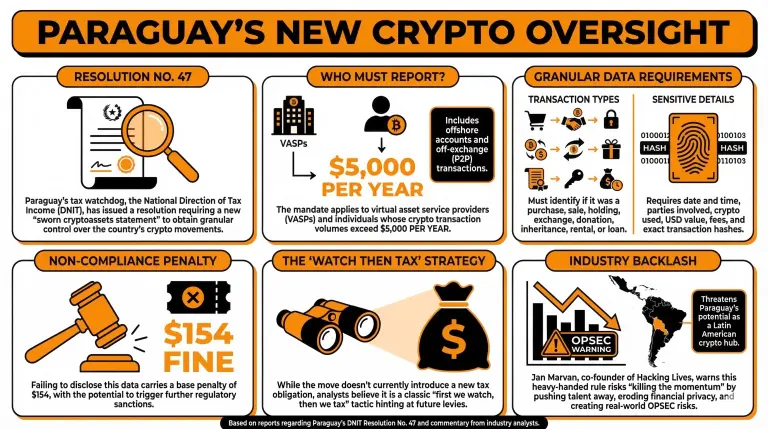
The document must identify, at the very minimum, the class of transaction completed -purchases and sales, holding or possession, exchanges between different crypto assets, donations, inheritances, temporary assignments, rentals, or loans, among others.
In the same way, for each transaction, the user must include sensitive data, such as date and time, the parties involved, the cryptocurrency used, the amount traded, the value transacted in U.S. dollars, fees, and transaction hashes.
The penalty for failing to disclose this data during the expected period is $154, and it could result in other penalties.
While this move doesn’t introduce a tax obligation, analysts believe this might be a classic “first we watch, then we tax” move, hinting at future moves to leverage this information via new levies.
Jan Marvan, co-founder of Hacking Lives, stressed that this was a troubling development for the nation’s crypto scene, as it could affect its possibilities of becoming a crypto hub in Latin America.
“This kind of heavy-handed rule risks killing that momentum. It will push talent away, slow down everyday adoption, erode financial privacy, and in the worst cases create real-world OPSEC risks for users,” he concluded.
FAQ
- What recent action has the government of Paraguay taken regarding cryptocurrencies?
Paraguay is increasing scrutiny of the crypto market by implementing a sworn cryptoassets statement for enhanced oversight of crypto transactions.
- What does Resolution No. 47 require from virtual asset service providers and individuals?
Operators and individuals engaging in crypto transactions over $5,000 per year must issue a detailed statement identifying transaction types and sensitive data.
- What details must be included in the sworn statement?
The statement must include transaction specifics such as date, time, parties involved, cryptocurrency used, and amount traded, along with the transaction hash.
- What implications does this resolution have for Paraguay’s crypto market?
Analysts warn that while it doesn’t introduce new taxes now, it may lead to future taxation, potentially hindering Paraguay’s growth as a crypto hub in Latin America.
Disclaimer: The information on this page may come from third parties and does not represent the views or opinions of Gate. The content displayed on this page is for reference only and does not constitute any financial, investment, or legal advice. Gate does not guarantee the accuracy or completeness of the information and shall not be liable for any losses arising from the use of this information. Virtual asset investments carry high risks and are subject to significant price volatility. You may lose all of your invested principal. Please fully understand the relevant risks and make prudent decisions based on your own financial situation and risk tolerance. For details, please refer to
Disclaimer.
Verwandte Artikel
Kanada will mit einem neuen Gesetz Krypto-Spenden für Wahlen verbieten
Kanadas Gesetzentwurf C-25 sieht Verbote von Krypto-Spenden und ähnlichen Methoden vor, unter anderem wegen Bedenken hinsichtlich Nachverfolgbarkeit und Identitätsprüfung.
Das Gesetz gilt für Parteien, Kandidaten und Dritte, mit strengen Strafen und Durchsetzungsmaßnahmen.
Der Wechsel erfolgt aufgrund zunehmender Transparenzbedenken und verlagert sich von r
CryptoFrontNews2Std her
UNI , AAVE geraten zuerst unter Druck! Analyst: Der US《CLARITY-Gesetzentwurf》 könnte die DeFi-Ertrags-Mythologie schwer erschüttern
„Digital Asset Market Clarity Act (CLARITY Act)“ konzentriert sich auf die Regulierung von Stablecoins; falls er verabschiedet wird, wird er die DeFi-Protokolle erheblich beeinflussen, insbesondere durch ein Verbot, dass Plattformen für Stablecoins Erträge anbieten. Dies würde dazu führen, dass Erträge stärker bei traditionellen Finanzinstituten gebündelt werden und den Wettbewerbsvorteil für Krypto-Plattformen verringern. Der Bericht warnt, dass mehrere DeFi-Projekte wie Uniswap und Aave möglicherweise mit strengeren Regulierungen konfrontiert sind, was das Handelsvolumen und die Liquidität beeinträchtigen könnte.
区块客3Std her
Coin Center warnt vor möglicher US-Krypto-Razzia ohne klare Regeln
Peter Van Valkenburgh warnt, dass zukünftige US-Regierungen ohne die Verabschiedung des CLARITY Act strenge Regulierungen für Krypto auferlegen könnten. Er betont, wie wichtig gesetzliche Schutzmaßnahmen sind, um sich nicht auf politische Stimmungen verlassen zu müssen, da aktuelle Vereinbarungen im Kongress ins Stocken geraten.
CryptoBreaking4Std her
Pro-XRP-Anwalt und Ripple-CEO einigen sich darauf, dass die USA sich keinen weiteren Gary-Gensler-Moment leisten können
Der pro-XRP-Anwalt John Deaton hat den jüngsten Äußerungen des Ripple-CEO Brad Garlinghouse zugestimmt, dass die Vereinigten Staaten sich keine weitere Erfahrung mit Gary Gensler leisten können. Er war der ehemalige Vorsitzende der U.S. Securities and Exchange Commission (SEC).
In einem Tweet, in dem er seine Meinung erläuterte, bestand Deaton darauf, dass t
CryptoPotato4Std her
Pierre Rochards Warnung vor einer Bitcoin-Lücke in der Basel-III-Überarbeitung
Pierre Rochard warnt, dass der US-Regulierungsansatz für Bitcoin in der Basler-III-Revision an Klarheit mangelt. Er betont die Notwendigkeit transparenter Kriterien und Daten, damit Banken Bitcoin-Risiken steuern können, und warnt davor, dass Unklarheit Innovationen im Finanzwesen und die Einhaltung von Vorschriften behindern könnte.
TapChiBitcoin5Std her
Clarity-Gesetz steht auf der Kippe: SEC könnte Kryptowährungen zur Rechenschaft ziehen, Ripple und Entwickler stehen unter immensem Druck
Die Aussichten des "Clarity-Gesetzes" sind ungewiss, was dazu führen könnte, dass die SEC Kryptowährungen erneut als Wertpapiere einstuft und dadurch die rechtlichen Risiken erhöht. Brancheninsider warnen, dass kurzfristiges Denken und Interessenkonflikte die Verabschiedung des Gesetzes verzögern könnten, was die rechtliche Stellung der Mainstream-Assets beeinträchtigen würde. Kryptowährungs-Lobbygruppen sind bereit, sich auf regulatorische Risiken einzustellen und fordern Einigkeit, um die langfristige Sicherheit der Branche zu gewährleisten.
GateNews8Std her


