ALPINE vs APT: Comparing Package Management Systems for Linux Distributions

10-6-2025, 12:40:47 AM
Altcoins
Blockchain
Crypto Ecosystem
Investing In Crypto
Layer 2
Article Rating : 4.8
half-star
0 ratings
This article offers an in-depth comparison of the investment value between Alpine F1 Team Fan Token (ALPINE) and Aptos (APT), analyzing historical price trends, supply mechanisms, institutional adoption, and technical ecosystems. It addresses key questions investors may have, such as "Which is the better buy right now?" and discusses risk management strategies tailored for different investor types. The article also predicts price movements up to 2030 while highlighting essential factors that affect both tokens' values, including market sentiment, regulatory attitudes, and technological developments. Readers can access real-time data and detailed predictions through Gate's platform for informed investment decisions.
ALPINE vs APT: Comparing Package Management Systems for Linux Distributions

Introduction: Investment Comparison between ALPINE and APT

In the cryptocurrency market, the comparison between Alpine F1 Team Fan Token (ALPINE) vs Aptos (APT) has been an unavoidable topic for investors. The two not only show significant differences in market cap ranking, application scenarios, and price performance but also represent different positions in crypto assets.

Alpine F1 Team Fan Token (ALPINE): Launched in 2022, it has gained market recognition as a fan token associated with the Alpine Formula One racing team.

Aptos (APT): Introduced in 2022, it has been hailed as a high-performance Layer 1 blockchain, becoming one of the most traded and highest market cap cryptocurrencies globally.

This article will provide a comprehensive analysis of the investment value comparison between ALPINE vs APT, focusing on historical price trends, supply mechanisms, institutional adoption, technical ecosystems, and future predictions, attempting to answer the question investors care about most:

"Which is the better buy right now?"

I. Price History Comparison and Current Market Status

  • 2023: ALPINE experienced significant volatility due to market fluctuations.
  • 2023: APT was impacted by its mainnet launch, showing price fluctuations.
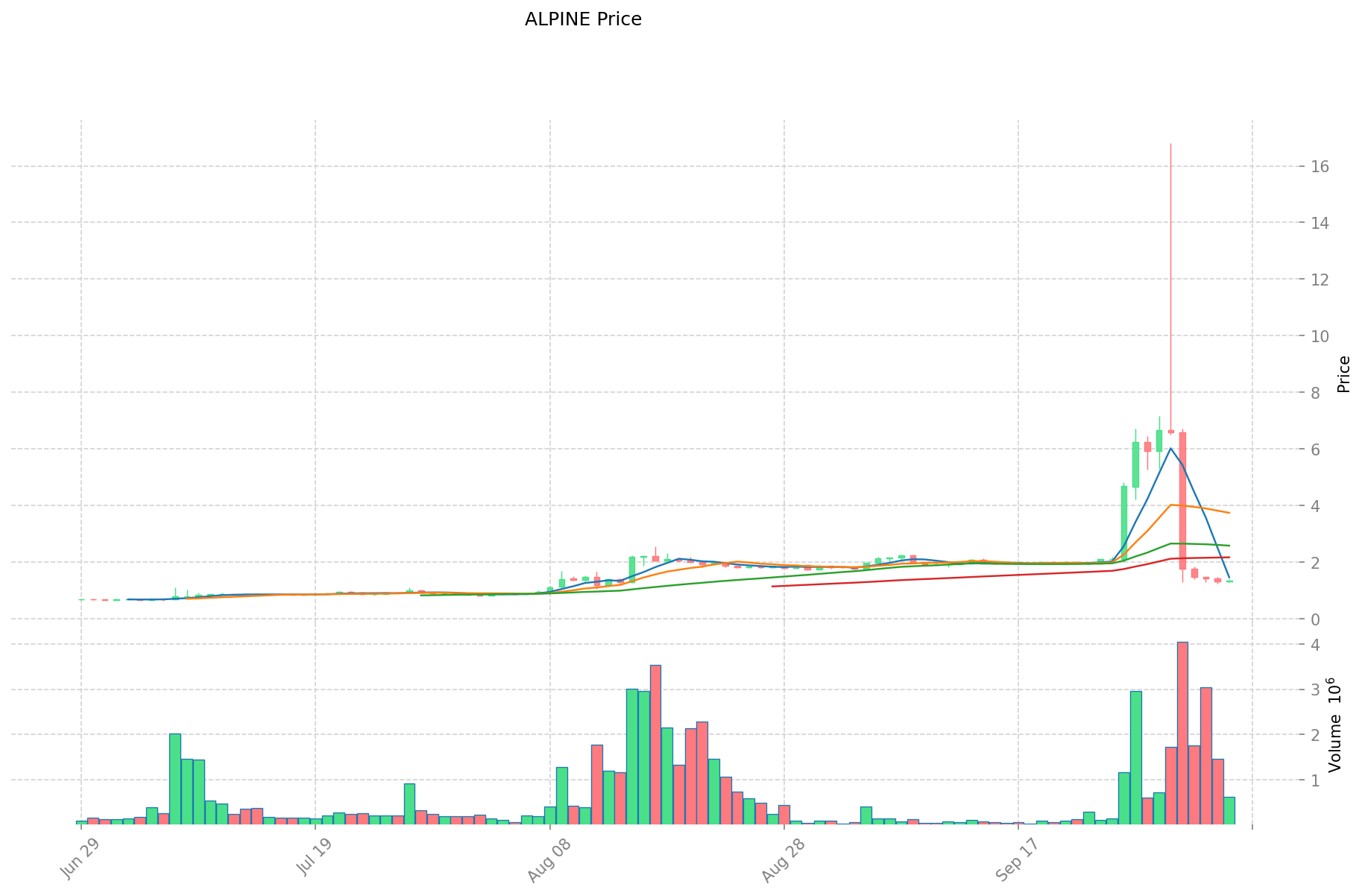
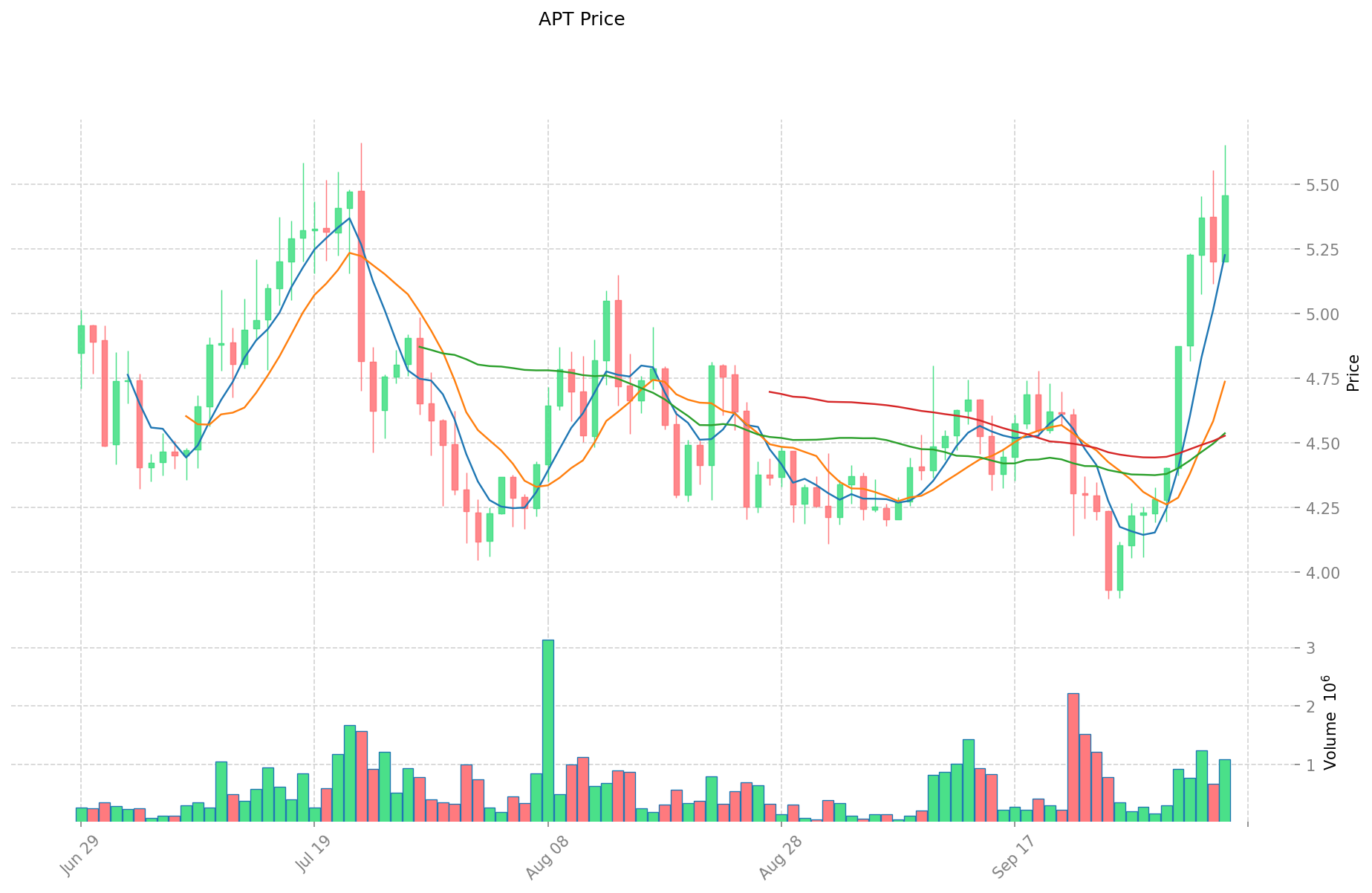
  • Comparative Analysis: During the recent market cycle, ALPINE dropped from its all-time high of $12.71 to a low of $0.593171, while APT showed more resilience, ranging from $19.92 to $3.08.

Current Market Situation (2025-10-06)

  • ALPINE current price: $1.3599
  • APT current price: $5.392
  • 24-hour trading volume: $824,684.390032 (ALPINE) vs $5,895,904.65431 (APT)
  • Market Sentiment Index (Fear & Greed Index): 74 (Greed)

Click to view real-time prices:

price_image1 price_image2

II. Key Factors Affecting ALPINE vs APT Investment Value

Supply Mechanism Comparison (Tokenomics)

  • APT: Market sentiment plays a significant role in APT's exchange rate with USD, alongside macroeconomic trends
  • ALPINE: Investment value primarily depends on its ecosystem and market demand
  • 📌 Historical Pattern: Supply mechanisms directly influence price cycle variations in both assets

Institutional Adoption and Market Applications

  • Institutional Holdings: Market sentiment and investor confidence significantly impact APT's valuation
  • Enterprise Adoption: APT's value is affected by policy regulations and technological innovations
  • Regulatory Attitudes: Regulatory policies across different jurisdictions influence the investment potential of both tokens

Technical Development and Ecosystem Building

  • APT Technical Upgrades: Technological innovation is a key factor driving APT's price movements
  • Ecosystem Comparison: The strength of respective ecosystems directly impacts the investment value of both assets

Macroeconomic Factors and Market Cycles

  • Performance in Inflationary Environments: Macroeconomic trends influence both tokens' value propositions
  • Monetary Policy Impact: External economic factors affect the market performance of both APT and ALPINE
  • Geopolitical Factors: Market sentiment and broader economic trends contribute to price volatility

III. 2025-2030 Price Prediction: ALPINE vs APT

Short-term Prediction (2025)

  • ALPINE: Conservative $0.84-$1.37 | Optimistic $1.37-$1.75
  • APT: Conservative $4.15-$5.39 | Optimistic $5.39-$6.52

Mid-term Prediction (2027)

  • ALPINE may enter a growth phase, with an estimated price range of $1.80-$2.38
  • APT may enter a consolidation phase, with an estimated price range of $4.90-$9.51
  • Key drivers: Institutional capital inflow, ETFs, ecosystem development

Long-term Prediction (2030)

  • ALPINE: Base scenario $1.98-$2.92 | Optimistic scenario $2.92-$4.32
  • APT: Base scenario $6.39-$11.84 | Optimistic scenario $11.84-$15.04

View detailed price predictions for ALPINE and APT

Disclaimer

ALPINE:

年份 预测最高价 预测平均价格 预测最低价 涨跌幅
2025 1.752704 1.3693 0.835273 0
2026 2.1854028 1.561002 0.87416112 14
2027 2.378967048 1.8732024 1.798274304 37
2028 2.61508421052 2.126084724 1.82843286264 56
2029 3.4610533221996 2.37058446726 1.7068208164272 74
2030 4.315411964200104 2.9158188947298 1.982756848416264 114

APT:

年份 预测最高价 预测平均价格 预测最低价 涨跌幅
2025 6.52311 5.391 4.15107 0
2026 8.4590181 5.957055 4.94435565 10
2027 9.514608246 7.20803655 4.901464854 33
2028 11.2877852373 8.361322398 5.8529256786 54
2029 13.8526208828865 9.82455381765 6.287714443296 81
2030 15.035005934840677 11.83858735026825 6.392837169144855 119

IV. Investment Strategy Comparison: ALPINE vs APT

Long-term vs Short-term Investment Strategies

  • ALPINE: Suitable for investors focused on fan engagement and sports-related ecosystems
  • APT: Suitable for investors seeking high-performance blockchain potential and ecosystem growth

Risk Management and Asset Allocation

  • Conservative investors: ALPINE: 30% vs APT: 70%
  • Aggressive investors: ALPINE: 50% vs APT: 50%
  • Hedging tools: stablecoin allocation, options, cross-currency portfolios

V. Potential Risk Comparison

Market Risk

  • ALPINE: Highly dependent on the performance and popularity of the Alpine F1 team
  • APT: Susceptible to broader cryptocurrency market trends and Layer 1 competition

Technical Risk

  • ALPINE: Limited scalability, network stability dependent on the Chiliz blockchain
  • APT: Potential security vulnerabilities, scalability challenges as the network grows

Regulatory Risk

  • Global regulatory policies may have differing impacts on fan tokens and Layer 1 blockchains

VI. Conclusion: Which Is the Better Buy?

📌 Investment Value Summary:

  • ALPINE advantages: Strong connection to real-world sports, potential for increased fan engagement
  • APT advantages: High-performance blockchain, growing ecosystem, potential for wider adoption

✅ Investment Advice:

  • New investors: Consider a balanced approach, leaning towards APT for its broader market potential
  • Experienced investors: Diversify between both, with a slight preference for APT based on ecosystem growth
  • Institutional investors: Focus on APT for its technological potential and market position

⚠️ Risk Warning: The cryptocurrency market is highly volatile. This article does not constitute investment advice. None

VII. FAQ

Q1: What are the main differences between ALPINE and APT? A: ALPINE is a fan token associated with the Alpine Formula One racing team, while APT is a high-performance Layer 1 blockchain. ALPINE focuses on fan engagement in sports, whereas APT aims to provide a scalable blockchain infrastructure for various applications.

Q2: Which cryptocurrency has shown better price performance historically? A: Based on historical data, APT has shown more resilience in price performance. During recent market cycles, ALPINE dropped from its all-time high of $12.71 to a low of $0.593171, while APT ranged from $19.92 to $3.08, demonstrating better stability.

Q3: What factors most significantly affect the value of ALPINE and APT? A: For ALPINE, the main factors are the performance and popularity of the Alpine F1 team, as well as overall fan engagement. For APT, key factors include technological innovations, ecosystem growth, institutional adoption, and broader cryptocurrency market trends.

Q4: How do the long-term price predictions for ALPINE and APT compare? A: By 2030, ALPINE is predicted to reach a base scenario of $1.98-$2.92, with an optimistic scenario of $2.92-$4.32. APT's base scenario for 2030 is $6.39-$11.84, with an optimistic scenario of $11.84-$15.04. APT is expected to have higher potential price growth.

Q5: What are the main risks associated with investing in ALPINE and APT? A: ALPINE risks include high dependence on the Alpine F1 team's performance and limited scalability. APT risks involve potential security vulnerabilities, scalability challenges as the network grows, and competition from other Layer 1 blockchains. Both are subject to regulatory risks and overall cryptocurrency market volatility.

Q6: How should investors allocate their portfolio between ALPINE and APT? A: Conservative investors might consider allocating 30% to ALPINE and 70% to APT, while aggressive investors could opt for a 50-50 split. The exact allocation should depend on individual risk tolerance and investment goals.

Q7: Which cryptocurrency is considered a better buy for different types of investors? A: New investors may prefer a balanced approach with a slight lean towards APT for its broader market potential. Experienced investors might diversify between both, with a preference for APT based on ecosystem growth. Institutional investors may focus more on APT due to its technological potential and market position.

* The information is not intended to be and does not constitute financial advice or any other recommendation of any sort offered or endorsed by Gate.

Related Articles
2025 SUI价格预测:区块链新贵的未来发展与投资价值分析

2025 SUI价格预测:区块链新贵的未来发展与投资价值分析

本文从市场地位、历史价格走势、持仓分布及影响因素等方面全面分析SUI的投资价值。重点预测2025-2030年价格走势,并提供专业投资策略和风险管理框架以帮助投资者决策。适用于关注区块链技术发展和加密货币市场趋势的个人及机构投资者。文章逻辑清晰,结构包括引言、市场回顾、影响因素分析、价格预测、投资策略及风险评估,旨在支持加密投资和决策。
9-9-2025, 10:38:03 AM
INV vs AVAX: A Comparative Analysis of Two Leading Blockchain Platforms

INV vs AVAX: A Comparative Analysis of Two Leading Blockchain Platforms

This article provides an in-depth comparison between Inverse (INV) and Avalanche (AVAX), two prominent blockchain platforms in the cryptocurrency market. It covers key aspects such as price history, supply mechanisms, institutional adoption, and technological ecosystems, offering insights into which platform might be a better investment. The piece addresses investor concerns about risk management, market trends, and future price predictions, particularly from 2025 to 2030. Intended for novice, experienced, and institutional investors, it evaluates long-term vs. short-term strategies and potential risks. For real-time pricing, readers are directed to Gate.

10-4-2025, 12:39:10 AM
2025 INITPrice Prediction: Market Analysis and Future Outlook for Initial Network Token Growth

2025 INITPrice Prediction: Market Analysis and Future Outlook for Initial Network Token Growth

This article explores the 2025 INIT price prediction, analyzing historical trends and potential growth factors, providing valuable insights and strategies for investors. It addresses factors influencing price, investment approaches, risks, and recommends trading methods exclusively on Gate. Ideal for long-term and active traders interested in the Initia blockchain. Structured with an introduction, market review, key factors, predictions, strategies, risks, and conclusion, offering comprehensive guidance for effective investment and risk management in the evolving cryptocurrency landscape.
9-30-2025, 10:47:34 AM
SWAP vs NEAR: Understanding the Key Differences Between These Blockchain Protocols

SWAP vs NEAR: Understanding the Key Differences Between These Blockchain Protocols

This article delves into the key differences between TrustSwap (SWAP) and NEAR Protocol, offering a comprehensive analysis of their investment values in the cryptocurrency market. Focusing on historical price trends, supply mechanisms, and technological ecosystems, it addresses the crucial question for investors: "Which is the better buy right now?" Designed for both novice and experienced investors, the article guides strategic allocation and risk management using detailed projections and comparisons. With insights on institutional adoption and scalability, it aids in discerning which token aligns with long-term investment goals. Real-time prices available through Gate links.
10-10-2025, 12:02:06 AM
Is Polygon Ecosystem Token (POL) a good investment?: Analyzing the potential and risks of this layer-2 scaling solution

Is Polygon Ecosystem Token (POL) a good investment?: Analyzing the potential and risks of this layer-2 scaling solution

This article explores the investment potential of Polygon Ecosystem Token (POL), analyzing its historical price trends, current market status, and technological advancements. It evaluates POL’s fixed supply, scarcity, institutional adoption, and the impact of macroeconomic factors, providing insights for investors considering POL for hedging or diversification. Suitable for various investors from beginners to institutional players, the article discusses investment strategies like HODL and active trading, while addressing associated risks such as market volatility and regulatory challenges. Access real-time POL prices on Gate to inform investment decisions.
10-15-2025, 4:43:35 AM
Is Astar Token (ASTR) a good investment?: Analyzing the potential and risks of this Polkadot ecosystem token

Is Astar Token (ASTR) a good investment?: Analyzing the potential and risks of this Polkadot ecosystem token

The article provides an in-depth analysis of Astar Token's (ASTR) investment potential within the Polkadot ecosystem. It examines historical price trends, current market status, key factors influencing investment value, and future price outlook from 2025 to 2030. The content addresses risks associated with ASTR investment and outlines strategies for beginners, experienced, and institutional investors, including risk management and investment techniques. Key features such as supply mechanism, institutional adoption, and ecosystem development are highlighted. A comprehensive FAQ section answers critical queries, enhancing SEO optimization and readability for investors seeking cryptocurrency insights.
10-19-2025, 4:26:33 AM
Recommended for You
What is TEXITcoin (TXC) fundamentals: whitepaper logic, use cases, and technical innovation analysis?

What is TEXITcoin (TXC) fundamentals: whitepaper logic, use cases, and technical innovation analysis?

The article presents an in-depth analysis of TEXITcoin (TXC), focusing on its core whitepaper logic, real-world use cases, and technical innovation architecture. It explores TXC's decentralized transaction protocol, token economics, and mining strategies aimed at democratizing network participation. The article addresses the needs for exchange liquidity management, institutional positioning, and price volatility, emphasizing its appeal to institutional investors. The comprehensive technical innovations include smart contract integration and cross-chain interoperability, enhancing TXC's capability as a secure and accessible solution for modern digital commerce. The insights are tailored for investors, developers, and industry participants looking to understand TXC's impact on blockchain technology.
12-23-2025, 8:17:29 AM
DIMO vs GMX: A Comprehensive Comparison of Decentralized Data and Derivatives Trading Platforms

DIMO vs GMX: A Comprehensive Comparison of Decentralized Data and Derivatives Trading Platforms

This article offers a comprehensive analysis of DIMO and GMX, comparing these decentralized platforms for data and derivatives trading. It evaluates historical price trends, tokenomics, and market adoption, aiming to help investors determine which asset is currently a better investment. The piece addresses investor concerns such as price stability, liquidity, and regulatory risks. It is structured to present a thorough comparative analysis, including project overviews, market performance metrics, and investment strategies. Keywords focus on crypto investment, DIMO, GMX, decentralized trading, and market analysis for enhanced readability and scannability.
12-23-2025, 8:16:18 AM
What is Lumia (LUMIA) price today with $14.94M market cap and 146.59M circulating supply?

What is Lumia (LUMIA) price today with $14.94M market cap and 146.59M circulating supply?

This article explores Lumia's (LUMIA) current market dynamics with a price of $0.1182 and a market cap of $14.94M. It highlights key metrics such as circulating supply, price performance, and trading volume. Lumia operates on the BNB Smart Chain with strategic listings on Gate, ensuring trading accessibility. The discussion includes liquidity constraints and the importance of monitoring supply inflation for investors. The text provides insights into Lumia's position within the decentralized finance ecosystem, beneficial for traders and investors evaluating market volatility and strategic opportunities.
12-23-2025, 8:14:55 AM
VXT vs DYDX: A Comprehensive Comparison of Two Leading Decentralized Exchange Tokens

VXT vs DYDX: A Comprehensive Comparison of Two Leading Decentralized Exchange Tokens

This article offers a comprehensive comparison between VXT and DYDX, focusing on their unique investment propositions within the decentralized finance ecosystem. By exploring historical price trends and current market conditions, it assesses their potential as investment assets. Key topics include tokenomics, trading mechanisms, and infrastructure requirements. The article caters to investors seeking clarity on whether VXT or DYDX offers better value, with strategic insights for conservative, aggressive, and institutional investors. Readers can expect concise analysis with optimized keyword density for quick scanning.
12-23-2025, 8:14:09 AM
SHPING vs VET: Comparing Two Leading Supply Chain and Logistics Blockchain Solutions

SHPING vs VET: Comparing Two Leading Supply Chain and Logistics Blockchain Solutions

The article provides a comprehensive comparative analysis of two leading blockchain solutions, SHPING and VET, highlighting their investment value within the cryptocurrency market. It explores their market trends, tokenomics, and adoption scenarios, addressing investor needs in choosing between consumer-focused technology (SHPING) and enterprise-grade infrastructure (VET). Key aspects include price performance, supply dynamics, and risk assessments. Structured logically, the article begins with an introduction, followed by detailed market comparisons, project overviews, and strategic investment recommendations. It targets both retail and institutional investors, emphasizing keywords like SHPING, VET, investment strategy, and market conditions.
12-23-2025, 8:14:00 AM
What are the compliance and regulatory risks in cryptocurrency? A guide to SEC regulations, KYC/AML policies, and audit transparency

What are the compliance and regulatory risks in cryptocurrency? A guide to SEC regulations, KYC/AML policies, and audit transparency

This article provides an in-depth guide to compliance and regulatory risks in cryptocurrency, with a focus on SEC regulations, KYC/AML policies, and audit transparency. It explores the SEC's regulatory framework, including licensing and AML requirements for exchanges like Gate. The piece addresses best practices for KYC/AML implementation, emphasizing risk-based identity verification and AI-driven transaction monitoring. The importance of audit transparency through third-party audits is discussed, highlighting how these practices bolster investor confidence and meet evolving compliance standards. Ideal for businesses and investors seeking clarity on cryptocurrency regulations and operational compliance.


12-23-2025, 8:12:26 AM