DIMO vs GMX: A Comprehensive Comparison of Decentralized Data and Derivatives Trading Platforms


Introduction: DIMO vs GMX Investment Comparison
In the cryptocurrency market, comparisons between DIMO and GMX have always been a topic investors cannot avoid. The two projects differ significantly in market capitalization ranking, application scenarios, and price performance, representing distinct positions within the crypto asset landscape. DIMO (DIMO): Launched in 2022, it has gained market recognition by liberating automotive data and establishing a global platform for developers, enabling users to create digital twins of their vehicles on the blockchain and earn tokens through verified data streams. GMX (GMX): Operating as a decentralized perpetual exchange, it functions as both a utility and governance token, with token holders entitled to 30% of platform-generated fees, establishing itself as a significant player in the decentralized derivatives trading space. This article will conduct a comprehensive analysis of DIMO vs GMX investment value comparison across historical price trends, supply mechanisms, market adoption, and technical ecosystems, while attempting to answer the question investors care most about:
"Which is the better buy right now?"
Comparative Analysis Report: DIMO and GMX Crypto Assets
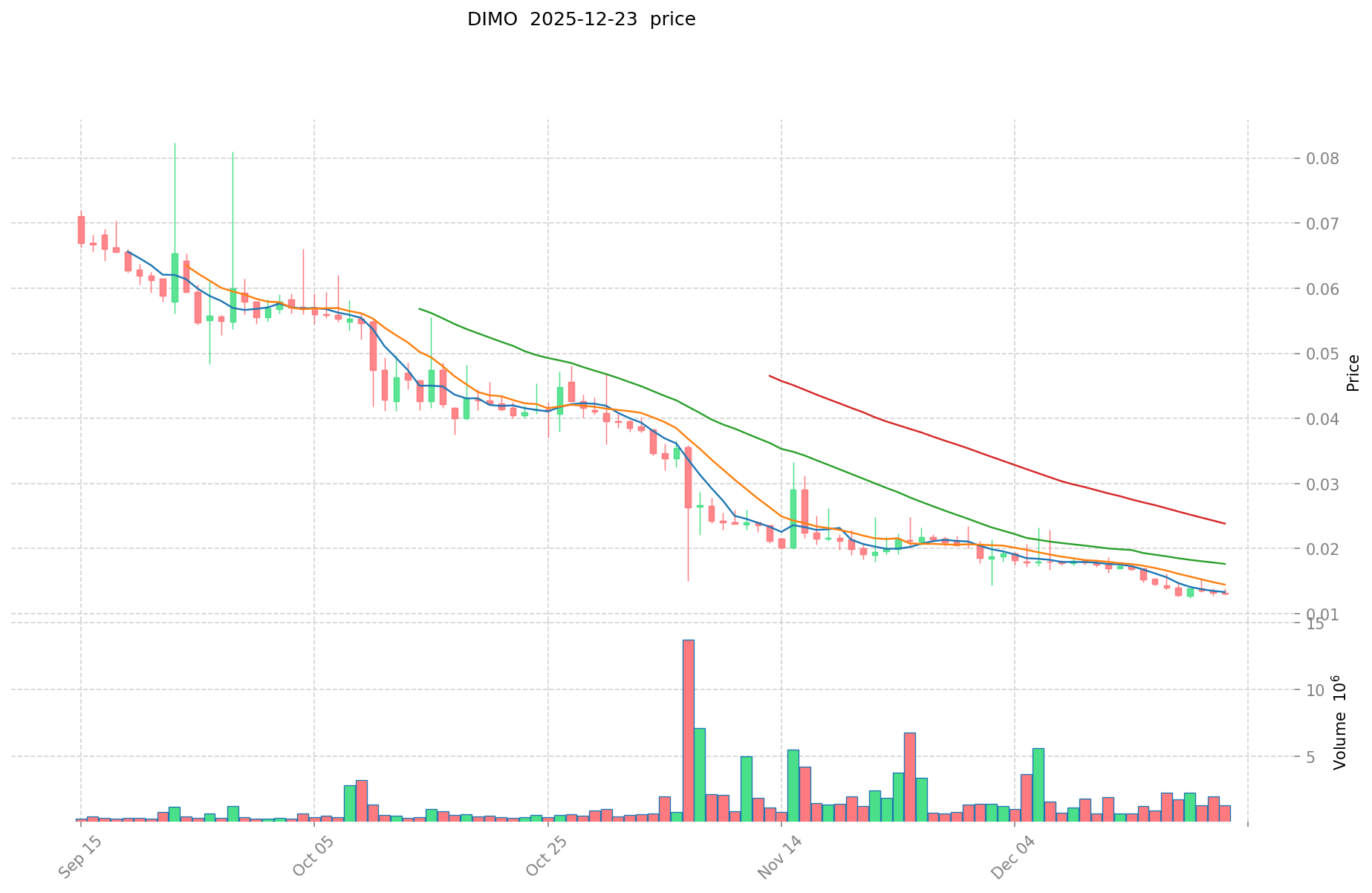
I. Historical Price Comparison and Current Market Status
Price Performance Overview of DIMO and GMX
DIMO Historical Performance:
- All-Time High (ATH): $2.00 (February 1, 2024)
- All-Time Low (ATL): $0.01236 (December 19, 2025)
- Historical decline: 99.38% from ATH to current levels
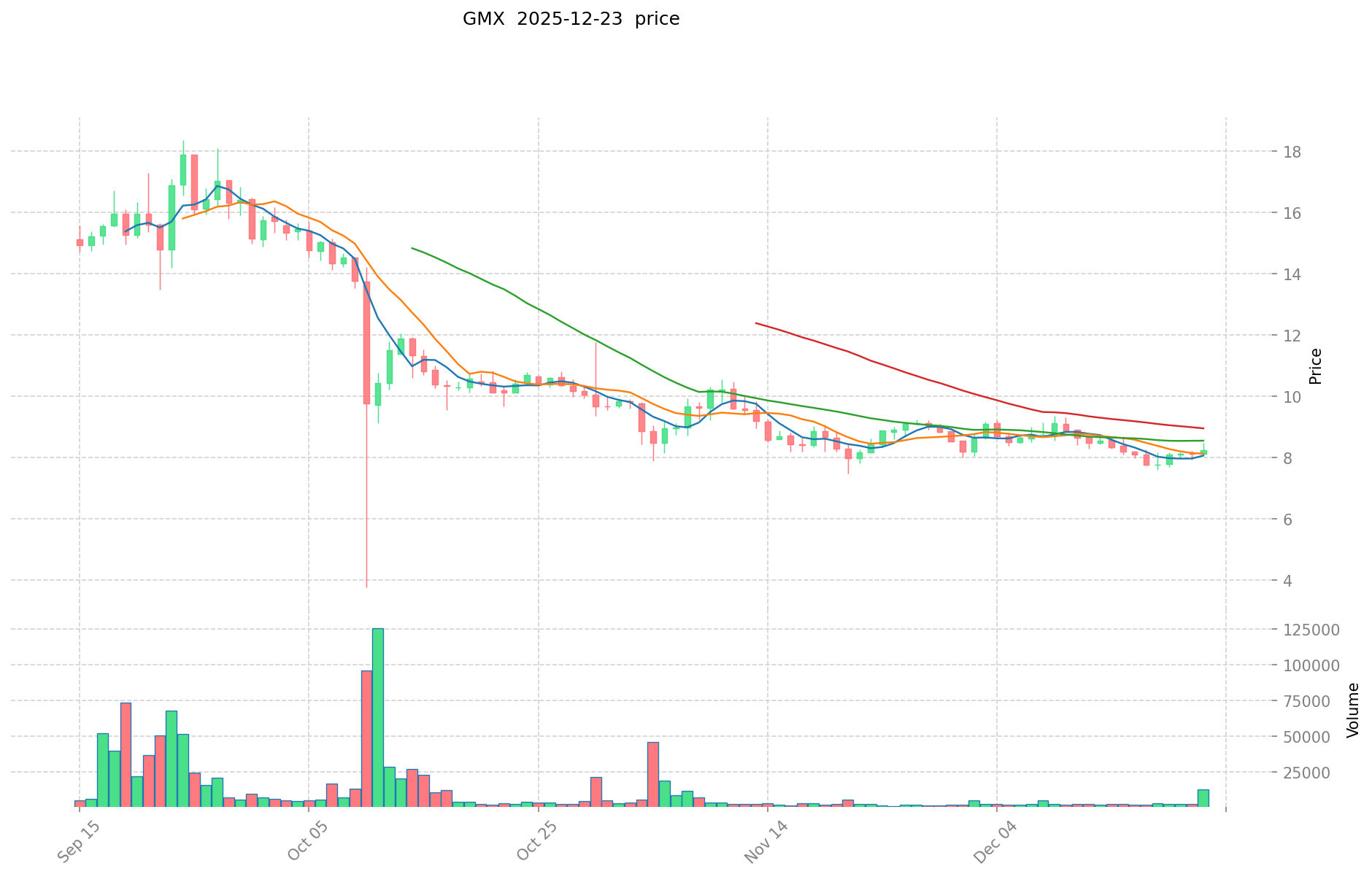
GMX Historical Performance:
- All-Time High (ATH): $91.07 (April 18, 2023)
- All-Time Low (ATL): $6.92 (October 11, 2025)
- Historical decline: 92.05% from ATH to current levels
Comparative Analysis: Both assets have experienced substantial long-term price deterioration. DIMO has declined 92.88% over the past year, while GMX has declined 70.12% over the same period. GMX demonstrates relatively better price stability compared to DIMO, though both tokens reflect challenging market conditions for their respective projects.
Current Market Status (December 23, 2025)
DIMO:
- Current Price: $0.01302
- 24-hour Change: -3.25%
- 7-day Change: -13.43%
- Market Capitalization: $13,020,000 USD
- 24-hour Trading Volume: $15,896.63 USD
- Circulating Supply: 412,245,810 tokens (41.22% of total supply)
- Total Supply: 1,000,000,000 tokens
GMX:
- Current Price: $8.146
- 24-hour Change: -1.43%
- 7-day Change: +0.99%
- Market Capitalization: $84,415,754.68 USD
- 24-hour Trading Volume: $118,534.09 USD
- Circulating Supply: 10,362,847.37 tokens (78.21% of total supply)
- Max Supply: 13,250,000 tokens
Market Sentiment:
- Crypto Fear & Greed Index: 24 (Extreme Fear)
Current Price References:
- DIMO market data: https://etherscan.io/token/0x5fab9761d60419c9eeebe3915a8fa1ed7e8d2e1b
- GMX market data: https://arbiscan.io/token/0xfc5a1a6eb076a2c7ad06ed22c90d7e710e35ad0a
II. Project Overview and Core Use Cases
DIMO: Decentralized Mobility Data Platform
Project Purpose: DIMO addresses data fragmentation in the trillion-dollar automotive industry by creating a blockchain-based platform for vehicle data liberation. The platform enables users to create digital twins (NFTs) of their vehicles on the blockchain and monetize vehicle data.
Key Features:
- Digital vehicle twins (NFT-based representation)
- DIMO Miner hardware for verified data streaming
- Integration with decentralized applications including:
- DeFi auto loans
- Peer-to-peer car sharing
- Web3-based ride-sharing
- Pay-per-mile insurance
Token Economics:
- Total Supply: 1,000,000,000 DIMO
- Current Circulating Supply: 412,245,810 tokens
- Token Function: Utility and governance token with earnings mechanism
- Blockchain: Ethereum (ERC-20 standard)
Market Position:
- Global Ranking: #1483
- Market Share: 0.00041%
- Total Holders: 8,381 addresses
GMX: Decentralized Perpetual Futures Exchange
Project Purpose: GMX operates as a decentralized exchange platform for perpetual futures trading, providing a sustainable alternative to centralized derivatives exchanges.
Token Economics:
- Circulating Supply: 10,362,847.37 tokens
- Max Supply: 13,250,000 tokens
- Token Function: Utility, governance token, and fee distribution mechanism
- Fee Distribution: GMX holders receive 30% of platform-generated fees
- Blockchain: Arbitrum (EVM-compatible)
Market Position:
- Global Ranking: #374
- Market Share: 0.0026%
- Total Holders: 300,914 addresses
- Exchange Availability: Listed on 32+ exchanges
III. Market Performance Metrics
Price Volatility Analysis
DIMO Short-term Performance:
| Time Period | Change | Price Movement |
|---|---|---|
| 1 Hour | -0.31% | -$0.000040 |
| 24 Hours | -3.25% | -$0.000437 |
| 7 Days | -13.43% | -$0.002020 |
| 30 Days | -34.11% | -$0.006740 |
| 1 Year | -92.88% | -$0.169845 |
GMX Short-term Performance:
| Time Period | Change | Price Movement |
|---|---|---|
| 1 Hour | -0.15% | -$0.012237 |
| 24 Hours | -1.43% | -$0.118178 |
| 7 Days | +0.99% | +$0.079855 |
| 30 Days | -0.67% | -$0.054946 |
| 1 Year | -70.12% | -$19.116383 |
Key Observations:
- GMX demonstrates more stable price movement with positive 7-day performance, while DIMO shows consistent downward pressure
- DIMO's 24-hour trading volume ($15,896.63) is significantly lower than GMX ($118,534.09), indicating lower liquidity
- GMX's market capitalization is approximately 6.5x larger than DIMO's
Liquidity and Market Depth
DIMO:
- Market Depth: 5 exchange listings
- Liquidity Status: Limited, with concentration on specific trading pairs
- Primary Trading Pairs: DIMO/USDT
GMX:
- Market Depth: 32+ exchange listings
- Liquidity Status: Substantially more liquid across multiple platforms
- Wide exchange availability enhances accessibility
IV. Risk Assessment and Market Sentiment
Regulatory and Operational Status
DIMO:
- Published Date: December 11, 2022
- Initial Price: $0.4244
- Current Status: Active reporting entity
- Supply Distribution: 41.22% of total supply circulating
GMX:
- Current Status: Operational across Arbitrum network
- Supply Distribution: 78.21% of total supply circulating
- Protocol Evolution: Transition and migration activities noted in token allocation
Current Market Sentiment
Crypto Fear & Greed Index: 24 (Extreme Fear)
This extreme fear sentiment reflects broader crypto market conditions characterized by:
- Reduced investor confidence
- Lower trading activity
- Risk-averse market behavior
- Potential buy-zone environment for contrarian investors
Important Disclaimer: This report is for informational purposes only and does not constitute investment advice. Cryptocurrency markets are highly volatile and subject to substantial risk. Historical price performance does not guarantee future results. Investors should conduct thorough due diligence and consult with qualified financial advisors before making investment decisions.
GMX Investment Value Analysis Report
I. Executive Summary
Based on available reference materials, this report analyzes GMX as a decentralized derivatives trading protocol. Information regarding DIMO was insufficient in the provided sources to conduct a comparative analysis. The analysis focuses on GMX's tokenomics, market positioning, and investment considerations as of December 2025.
II. Core Factors Affecting GMX Investment Value
Tokenomics and Supply Mechanism
GMX Token Distribution:
- GMX entered the market in September 2021, addressing sustainability issues in token emission
- The protocol pioneered the Peer-to-Pool model combined with user fee-sharing mechanisms
- Fee revenue is distributed in the form of major cryptocurrencies (ETH/AVAX) and GMX native tokens
- GMX and Gains Network conducted token conversions from predecessor tokens, meaning most supply was unlocked at launch, resulting in minimal future reward releases relative to circulating supply
- Unlike dYdX and Synthetix, which reserved 27.7% and 50% of supply respectively for investors with extended lock periods, GMX achieved community-oriented distribution through public token sales only
Fee-Sharing Incentive Structure:
- GMX v1 allocated 100% of fee revenue: 70% to GLP (liquidity provider) holders and 30% to GMX stakers
- GMX v2 implemented subtle adjustments, reducing fee allocations by 10% for stakers and GLP holders
- Community voting supported this adjustment, indicating protocol benefit despite reduced immediate rewards
- High token staking rates across GMX, Gains Network, and Synthetix demonstrate adequate reward incentives for users providing capital
Market Adoption and Application
Peer-to-Pool Model Innovation:
- GMX's success catalyzed the creation of similar Peer-to-Pool systems, including Gains Network
- The model requires LPs as counterparties for on-chain trades, distinguishing it from traditional oracle-based approaches
- On-chain pricing forms through market transactions via pool mechanics (Mint/Redeem functions), enabling event-driven trading opportunities to manifest first on-chain ahead of traditional markets
Community Governance:
- GMX and Gains Network are exceptions in the peer-to-pool ecosystem by raising funds exclusively through public token sales
- "Community-owned" protocols reduce investor concerns, incentivizing token retention and protocol participation
- Community voting demonstrates active participation in protocol governance decisions
Technical Architecture and Ecosystem Development
Protocol Evolution:
- GMX utilizes dual-staking mechanisms to distribute rewards in both major tokens (ETH/AVAX) and native GMX tokens
- The protocol implements Peer-to-Pool mechanics requiring liquidity providers as trade counterparties
- On-chain price discovery mechanisms function similarly to platforms like Hyperliquid, contrasting with FTX's oracle-based pricing model
Comparative Advantage Over Predecessors:
- Gambit Financial (GMX's predecessor on BNB) allocated only 40% fee revenue (20% to USDG + 20% to stakers)
- GMX v1's 100% fee allocation to liquidity providers and stakers demonstrated that higher LP yields effectively incentivize greater liquidity provision
- This mechanism improvement represents learning from case studies across multiple protocols (Gambit, Gains Network, Synthetix)
Macroeconomic Considerations and Market Dynamics
Volatility and Risk Profile:
- GMX exhibits volatility inherent to decentralized derivatives trading platforms
- Token staking rates indicate user confidence in reward sustainability despite market fluctuations
- The protocol's fee-sharing model provides revenue diversification through multiple asset denominations
Market Structure:
- GMX operates within the broader decentralized derivatives ecosystem competing with platforms like dYdX and Synthetix
- The protocol's success demonstrates market demand for Peer-to-Pool models and fee-sharing incentives
- Community-controlled governance and transparent fee distribution reduce counterparty risk concerns
III. Investment Considerations
Strengths
- Proven tokenomics model with high user staking rates indicating reward adequacy
- Community-owned structure reducing investor concentration risk
- Successful innovation in fee-sharing mechanisms driving ecosystem adoption
- Active community governance participation
- Dual-token reward system (major cryptocurrencies + native token) providing diversified returns
Risk Factors
- Inherent volatility of decentralized derivatives trading platforms
- Competitive pressure from alternative protocols (dYdX, Synthetix, Gains Network)
- Regulatory uncertainty affecting decentralized finance platforms
- Smart contract risks and technical vulnerabilities
- Market concentration risk in specific trading pairs or asset classes
IV. Conclusion
GMX's investment value hinges on technology innovation, protocol governance effectiveness, and market adoption of decentralized derivatives trading. The platform's community-owned structure and fee-sharing mechanisms have demonstrated effectiveness in incentivizing liquidity provision and user participation. However, investment decisions should account for the inherent volatility and competitive dynamics within the decentralized derivatives ecosystem. Future protocol upgrades and market conditions will significantly influence long-term value creation.
Data Timestamp: December 23, 2025
Note: This analysis is based on available reference materials current through mid-2023. Real-time market data and recent protocol developments should be consulted for current investment assessment.
III. 2025-2030 Price Forecast: DIMO vs GMX
Short-term Forecast (2025)
- DIMO: Conservative $0.00859-$0.01302 | Optimistic $0.01523
- GMX: Conservative $5.48-$8.17 | Optimistic $9.07
Mid-term Forecast (2027-2028)
- DIMO may enter consolidation phase with volatility, estimated price range $0.0086-$0.0192, showing cumulative growth of 13%-27%
- GMX may experience momentum-driven expansion, estimated price range $6.89-$14.95, reflecting sustained uptrend with 24%-46% appreciation
- Key drivers: institutional capital inflows, derivative market development, ecosystem expansion
Long-term Forecast (2030)
- DIMO: Base scenario $0.01153-$0.02134 | Optimistic scenario $0.03116
- GMX: Base scenario $14.17-$15.40 | Optimistic scenario $17.10
Disclaimer: This analysis is based on historical data models and predictive algorithms. Cryptocurrency markets are highly volatile and subject to regulatory, technological, and macroeconomic uncertainties. Price predictions do not constitute investment advice. Past performance does not guarantee future results. Investors should conduct independent research and consult financial advisors before making investment decisions.
DIMO:
| 年份 | 预测最高价 | 预测平均价格 | 预测最低价 | 涨跌幅 |
|---|---|---|---|---|
| 2025 | 0.0152334 | 0.01302 | 0.0085932 | 0 |
| 2026 | 0.015398103 | 0.0141267 | 0.009041088 | 8 |
| 2027 | 0.018453001875 | 0.0147624015 | 0.00856219287 | 13 |
| 2028 | 0.0192649339575 | 0.0166077016875 | 0.011127160130625 | 27 |
| 2029 | 0.02475211859505 | 0.0179363178225 | 0.010582427515275 | 37 |
| 2030 | 0.031162558584811 | 0.021344218208775 | 0.011525877832738 | 63 |
GMX:
| 年份 | 预测最高价 | 预测平均价格 | 预测最低价 | 涨跌幅 |
|---|---|---|---|---|
| 2025 | 9.07314 | 8.174 | 5.47658 | 0 |
| 2026 | 11.6418195 | 8.62357 | 6.2089704 | 5 |
| 2027 | 13.78046486 | 10.13269475 | 6.89023243 | 24 |
| 2028 | 14.94572475625 | 11.956579805 | 6.33698729665 | 46 |
| 2029 | 17.35198644200625 | 13.451152280625 | 12.77859466659375 | 65 |
| 2030 | 17.095741991060343 | 15.401569361315625 | 14.169443812410375 | 89 |
Comparative Investment Analysis Report: DIMO vs GMX
IV. Investment Strategy Comparison: DIMO vs GMX
Long-term vs Short-term Investment Strategies
DIMO: Suited for investors focusing on emerging automotive data infrastructure and blockchain-based vehicle monetization ecosystems. Given the project's early-stage status and significant price volatility, this represents a high-risk, speculative allocation requiring extended time horizons (3-5 years minimum) to realize potential value from ecosystem adoption.
GMX: Suited for investors seeking exposure to established decentralized derivatives trading with demonstrated fee-sharing revenue models and active community governance. The protocol's more mature market position and higher liquidity make it suitable for both medium-term (1-2 years) and long-term strategic positioning.
Risk Management and Asset Allocation
Conservative Investors:
- DIMO: 2-5% allocation (speculative position only)
- GMX: 15-20% allocation (core portfolio exposure)
- Hedging instruments: Stablecoin reserves (40-50%), multi-asset diversification across Ethereum and Arbitrum-based protocols
Aggressive Investors:
- DIMO: 10-15% allocation (high-risk growth position)
- GMX: 20-30% allocation (significant protocol exposure)
- Hedging tools: Derivatives positions via futures markets, cross-protocol yield farming strategies, option structures for downside protection
V. Comparative Risk Analysis
Market Risk
DIMO:
- Extreme volatility with 99.38% decline from all-time high, indicating severe asset depreciation
- Minimal 24-hour trading volume ($15,896.63) creates significant liquidity constraints and price slippage risk
- Market capitalization of $13.02 million reflects low market adoption and concentration risk
- Limited exchange availability (5 listings) restricts accessibility and exit liquidity
GMX:
- Substantial but moderate volatility with 92.05% decline from all-time high
- Significantly higher trading volume ($118,534.09) providing improved liquidity and reduced slippage
- Market capitalization of $84.42 million enables more stable price discovery
- Extensive exchange availability (32+ listings) enhances market accessibility and exit options
Technical Risk
DIMO:
- Smart contract risks inherent to vehicle data stream verification mechanisms
- Scalability concerns for supporting large-scale DIMO Miner hardware networks
- Dependence on data oracle accuracy for verified data streaming processes
- Limited technical documentation regarding network stability under load conditions
GMX:
- Peer-to-Pool model creates counterparty risk requiring sufficient liquidity provider participation
- Smart contract vulnerabilities in perpetual futures mechanics (liquidation algorithms, price discovery mechanisms)
- Protocol migration activities introduce transition risks and potential fund management complexities
- Arbitrum network dependencies and cross-chain bridge security considerations
Regulatory Risk
Global Regulatory Environment: Both assets face comparable regulatory uncertainties affecting decentralized finance platforms:
- Decentralized derivatives trading faces increasing scrutiny from securities regulators (SEC, FCA, CFTC) regarding market manipulation and investor protection
- Data privacy regulations (GDPR, CCPA) create specific compliance challenges for DIMO's automotive data monetization model
- Staking mechanisms and fee distribution protocols increasingly subject to regulatory classification as securities or financial products
- Regional restrictions may limit market access and ecosystem expansion opportunities for both protocols
VI. Conclusion: Which Is the Better Buy?
📌 Investment Value Summary
DIMO Advantages:
- First-mover positioning in blockchain-based automotive data infrastructure
- Trillion-dollar addressable market within automotive industry
- NFT-based vehicle digital twins represent innovative asset class
- Token economics enable data provider monetization mechanisms
- Emerging Web3 mobility applications (ride-sharing, insurance, peer-to-peer lending) offer ecosystem expansion potential
GMX Advantages:
- Proven market adoption with 300,914+ token holders demonstrating strong community engagement
- Established fee-sharing mechanism generating sustainable protocol revenue
- Community-owned governance structure reducing investor concentration risk
- Higher market liquidity and exchange availability enabling practical portfolio management
- Dual-token reward system (ETH/AVAX + GMX) providing diversified return mechanisms
- Competitive positioning within established decentralized derivatives ecosystem
- Positive 7-day price momentum (+0.99%) versus DIMO's continued decline (-13.43%)
✅ Investment Recommendations
Beginner Investors:
- Prioritize GMX exposure due to superior market maturity, liquidity, and established use cases
- Maintain minimal DIMO allocation (0-2%) for speculative exposure only
- Implement conservative 70% stablecoin reserve for market volatility management
- Focus on understanding fee-sharing mechanisms and governance participation with GMX
Experienced Investors:
- Construct diversified portfolio with primary GMX position (20-25%) supplemented by selective DIMO allocation (5-10%)
- Implement strategies leveraging GMX fee distribution through staking mechanisms
- Execute dollar-cost averaging over 6-12 month periods to manage entry point volatility
- Monitor DIMO ecosystem development milestones (DIMO Miner adoption rates, application integrations) for rebalancing triggers
- Consider derivatives hedging for downside protection given current crypto market fear sentiment
Institutional Investors:
- GMX represents primary allocation target with established protocol metrics and transparent governance
- Implement staking strategies capturing 30% fee revenue participation
- Conduct operational due diligence on Arbitrum infrastructure reliability and cross-chain security
- DIMO consideration contingent on demonstrable traction in vehicle data monetization and developer ecosystem growth
- Maintain strategic positioning to capitalize on potential automotive industry blockchain adoption acceleration
⚠️ Risk Disclaimer: Cryptocurrency markets exhibit extreme volatility and remain subject to substantial regulatory, technological, and macroeconomic uncertainties. This analysis is provided for informational purposes only and does not constitute investment advice. Historical price performance does not guarantee future results. The Crypto Fear & Greed Index reading of 24 (Extreme Fear) reflects current market pessimism but provides no certainty regarding future price directions. Investors must conduct independent due diligence and consult qualified financial advisors before making investment decisions. All cryptocurrency investments carry risk of total loss.
Report Date: December 23, 2025
Data Sources: Etherscan, Arbiscan, Market capitalization data, Historical price records
Disclaimer: This report is based on available reference materials and market data current through December 23, 2025. Real-time market conditions and protocol developments should be consulted for current investment assessment.
None
FAQ: DIMO vs GMX Investment Comparison
I. Market Performance and Valuation
Q1: How have DIMO and GMX performed compared to their all-time highs?
A: Both assets have experienced substantial long-term price deterioration. DIMO has declined 99.38% from its all-time high of $2.00 (February 1, 2024) to the current price of $0.01302. GMX has declined 92.05% from its all-time high of $91.07 (April 18, 2023) to the current price of $8.146. Over the past year specifically, DIMO declined 92.88% while GMX declined 70.12%, indicating that GMX has demonstrated relatively better price stability compared to DIMO.
Q2: What is the current market capitalization difference between DIMO and GMX?
A: GMX has a significantly larger market capitalization of $84.42 million compared to DIMO's $13.02 million, making GMX approximately 6.5 times larger. Additionally, GMX has substantially higher 24-hour trading volume ($118,534.09) compared to DIMO ($15,896.63), indicating superior liquidity and market depth. GMX is also listed on 32+ exchanges versus DIMO's limited 5 exchange listings.
II. Project Fundamentals and Use Cases
Q3: What are the core differences between DIMO and GMX's business models?
A: DIMO is a decentralized mobility data platform that enables users to create digital vehicle twins (NFTs) on the blockchain and monetize vehicle data through verified data streams. Its ecosystem includes DeFi auto loans, peer-to-peer car sharing, Web3-based ride-sharing, and pay-per-mile insurance applications. GMX, conversely, operates as a decentralized perpetual futures exchange utilizing a Peer-to-Pool model where liquidity providers serve as counterparties for on-chain trades. GMX token holders receive 30% of platform-generated fees, establishing a sustainable fee-sharing mechanism.
Q4: How do the tokenomics differ between DIMO and GMX?
A: DIMO has a total supply of 1,000,000,000 tokens with 412,245,810 circulating (41.22% of total supply). GMX has a maximum supply of 13,250,000 tokens with 10,362,847.37 circulating (78.21% of total supply). GMX achieved greater supply distribution through public token sales exclusively, with minimal future reward releases relative to circulating supply. Both tokens serve utility and governance functions, though GMX includes direct fee-sharing mechanisms where stakers receive 30% of protocol revenue.
III. Risk Assessment and Market Conditions
Q5: Which asset presents lower investment risk for conservative investors?
A: GMX presents substantially lower risk for conservative investors. GMX demonstrates more stable price movement with positive 7-day performance (+0.99%) versus DIMO's continued decline (-13.43%). GMX's market capitalization of $84.42 million provides greater stability compared to DIMO's $13.02 million. GMX's higher trading volume and 32+ exchange listings create superior liquidity, while DIMO's minimal trading volume ($15,896.63) creates significant slippage risk. Current Crypto Fear & Greed Index reading of 24 (Extreme Fear) affects both assets, but GMX's established market adoption and governance structures provide greater downside protection.
Q6: What regulatory risks do both assets face?
A: Both DIMO and GMX face comparable regulatory uncertainties affecting decentralized finance platforms. Decentralized derivatives trading (GMX's primary use case) faces increasing scrutiny from securities regulators regarding market manipulation and investor protection. DIMO specifically faces data privacy compliance challenges (GDPR, CCPA) related to automotive data monetization. Staking mechanisms and fee distribution protocols increasingly face regulatory classification scrutiny as potential securities. Regional restrictions may limit market access and ecosystem expansion opportunities for both protocols, with decentralized perpetual futures platforms experiencing heightened regulatory pressure in multiple jurisdictions.
IV. Investment Strategy and Future Outlook
Q7: Which asset is more suitable for different investor profiles?
A: For beginner investors, GMX is recommended with 15-20% portfolio allocation due to superior market maturity and liquidity, with minimal DIMO allocation (0-2%) for speculative exposure only. For experienced investors, GMX should comprise 20-25% of portfolio holdings supplemented by selective DIMO allocation (5-10%), implementing dollar-cost averaging strategies over 6-12 month periods. Institutional investors should prioritize GMX as primary allocation target with staking strategies capturing 30% fee revenue participation, while DIMO consideration remains contingent on demonstrable ecosystem traction in vehicle data monetization and developer adoption metrics.
Q8: What are the price forecasts for DIMO and GMX through 2030?
A: Conservative 2025 forecasts estimate DIMO ranging $0.00859-$0.01302 (conservative) and GMX ranging $5.48-$8.17 (conservative). By 2030, base scenario forecasts project DIMO at $0.01153-$0.02134 and GMX at $14.17-$15.40, reflecting cumulative appreciation of 13%-63% for DIMO and 65%-89% for GMX respectively. Mid-term forecasts (2027-2028) suggest DIMO may enter consolidation phases with 13%-27% cumulative growth, while GMX may experience momentum-driven expansion with 24%-46% appreciation. Key drivers include institutional capital inflows, derivative market development, and ecosystem expansion, though these predictions carry substantial uncertainty given cryptocurrency market volatility.
Report Date: December 23, 2025
Important Disclaimer: This FAQ is provided for informational purposes only and does not constitute investment advice. Cryptocurrency markets are highly volatile and subject to regulatory, technological, and macroeconomic uncertainties. Historical price performance does not guarantee future results. Investors should conduct independent research and consult qualified financial advisors before making investment decisions.
Share
Content
Introduction: DIMO vs GMX Investment Comparison
I. Historical Price Comparison and Current Market Status
II. Project Overview and Core Use Cases
III. Market Performance Metrics
IV. Risk Assessment and Market Sentiment
I. Executive Summary
II. Core Factors Affecting GMX Investment Value
III. Investment Considerations
IV. Conclusion
Short-term Forecast (2025)
Mid-term Forecast (2027-2028)
Long-term Forecast (2030)
IV. Investment Strategy Comparison: DIMO vs GMX
V. Comparative Risk Analysis
VI. Conclusion: Which Is the Better Buy?
I. Market Performance and Valuation
II. Project Fundamentals and Use Cases
III. Risk Assessment and Market Conditions
IV. Investment Strategy and Future Outlook
How to Buy Cryptocurrency


Trending Cryptocurrencies



Is Perpetual Protocol (PERP) a Good Investment?: A Comprehensive Analysis of Its Long-term Potential in the DeFi Derivatives Market

Is NASDEX (NSDX) a good investment?: Analyzing the potential of this decentralized derivatives exchange token

What Do Derivatives Market Signals Reveal About MYX's 20% Pullback Risk?

KCT vs GMX: The Battle of Cryptocurrency Trading Platforms Heats Up

What Are the Key Signals from Crypto Derivatives Markets in 2025?
How Will Derivatives Market Signals Impact HBAR's Price in 2025?

Catcoin (CAT) là gì? Khám phá tiền mã hóa trong hệ sinh thái Web3
What is the current cryptocurrency market cap ranking and 24H trading volume overview?

1000CAT Coin: Khám Phá Loại Tiền Điện Tử Mới và Cách Sở Hữu
What Factors Drive Crypto Price Volatility and How to Analyze Support and Resistance Levels?
Top Platform for Trading Cryptocurrencies Such as Bitcoin and Ethereum