$RIVER — How Strong Trends Actually Continue (And Why Most Traders Exit Too Early)
Price doesn’t move randomly.
It moves in phases, and each phase leaves measurable evidence on the chart.
Using the 1D, 4H, and lower-timeframe structure of $RIVER, let’s break down:
how the current trend was formed
where the market absorbed supply
why price is holding near highs
and what outcomes are realistically possible from here
This is not prediction.
This is context + probability.
Phase 1: Base Formation and Demand Shift ($3.90 → $7.00)
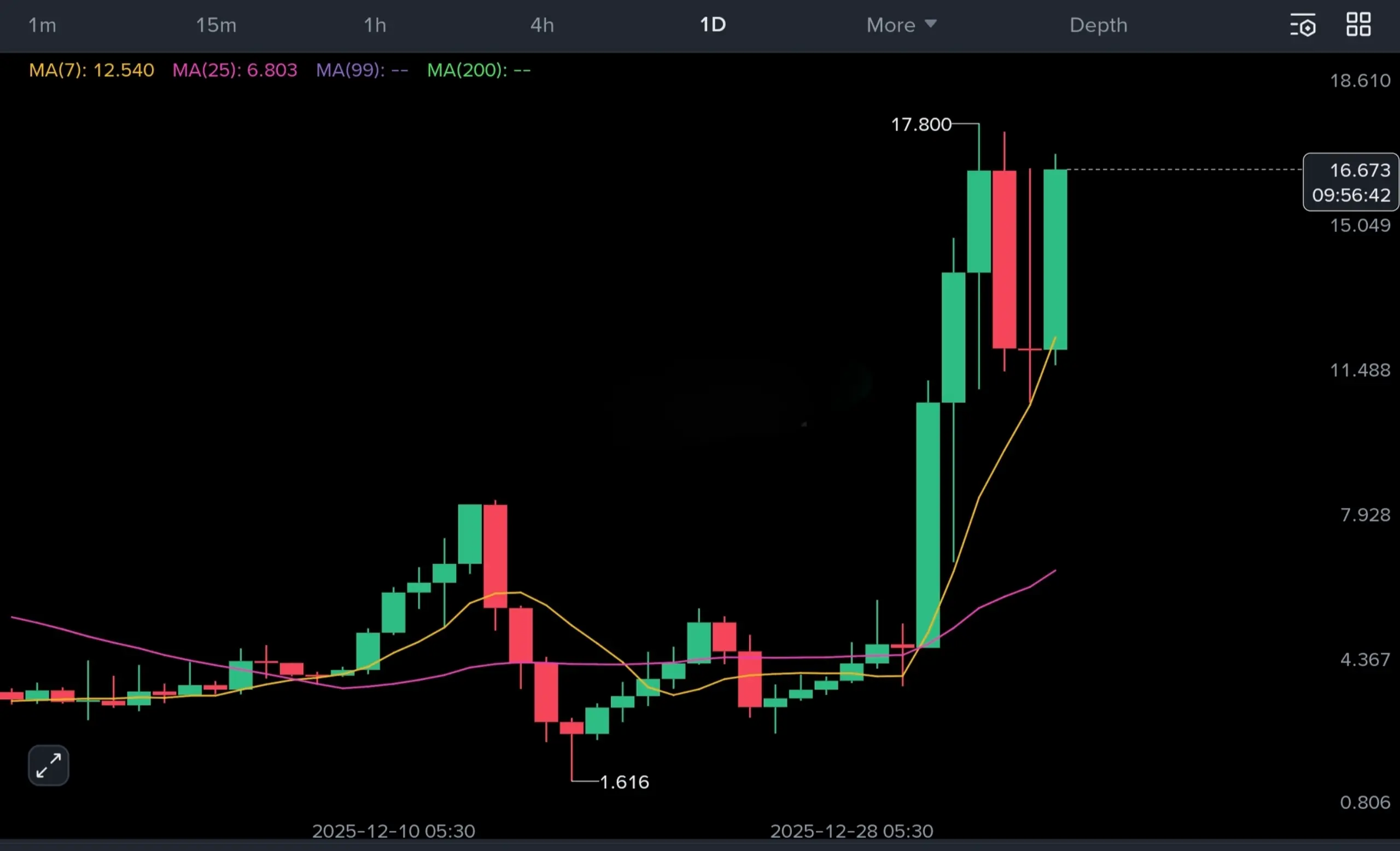
On the higher timeframe, $RIVER spent a long period ranging near $3.9–$4.5.
This zone acted as a long accumulation base.
Key observations:
Price stopped making lower lows
Selling pressure gradually weakened
Time passed without price breaking down
This phase matters because time replaced price as the corrective mechanism.
When price refuses to go lower for long periods, it usually means:
> sellers are exhausted, not aggressive.
That base later became the foundation for the entire move.
Phase 2: Trend Ignition and Expansion ($7.00 → $17.80)
Once price cleared the upper boundary of the base, price expanded rapidly.
The move from roughly $7 to $17.8 happened with:
strong directional candles
minimal overlap
very shallow internal pullbacks
This is a textbook impulse leg.
Impulse legs tell us:
demand is stronger than supply
resistance above is thin
price must reprice quickly
Importantly, this move did not occur after multiple failed attempts.
It happened cleanly — a sign of structural strength, not hype.
Phase 3: First Rejection and Controlled Pullback ($17.80 → $11.60)
At $17.80, price met visible supply.
What followed was not panic — it was controlled retracement.
Price pulled back toward the $11.6–$12.0 zone and stabilized.
This level is critical because:
it sits well above the original base
buyers stepped in before price returned to prior lows
selling pressure slowed as price approached this zone
This behavior confirms a higher-low structure, which is a defining trait of trend continuation.
A real trend fails when price collapses back into the origin zone.
That did not happen here.
Phase 4: Reclaim and Trend Continuation ($12.00 → $16.70)
After stabilizing near $11.6–$12, $RIVER reclaimed higher prices and pushed back toward $16.5–$16.8.
This reclaim is important:
sellers failed to extend downside
buyers regained control faster than expected
price recovered without prolonged consolidation
The market effectively said:
> “Supply above $12 is no longer strong enough.”
As of the latest chart, price is holding around $16.6–$16.7, very close to recent highs.
Holding near highs after a large move is not weakness.
It is evidence of acceptance at higher value.
Current Structure: Where Price Is Sitting Now
Let’s summarize the key zones clearly:
Major resistance: $17.80
Current value area: $16.50–$16.80
Immediate demand zone: $14.80–$15.20
Structural support: $11.60–$12.00
Trend invalidation (structure break): Below $11.00
As long as price remains above $12, the higher-timeframe trend remains intact.
What Are the Realistic Possibilities From Here?
Scenario 1: Continuation Toward Range High (High Probability)
If price continues holding above $15.0–$15.5:
consolidation replaces deep pullbacks
buyers defend dips early
pressure builds toward $17.8 again
A clean acceptance above $17.8 would open a new price-discovery phase.
This is the most natural outcome in trending conditions.
Scenario 2: Sideways Expansion (Neutral but Healthy)
Price may move between $15.0 and $17.8 for some time.
This would:
absorb remaining supply
cool momentum indicators
allow the trend to reset without damage
Sideways movement at elevated levels is not bearish — it’s structural digestion.
Scenario 3: Deeper Pullback (Still Valid Above $12)
A deeper retracement toward $13–$12 is possible.
This becomes concerning only if:
selling becomes impulsive
price loses acceptance above $12
buyers fail to respond
Until then, such a move would still fall under trend correction, not reversal.
When Would This Trend Actually Fail?
The bullish structure breaks only if:
price loses $11.6 decisively
the market re-enters the prior base
demand stops defending higher levels
Trends don’t end because price moved “too much.”
They end when buyers disappear.
That has not happened yet.
Conclusion -
$RIVER’s structure shows:
accumulation at lows
clean impulse expansion
controlled retracement
strong reclaim
acceptance near highs
This is how real trends behave.
Right now, the market is not asking whether the move was big —
it’s asking whether demand still outweighs supply.
Based on price behavior alone, the trend is being tested, not broken.
And in markets, that distinction makes all the difference.
#CryptoMarketWatch
Price doesn’t move randomly.
It moves in phases, and each phase leaves measurable evidence on the chart.
Using the 1D, 4H, and lower-timeframe structure of $RIVER, let’s break down:
how the current trend was formed
where the market absorbed supply
why price is holding near highs
and what outcomes are realistically possible from here
This is not prediction.
This is context + probability.
Phase 1: Base Formation and Demand Shift ($3.90 → $7.00)
On the higher timeframe, $RIVER spent a long period ranging near $3.9–$4.5.
This zone acted as a long accumulation base.
Key observations:
Price stopped making lower lows
Selling pressure gradually weakened
Time passed without price breaking down
This phase matters because time replaced price as the corrective mechanism.
When price refuses to go lower for long periods, it usually means:
> sellers are exhausted, not aggressive.
That base later became the foundation for the entire move.
Phase 2: Trend Ignition and Expansion ($7.00 → $17.80)
Once price cleared the upper boundary of the base, price expanded rapidly.
The move from roughly $7 to $17.8 happened with:
strong directional candles
minimal overlap
very shallow internal pullbacks
This is a textbook impulse leg.
Impulse legs tell us:
demand is stronger than supply
resistance above is thin
price must reprice quickly
Importantly, this move did not occur after multiple failed attempts.
It happened cleanly — a sign of structural strength, not hype.
Phase 3: First Rejection and Controlled Pullback ($17.80 → $11.60)
At $17.80, price met visible supply.
What followed was not panic — it was controlled retracement.
Price pulled back toward the $11.6–$12.0 zone and stabilized.
This level is critical because:
it sits well above the original base
buyers stepped in before price returned to prior lows
selling pressure slowed as price approached this zone
This behavior confirms a higher-low structure, which is a defining trait of trend continuation.
A real trend fails when price collapses back into the origin zone.
That did not happen here.
Phase 4: Reclaim and Trend Continuation ($12.00 → $16.70)
After stabilizing near $11.6–$12, $RIVER reclaimed higher prices and pushed back toward $16.5–$16.8.
This reclaim is important:
sellers failed to extend downside
buyers regained control faster than expected
price recovered without prolonged consolidation
The market effectively said:
> “Supply above $12 is no longer strong enough.”
As of the latest chart, price is holding around $16.6–$16.7, very close to recent highs.
Holding near highs after a large move is not weakness.
It is evidence of acceptance at higher value.
Current Structure: Where Price Is Sitting Now
Let’s summarize the key zones clearly:
Major resistance: $17.80
Current value area: $16.50–$16.80
Immediate demand zone: $14.80–$15.20
Structural support: $11.60–$12.00
Trend invalidation (structure break): Below $11.00
As long as price remains above $12, the higher-timeframe trend remains intact.
What Are the Realistic Possibilities From Here?
Scenario 1: Continuation Toward Range High (High Probability)
If price continues holding above $15.0–$15.5:
consolidation replaces deep pullbacks
buyers defend dips early
pressure builds toward $17.8 again
A clean acceptance above $17.8 would open a new price-discovery phase.
This is the most natural outcome in trending conditions.
Scenario 2: Sideways Expansion (Neutral but Healthy)
Price may move between $15.0 and $17.8 for some time.
This would:
absorb remaining supply
cool momentum indicators
allow the trend to reset without damage
Sideways movement at elevated levels is not bearish — it’s structural digestion.
Scenario 3: Deeper Pullback (Still Valid Above $12)
A deeper retracement toward $13–$12 is possible.
This becomes concerning only if:
selling becomes impulsive
price loses acceptance above $12
buyers fail to respond
Until then, such a move would still fall under trend correction, not reversal.
When Would This Trend Actually Fail?
The bullish structure breaks only if:
price loses $11.6 decisively
the market re-enters the prior base
demand stops defending higher levels
Trends don’t end because price moved “too much.”
They end when buyers disappear.
That has not happened yet.
Conclusion -
$RIVER’s structure shows:
accumulation at lows
clean impulse expansion
controlled retracement
strong reclaim
acceptance near highs
This is how real trends behave.
Right now, the market is not asking whether the move was big —
it’s asking whether demand still outweighs supply.
Based on price behavior alone, the trend is being tested, not broken.
And in markets, that distinction makes all the difference.
#CryptoMarketWatch
 :
: