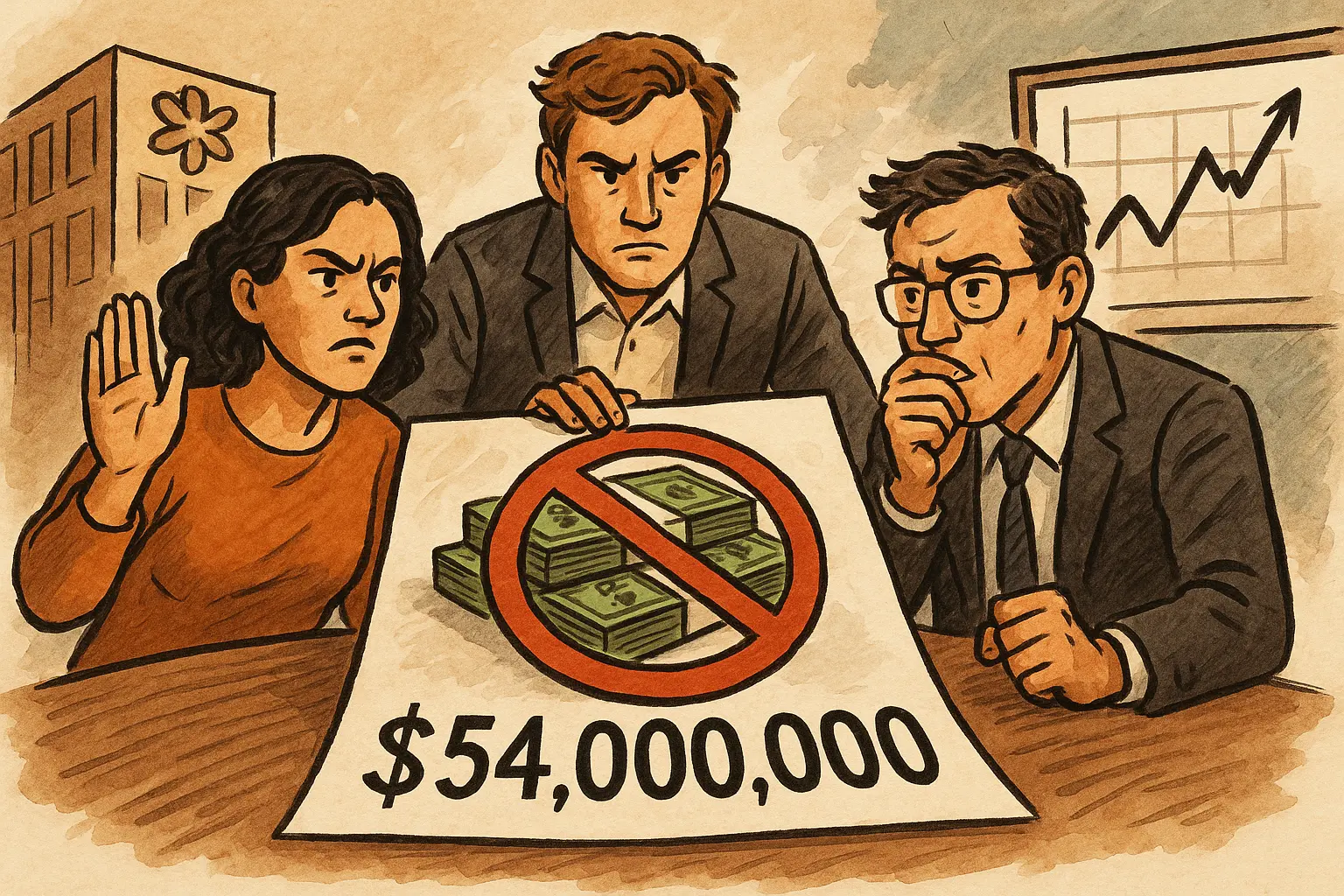
Prediction market platform Kalshi announced that it would not pay users the expected approximately $54 million compensation for the outcome of Iran’s Supreme Leader Khamenei’s death, citing that the platform’s “out of power” contract definition does not cover assassination scenarios. The incident also triggered insider trading suspicions against competitor Polymarket, with U.S. senators immediately indicating they would push legislation to ban government action-related prediction market contracts.
Kalshi Settlement Dispute: “Out of Power” Definition Sparks Contract Dispute
After the U.S. and Israel launched a joint airstrike on Tehran, Kalshi actively promoted event contracts asking whether Khamenei was “out of power,” and publicly displayed on social media that the probability of his removal had risen to 68%. Following confirmation of Khamenei’s death, some users’ systems showed their bets as successful, but the platform immediately announced that settlement would be based on the last traded price before Khamenei’s death was confirmed, rather than paying out based on the final result.
Kalshi CEO Tarek Mansour explained, “‘Out of power’ in the contract includes resignation or peaceful transfer of power, but assassination is not within the scope of the definition.” The platform offered to compensate for trading losses during the clarification period but refused to pay the full winnings.
User expected total payout: approximately $54 million (based on the outcome of Khamenei’s death)
Platform actual plan: refund the principal of bets, plus handling fees and compensation for losses during the clarification period
Typical user loss: One user invested a total of $3,460, initially expecting to win about $63,000, but ultimately received no payout
Amanda Fischer, former chief of staff at the U.S. SEC and current policy director at Better Markets, pointed out that many participants actually viewed such contracts as “death market” trades. She directly questioned, “An 86-year-old supreme leader of a theocratic state—how else could he lose power besides death?” She believes this incident exposes structural definitional loopholes in the prediction market industry.
Insider Trading Allegations Surface: Political-Related Accounts Suspected of Early Knowledge of Military Action
The controversy surrounding Kalshi has not yet subsided, and competitor Polymarket also faces similar accusations. Bubblemaps indicated that six suspected related accounts profited about $1.2 million by betting on the U.S. strike against Iran on February 28, with the betting dates closely aligned with the launch of “Operation Epic Fury.”
Further concerns about political connections deepen—former U.S. President Donald Trump Jr., the son of Donald Trump, joined Polymarket’s advisory board last August. In January, a similar incident occurred: an anonymous Polymarket trader accurately predicted the timing of the U.S. military’s capture of Venezuelan President Maduro, winning about $400,000 in a short period, raising widespread questions about the platform’s trading compliance framework.
Regulatory Pressure Mounts: U.S. Plans Legislation to Restrict Government Action Prediction Markets
U.S. Connecticut Democratic Senator Chris Murphy publicly criticized these prediction markets as “dystopian,” claiming they “package good and evil, life and death, and war into financial products,” distorting public judgment of right and wrong. He stated he is drafting legislation to prohibit prediction contracts related to government actions and war, arguing that such trades could undermine public decision-making processes and create incentives for insider trading.
Murphy directly commented on the Polymarket insider trading suspicion: “It’s crazy that this is even legal,” and said he will push for legislation to prevent such behavior as soon as possible.
Frequently Asked Questions
Q: Why did Kalshi refuse to pay the $54 million payout?
Kalshi cited platform rules, asserting that their contracts do not settle based on death. The “out of power” definition includes resignation or peaceful transfer of power but excludes assassination. The platform offered to compensate losses during the clarification period but refused to pay the full winnings based on Khamenei’s death outcome.
Q: Why is insider trading in prediction markets difficult to regulate?
Prediction markets operate through event contracts, and if traders gain non-public information about government actions or military strikes in advance, they can place highly accurate bets for profit. Existing financial regulatory frameworks lack clear definitions and jurisdiction over such behaviors, and platforms themselves lack standard mechanisms to detect abnormal trading activities.
Q: What is the status of U.S. legislation regulating prediction markets?
Senator Chris Murphy has explicitly stated he is drafting legislation to restrict government action-related prediction contracts. Details of the draft are not yet public, and the legislative timetable is influenced by political factors. However, the controversies involving Kalshi and Polymarket have significantly accelerated legislative discussions.
Disclaimer: The information on this page may come from third parties and does not represent the views or opinions of Gate. The content displayed on this page is for reference only and does not constitute any financial, investment, or legal advice. Gate does not guarantee the accuracy or completeness of the information and shall not be liable for any losses arising from the use of this information. Virtual asset investments carry high risks and are subject to significant price volatility. You may lose all of your invested principal. Please fully understand the relevant risks and make prudent decisions based on your own financial situation and risk tolerance. For details, please refer to
Disclaimer.
Related Articles
Court ruling: sports betting contract is a derivative! The U.S. CFTC blocks local law enforcement, seeking regulatory authority over prediction markets
The U.S. federal government is working jointly with the CFTC and the Department of Justice to try to shift regulatory authority over Kalshi prediction markets from local governments to the federal level, arguing that sports event contracts are financial derivatives. If the court backs this position, it would change the legal status of prediction markets and standardize regulation nationwide, reducing the impact of local wagering laws.
CryptoCity1h ago
Sports-betting event contracts are derivatives! The U.S. CFTC blocks local law enforcement and seeks regulatory authority over prediction markets
The U.S. federal government is working with the CFTC and the Department of Justice to try to transfer regulatory authority over Kalshi prediction markets from local governments to the federal level, arguing that sports event contracts are financial derivatives. If the court supports this position, it will change the legal status of prediction markets and standardize regulation nationwide, reducing the impact of state-level gaming laws.
CryptoCity4h ago
A court rules that sports betting contract agreements are derivatives! The US CFTC blocks local law enforcement and fights for regulatory control of prediction markets.
The U.S. federal government is working jointly with the CFTC and the Department of Justice to try to shift regulatory authority over Kalshi prediction markets from local governments to the federal government, arguing that sports betting contracts are financial derivatives. If the court supports this position, it will change the legal status of prediction markets and unify regulation nationwide, reducing the impact of local gambling laws.
CryptoCity7h ago
Claude Code automation research wins the hackathon championship! Winner: I didn’t even know how we won
At the Autoresearch Hackathon hosted by Paradigm, Ryan Li used AI to complete the problem-solving process and ultimately won the championship. He used multiple AI agents to automate research, generated more than 1,000 strategies, and successfully created an approximately 900-line Python market-making algorithm, demonstrating AI’s advantages in problem-solving. The competition emphasized AI’s exploration and decision-making capabilities, showing that it can serve as a core execution unit.
ChainNewsAbmedia10h ago
Holding sports betting contracts as derivatives! The U.S. CFTC blocks local enforcement and seeks regulatory control over prediction markets
The U.S. federal government is working with the CFTC and the Department of Justice to try to shift regulatory authority over Kalshi prediction markets from state and local governments to the federal government, arguing that sports betting contracts are financial derivatives. If the court supports this position, it would change the legal status of prediction markets and standardize regulation nationwide, reducing the impact of state and local gambling laws.
CryptoCity10h ago
Polymarket Investigation Demanded by Congress After 50 New Accounts Bet on Iran Ceasefire Before Trump Announced It
Congressional scrutiny arises over Polymarket after over 50 new accounts placed bets on a US-Iran ceasefire just before Trump's announcement. Lawmakers are demanding a CFTC investigation, highlighting concerns about insider trading and the platform's regulatory status.
Cryptonews11h ago


