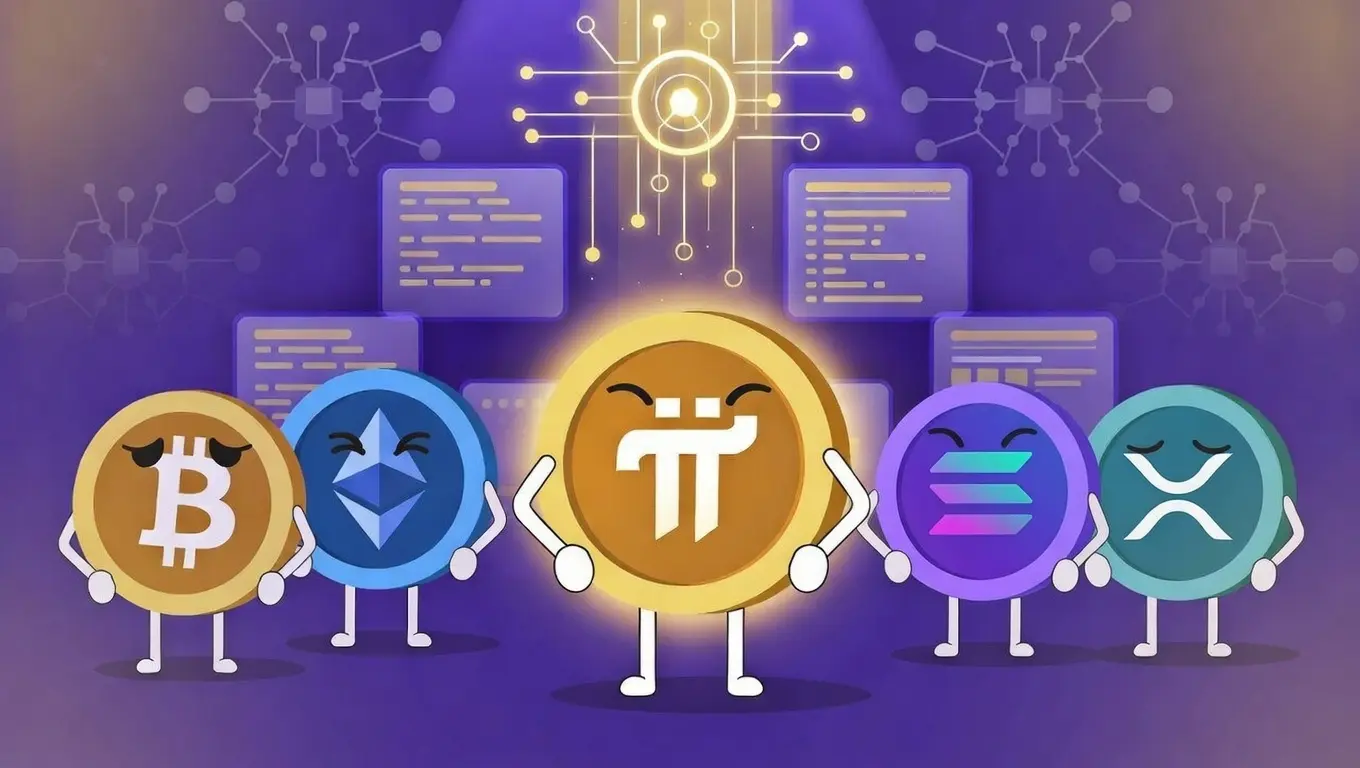
 Pi Coin (PI) has declined 17% year-to-date through March 4, 2026, outperforming major cryptocurrencies including Bitcoin (down 23%), Ethereum (down 35%), XRP (down 27%), and Solana (down 33%) amid a series of network-specific catalysts.
The relative strength follows the completion of the mandatory V19.9 protocol upgrade, anticipation of a potential Kraken exchange listing, and the scheduled March 12 launch of a native decentralized exchange. PI currently trades near $0.17, well below its post-mainnet peak near $2.10, with analysts monitoring whether upcoming developments can drive sustained utility and demand.
Catalysts Driving Pi Network’s Relative Strength
Pi Network has demonstrated resilience compared to broader crypto market weakness, supported by several key developments. The project marked its first mainnet anniversary in February 2026, with developers highlighting milestone achievements including millions of users completing Know Your Customer verification and migrating to mainnet.
Investor sentiment received a boost following Kraken’s addition of Pi Network to its listing roadmap page, increasing expectations that trading on the major exchange could occur in 2026. A Kraken listing would provide significantly expanded access to Pi for global traders and potentially improve price discovery.
The network successfully completed the mandatory upgrade to protocol version 19.9 by the March 1 deadline, with node operators required to update or face disconnection. The transition succeeded, resulting in over 421,000 active nodes. This upgrade aligns Pi Coin with the Stellar Consensus Protocol, enhancing scalability for higher transaction volumes and supporting future smart contract capabilities. It serves as a foundational step toward Protocol v23, anticipated in Q2 2026.
Additionally, anticipation of validator rewards distribution, expected later this month, has contributed to positive sentiment. The developers are also working on native token infrastructure, including automated market maker and decentralized exchange tools.
March 12 DEX Launch: Enabling Native On-Chain Trading
The most significant near-term development is the Pi Network DEX launch scheduled for March 12, 2026. This decentralized exchange will enable peer-to-peer trading directly on the Pi blockchain, reducing dependence on centralized platforms such as Gate. The DEX introduces liquidity pools to facilitate trades without intermediaries.
With over 35 million Pioneers and more than 17.7 million KYC-verified users, the DEX could foster native on-chain activity and reduce selling pressure from users forced to move tokens to external exchanges. The PiRC1 framework complements this by requiring ecosystem projects to demonstrate functional applications before token issuance, with proceeds directed to permanent liquidity pools.
For Pi Coin analysis, the DEX represents a potential shift toward genuine utility beyond speculative trading. Successful execution could drive organic trading volume and demand for PI. However, outcomes depend on adoption levels, particularly in the initial days and weeks post-launch. Low participation or thin liquidity might limit immediate effects.
Risks and Challenges Facing Pi Network
Despite recent outperformance, Pi Network faces significant structural risks. The token remains highly inflationary with no burning mechanism, and millions of tokens are unlocked daily. Data indicates that over 1.4 billion tokens will be unlocked in the next 12 months, potentially creating sustained selling pressure.
Centralization concerns persist, with the foundation holding over 90 billion tokens and making all major decisions without community input. This governance structure diverges from the decentralized ethos of most major cryptocurrency networks.
Some analysts characterize the recent price strength as a potential dead-cat bounce, similar to May 2025 when the team teased a major announcement that turned out to be a $100 million ecosystem fund launch. That announcement, while substantive, disappointed investors expecting an exchange listing and pushed the token lower.
Pi Network’s ecosystem activity remains limited. A year after mainnet launch, there are no major applications operating on the network, leading some observers to characterize it as a “ghost chain” despite its large user base. The upcoming DEX and associated developer tools will test whether the network can translate its substantial community into meaningful on-chain economic activity.
FAQ: Pi Network Developments and Price Outlook
Why has Pi Coin outperformed major cryptocurrencies in 2026?
Pi Coin’s 17% year-to-date decline compares favorably to Bitcoin’s 23% drop and larger losses for Ethereum, XRP, and Solana. The relative strength reflects network-specific catalysts including completion of the mandatory V19.9 protocol upgrade, anticipation of a potential Kraken exchange listing, and the scheduled March 12 launch of a native decentralized exchange.
What is the significance of the March 12 DEX launch for Pi Network?
The DEX will enable peer-to-peer trading directly on the Pi blockchain, reducing dependence on centralized exchanges like Gate. With over 17.7 million KYC-verified users, the DEX could foster native on-chain activity and create genuine utility for PI beyond speculative trading. Successful execution could drive organic demand, though outcomes depend on post-launch adoption levels.
What risks does Pi Network face despite recent outperformance?
Pi Network faces significant structural risks including high inflation with no burning mechanism (over 1.4 billion tokens unlocking in 12 months), centralization with the foundation holding over 90 billion tokens and making all decisions, and limited ecosystem activity with no major applications operating on the network a year after mainnet launch. These factors could constrain long-term price appreciation.
Disclaimer: The information on this page may come from third parties and does not represent the views or opinions of Gate. The content displayed on this page is for reference only and does not constitute any financial, investment, or legal advice. Gate does not guarantee the accuracy or completeness of the information and shall not be liable for any losses arising from the use of this information. Virtual asset investments carry high risks and are subject to significant price volatility. You may lose all of your invested principal. Please fully understand the relevant risks and make prudent decisions based on your own financial situation and risk tolerance. For details, please refer to
Disclaimer.
Related Articles
NAT Officially Launches on SpiderPool, Enabling BTC Dual-Mining in Same Block
NAT has launched on SpiderPool, enabling dual-mining with Bitcoin without extra setup. It generates 386 million NAT per block every 10 minutes, valued at $38, with a total market cap of $38 million. The code is open-source.
GateNews20m ago
BlackRock Withdraws 3,899 BTC Worth $289.88M from Major CEX
BlackRock withdrew 3,899 BTC worth $289.88 million and 839 ETH valued at $1.95 million from a major exchange, indicating a significant move of institutional assets off the platform.
GateNews2h ago
Beijing Professor Jiang Xueqin Claims Bitcoin May Be US Intelligence Project, Community Disputes Theory
Educator Jiang Xueqin claimed Bitcoin might be linked to U.S. intelligence agencies due to its anonymous creator and technical complexity. Critics countered that Bitcoin's decentralized and open-source nature prevents centralized control.
GateNews3h ago
Charles Schwab Launches Bitcoin and Ethereum Trading
Charles Schwab launched Bitcoin and Ethereum trading on its Schwab Crypto platform, starting with an employee pilot and expanding to a client waitlist by Q2 2026. The service targets 46 million brokerage accounts at a competitive 0.75% fee, positioning Schwab against existing crypto platforms.
CryptoFrontier4h ago
Justin Sun Announces TRON’s PQ Transition, Criticizes Bitcoin And Ethereum
Justin Sun has launched TRON’s PQ upgrade plan, positioning it as the first major blockchain to adopt quantum-resistant technology, while criticizing Bitcoin and Ethereum for their slower progress in addressing quantum threats.
Blockzeit4h ago
Bitcoin Hovers Near $75K as Whales Accumulate 270K BTC Over 30 Days, Largest Since 2013
Bitcoin nears $75,000, driven by significant whale accumulation of 270,000 BTC and low exchange reserves. Despite fluctuations and negative funding rates, it rebounded after geopolitical news, with futures inflows increasing since March.
GateNews5h ago


