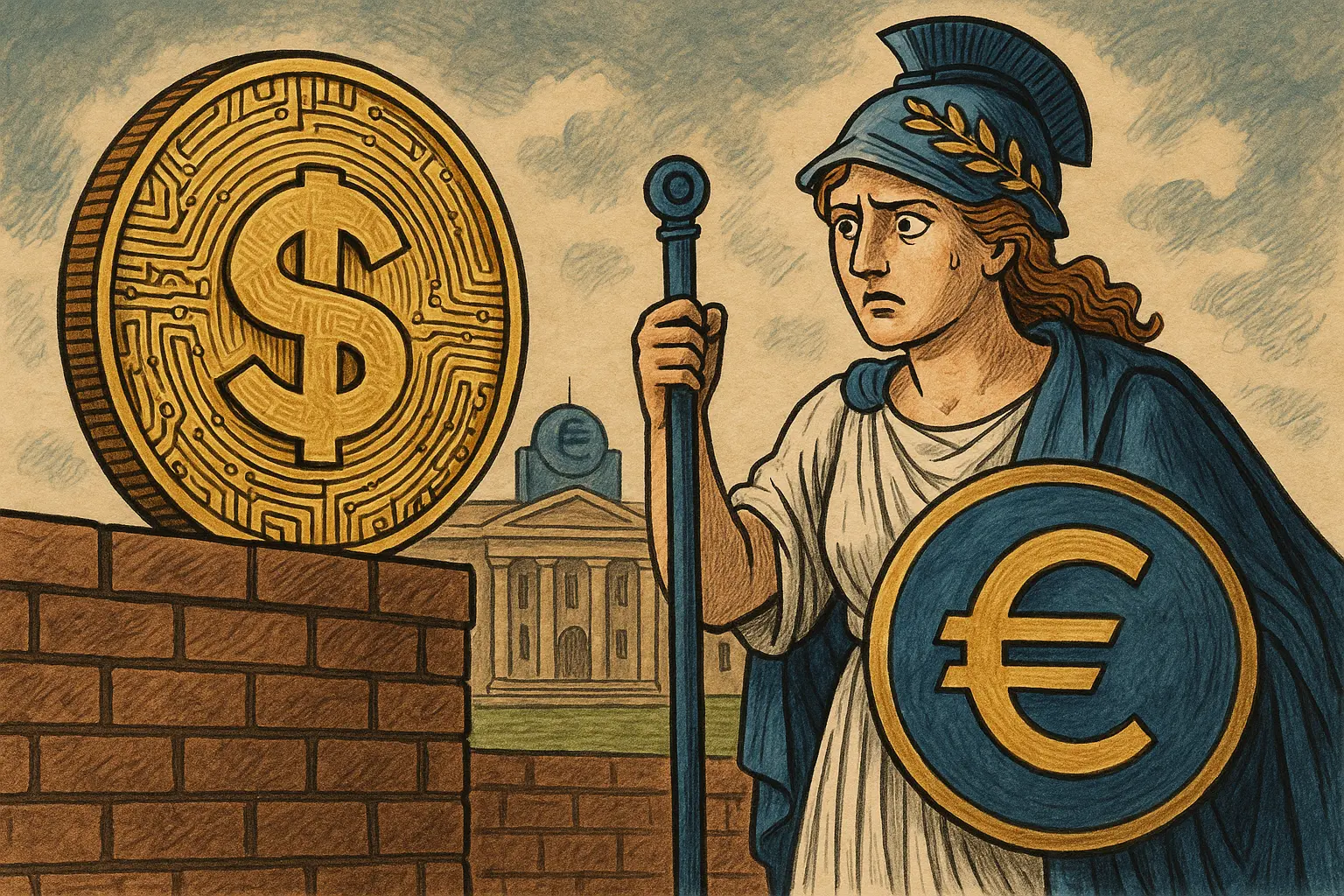
Researchers at the European Central Bank (ECB) have published a working paper warning that widespread adoption of stablecoins could pose significant risks to the euro area banking system and the ECB’s monetary sovereignty, especially in a context where foreign currency-denominated instruments such as the US dollar dominate. This could introduce external currency conditions into the eurozone and increase uncertainty in the transmission of monetary policy.
Core Risk Identification Framework of the Working Paper
This jointly authored working paper by multiple ECB researchers identifies three main transmission channels through which the widespread adoption of stablecoins could impact the euro area’s monetary system.
First, rapid expansion could trigger large-scale reallocation of funds from retail bank deposits into digital assets, weakening the stability of banks’ funding sources; second, impaired banking intermediation could reduce the effectiveness of ECB policy rate transmission to actual lending volumes; third, if the stablecoin market is dominated by non-euro-denominated instruments, the impact could be significantly amplified—fluctuations in demand for foreign currency-denominated stablecoins may directly transmit external currency and financial shocks into the euro area.
The document states: “Demand fluctuations for foreign currency-pegged stablecoins could transmit external currency and financial shocks directly into the euro area, effectively introducing external liquidity conditions that may be orthogonal to domestic policy stances.”
Policy Context: Trump’s Crypto Policies Trigger European Regulatory Vigilance
The release of this ECB working paper coincides with the Trump administration actively promoting mainstream adoption of cryptocurrencies, raising broad concerns about the potential expansion of US dollar-backed stablecoins in European markets. ECB Executive Board member Piero Cipollone previously stated in January that such tools could “threaten financial stability”; meanwhile, German Bundesbank President Joachim Nagel has expressed a more positive view, emphasizing the potential benefits of euro-pegged stablecoins in payment scenarios.
Currently, major European banks such as Citigroup, ING, UniCredit, and DekaBank are collaborating on developing regulated euro stablecoins, seen as an active European response to counter the expansion of dollar-denominated stablecoins.
Key Risk Points Identified in the ECB Working Paper
Deposit Reallocation: Rapid expansion may lead to large-scale transfer of retail deposits into digital assets, weakening banks’ funding base.
Impaired Intermediation: Unstable bank funding sources reduce credit provisioning capacity, impacting real economy financing.
Reduced Policy Transmission Effectiveness: ECB rate adjustments face obstacles in transmission to the loan market, weakening monetary policy effectiveness.
Amplification by Foreign Currency Stablecoins: When dollar and other foreign currency stablecoins dominate the market, external currency shocks can enter the euro area directly without ECB control.
Wholesale Financing Risks: Banks may increase reliance on foreign currency wholesale funding, further diminishing sensitivity to ECB policy stance.
Frequently Asked Questions
What exactly does the ECB mean by the “monetary sovereignty” risk?
The ECB’s monetary sovereignty refers to its ability to effectively influence borrowing costs and credit flows in the euro area through policy rate adjustments. When large funds shift from ECB-regulated bank deposits to foreign currency-denominated stablecoins, the ECB’s policy tools have significantly less influence over these funds, weakening the transmission of interest rate decisions.
Why are US dollar stablecoins more threatening to European monetary policy than euro stablecoins?
Euro stablecoins’ reserves and operations are still under ECB regulation, maintaining relatively complete monetary policy transmission channels. In contrast, the liquidity and value of US dollar-denominated stablecoins are determined by the Federal Reserve’s policies. Once widely circulated in the euro area, they effectively introduce US monetary conditions directly into European markets, bypassing ECB tools and creating a direct channel for external currency shocks.
Can the joint development of euro stablecoins by European banks effectively address ECB’s risk concerns?
The euro stablecoin plans led by institutions like Citigroup, ING, UniCredit, and DekaBank align somewhat with the ECB’s stance—German Bundesbank President Nagel has expressed a positive attitude toward euro stablecoins in payment applications. If euro stablecoins can compete with dollar stablecoins in scale and usability, they may reduce users’ motivation to switch to foreign currency tools. However, specific regulatory frameworks and launch timelines remain unclear.
Disclaimer: The information on this page may come from third parties and does not represent the views or opinions of Gate. The content displayed on this page is for reference only and does not constitute any financial, investment, or legal advice. Gate does not guarantee the accuracy or completeness of the information and shall not be liable for any losses arising from the use of this information. Virtual asset investments carry high risks and are subject to significant price volatility. You may lose all of your invested principal. Please fully understand the relevant risks and make prudent decisions based on your own financial situation and risk tolerance. For details, please refer to
Disclaimer.
Related Articles
Reuters Survey: 79% of Economists Expect the Federal Reserve to Cut Rates 1-2 Times This Year
Gate News reports that on March 26, Reuters surveyed 82 economists, and the results showed that 65 of them (about 79%) believe the Federal Reserve will cut interest rates once or twice this year.
GateNews14m ago
The U.S. Department of Labor's proposed new regulation has been approved by the White House, which will determine whether retirement funds can invest in cryptocurrencies.
The proposed rule by the U.S. Department of Labor has been approved by the White House, potentially allowing cryptocurrencies and private equity to be included in 401(k) plans, aiming to change investment options in the $10 trillion market. The proposal originates from an executive order by Trump, emphasizing the facilitation of alternative investments.
BlockBeatNews1h ago
The U.S. is moving closer to opening crypto to the $10 trillion 401(k) retirement fund.
A proposed regulation by the U.S. Labor Department to change investment options in the $10 trillion 401(k) market has passed White House review. It aims to allow cryptocurrencies and private equity in portfolios, following Trump's directive. This comes as retirement savings hit record highs.
TapChiBitcoin1h ago
The OECD expects the Federal Reserve to keep interest rates unchanged in 2026 and 2027.
Gate News reports that on March 26, the Organization for Economic Co-operation and Development (OECD) released its monetary policy forecast, expecting the Federal Reserve to keep interest rates unchanged in 2026 and 2027.
GateNews1h ago
ETH drops 1.56% in 15 minutes: Whales' on-chain fund flows and options expiration jointly trigger selling pressure
From 09:30 to 09:45 (UTC) on March 26, 2026, ETH price dropped by -1.56% within 15 minutes, with a price range of 2075.21 to 2116.99 USDT and a volatility of 1.97%. The market experienced clear fluctuations, on-chain trading volume surged, and market attention quickly intensified. Short-term capital accelerated flow, and derivatives market volatility increased, indicating the characteristics of a trend reversal under multiple structural pressures.
The main driver of this movement was whales collateralizing ETH through DeFi protocols to release liquidity, then transferring large amounts of funds into a major exchange, leading to
GateNews2h ago
Gold crashes 21%, hitting a 106-year record. After Bitcoin stays steady at $70,000, what is its future trend?
In March 2026, gold experienced its largest decline in nearly a century, dropping from $5,193 to $4,098, reflecting a reassessment of its safe-haven properties by investors. Meanwhile, Bitcoin performed relatively stably, becoming a new store of value for some investors. The correlation between gold and Bitcoin has fallen to -0.31, indicating diverging trends. Market opinions on gold's outlook are divided, and future movements will be influenced by geopolitical and monetary policy developments.
GateNews4h ago


