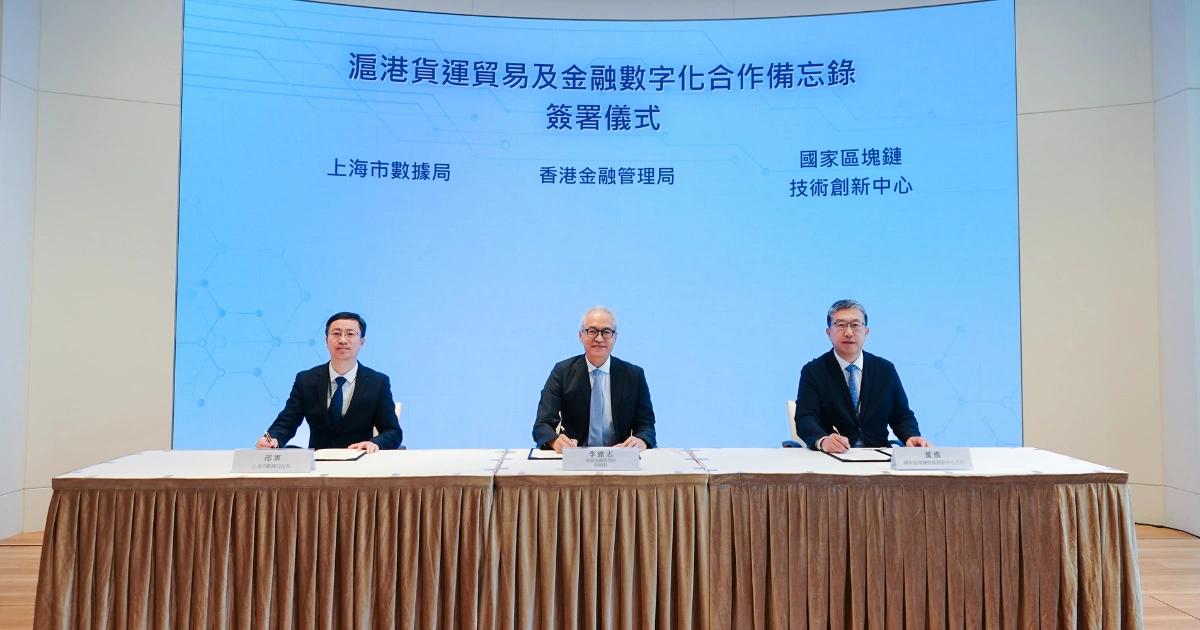
HKMA and Shanghai Sign MoU to Promote Project Ensemble, Integrating a $1.5 Trillion Trade Financing Market, and Simultaneously Improving Stablecoin and Tax Frameworks.
Deep Financial Technology Collaboration Between Shanghai and Hong Kong, Project Ensemble Leads Cross-Border Digital Trade Transformation
The Hong Kong Monetary Authority (HKMA) announced a major development this Monday (3/2), officially signing a Memorandum of Understanding (MoU) with Shanghai Data Bureau (SDB) and the National Blockchain Technology Innovation Center (NTICBC). This cooperation deepens collaboration between Hong Kong and Shanghai in the digitalization of goods trade and financial industries, with both parties jointly researching the use of blockchain technology to build a robust “cross-border platform.” The plan incorporates HKMA’s Project Ensemble framework launched in 2024, focusing on tokenization market infrastructure and creating new digital pathways for financial services.
According to the agreement, the three organizations will conduct joint research on key industries such as trade data interconnection, electronic bills of lading (eBL), and financial applications, attempting to solve longstanding pain points in the trade industry through technological means.
This marks a milestone in the digital innovation partnership between Hong Kong and Shanghai. Both sides plan to develop digital infrastructure that connects the two cities.
HKMA Deputy Chief Howard Lee stated that this initiative promotes the integration of China’s trade data with global systems, leveraging Hong Kong’s unique advantages as an international financial center and “super connector” to drive innovative digital applications.
Integrating CDI and CargoX Infrastructure to Eliminate $1.5 Trillion Trade Finance Frictions
To enhance cross-border financial efficiency, the platform integrates HKMA’s existing blockchain-based financial data infrastructure, the Commercial Data Interchange (CDI). Since its launch in 2022, CDI has been dedicated to enabling financial institutions to access authorized corporate data to streamline loan processes.
This Shanghai-Hong Kong collaboration further extends the system’s application scenarios by introducing the development成果 of Project CargoX. CargoX, built on CDI, is an initiative specifically designed to strengthen trade data processing capabilities for financing and related services, ensuring data authenticity and immutability through blockchain technology.
Currently, the global annual cargo financing market reaches up to $1.5 trillion, but cumbersome paper processes, fragmented data structures, and manual verification often cause serious financing delays and even fraud risks. By adopting electronic bills of lading and blockchain technology, banks and financial institutions can significantly reduce processing times and operational costs.
Shanghai Data Bureau Director Shao Jun said, “This cooperation is an important step toward realizing data-driven and innovation-driven development. Both sides are committed to building a secure, efficient, and open digital infrastructure that transforms dispersed freight data into credit references with financial value.”
Hong Kong’s Dual-Track Digital Asset Policy: Tax Exemptions and Stablecoin Regulation
While promoting trade digitalization, Hong Kong is also accelerating along another policy track to enhance its competitiveness as a digital asset hub. Financial Secretary Paul Chan proposed a key bill at the Legislative Council’s Financial Services Committee on Monday, aiming to include digital assets within the qualified investments for investment funds and family offices, with corresponding tax exemptions. If approved, profits from digital assets held under these structures will be tax-exempt in the future. This move aims to attract more overseas capital to Hong Kong and strengthen its global appeal in the Web3 industry.
Additionally, Hong Kong’s digital asset regulatory framework is maturing. HKMA expects to approve the first stablecoin issuers under the new “Stablecoin Ordinance.” Regulations require authorized companies to issue stablecoins backed by Hong Kong dollars, with strict safeguards including 100% reserve backing, customer funds held in segregated trust accounts, and compliance with AML regulations. Issuers must also have at least HKD 25 million in capital and establish physical offices in Hong Kong. The Securities and Futures Commission (SFC) has provided clear guidelines for tokenized real-world assets (RWA) since 2023, laying a regulatory foundation for the market’s full development by 2026.
Looking Ahead to 2026: Blockchain Shifts from Pilot to Core of the Real Economy
With the maturation of technology and regulation, blockchain experienced a pivotal shift in 2025 from a market hype to a foundation with real income and fundamentals. Industry experts predict 2026 will be the year when the Machine Economy emerges. Under this trend, machinery, automation agents, and robots will begin trading and collaborating on the chain. Hong Kong already has robots in production lines earning rewards recorded on the blockchain, and this integration of AI and blockchain is gradually transforming global supply chains and governance models.
Hong Kong’s connectivity with Shanghai’s trade data aims to transform blockchain from a mere financial experiment into a core cross-border infrastructure. This strategy extends the influence of digital assets from sovereign bond tokenization and virtual currencies into the most labor-intensive physical economy sectors like cargo financing. It will deepen Hong Kong’s integration into China’s supply chain ecosystem and provide international investors and banks with a compliant channel to access Chinese trade data. Supported by policy subsidies, tax optimization, and infrastructure development, Hong Kong is gradually realizing its grand vision as a global digital innovation laboratory.
Disclaimer: The information on this page may come from third parties and does not represent the views or opinions of Gate. The content displayed on this page is for reference only and does not constitute any financial, investment, or legal advice. Gate does not guarantee the accuracy or completeness of the information and shall not be liable for any losses arising from the use of this information. Virtual asset investments carry high risks and are subject to significant price volatility. You may lose all of your invested principal. Please fully understand the relevant risks and make prudent decisions based on your own financial situation and risk tolerance. For details, please refer to
Disclaimer.
Related Articles
Post-quantum threat mitigation! Industry proposes Bitcoin wallet rescue tools, a QSB方案 that requires no soft fork
Bitcoin communities have recently proposed two major defense approaches against the risk of quantum computers breaking them: Lightning Labs’ rescue tool can prove wallet ownership without disclosing the seed; StarkWare’s Quantum-Safe Bitcoin (QSB) enhances transaction security by using hash functions, without changing the core protocol. These technologies help improve Bitcoin’s resilience in facing future risks.
CryptoCity21m ago
Counter Quantum Threat! Industry Proposes a Bitcoin Wallet Rescue Tool—No Need for a Soft Fork QSB Plan
The Bitcoin community, in response to the risks of quantum computer cracking, has recently proposed two major defensive approaches: Lightning Labs’ recovery tool can prove wallet ownership without revealing the seed; StarkWare’s Quantum-Secure Bitcoin (QSB) enhances transaction security by using hash functions without changing the core protocol. These technologies help improve Bitcoin’s resilience in dealing with future risks.
CryptoCity3h ago
Countering Quantum Threats! Industry proposes a Bitcoin wallet recovery tool—no soft fork QSB solution
The Bitcoin community has recently proposed two major defense measures against the risk of quantum computer attacks: Lightning Labs’ rescue tools can prove wallet ownership without exposing the seed; StarkWare’s Quantum-Safe Bitcoin (QSB) strengthens transaction security by using hash functions, without changing the core protocol. These technologies can help improve Bitcoin’s resilience in the face of future risks.
CryptoCity6h ago
Tether Launches Open-Source Local AI SDK
Paolo Ardoino, CEO of Tether, criticizes centralized AI and champions decentralization through the QVAC SDK, allowing local AI model deployment. This shift enhances data privacy and user control, positioning Tether at the convergence of blockchain and AI, challenging dominant tech firms.
Coinfomania7h ago
Post-Quantum Threat Mitigation! Industry Proposes Bitcoin Wallet Rescue Tools, No Need for a Soft Fork QSB Plan
Bitcoin communities have recently proposed two major defensive measures to address the risk of quantum computer attacks: Lightning Labs’ rescue tools can prove wallet ownership without exposing the seed; StarkWare’s Quantum-Safe Bitcoin (QSB) strengthens transaction security by using hash functions without changing the core protocol. These technologies help improve Bitcoin’s resilience in the face of future risks.
CryptoCity9h ago
Grayscale Says Aave Could Become Household Name
Grayscale says Aave could become mainstream, highlighting its decentralized lending model without intermediaries.
Bank of Canada finds Aave has lower margins due to reduced costs but flags risks from leveraged trading.
Governance issues and liquidations persist, though upgrades and ETF
CryptoFrontNews10h ago


