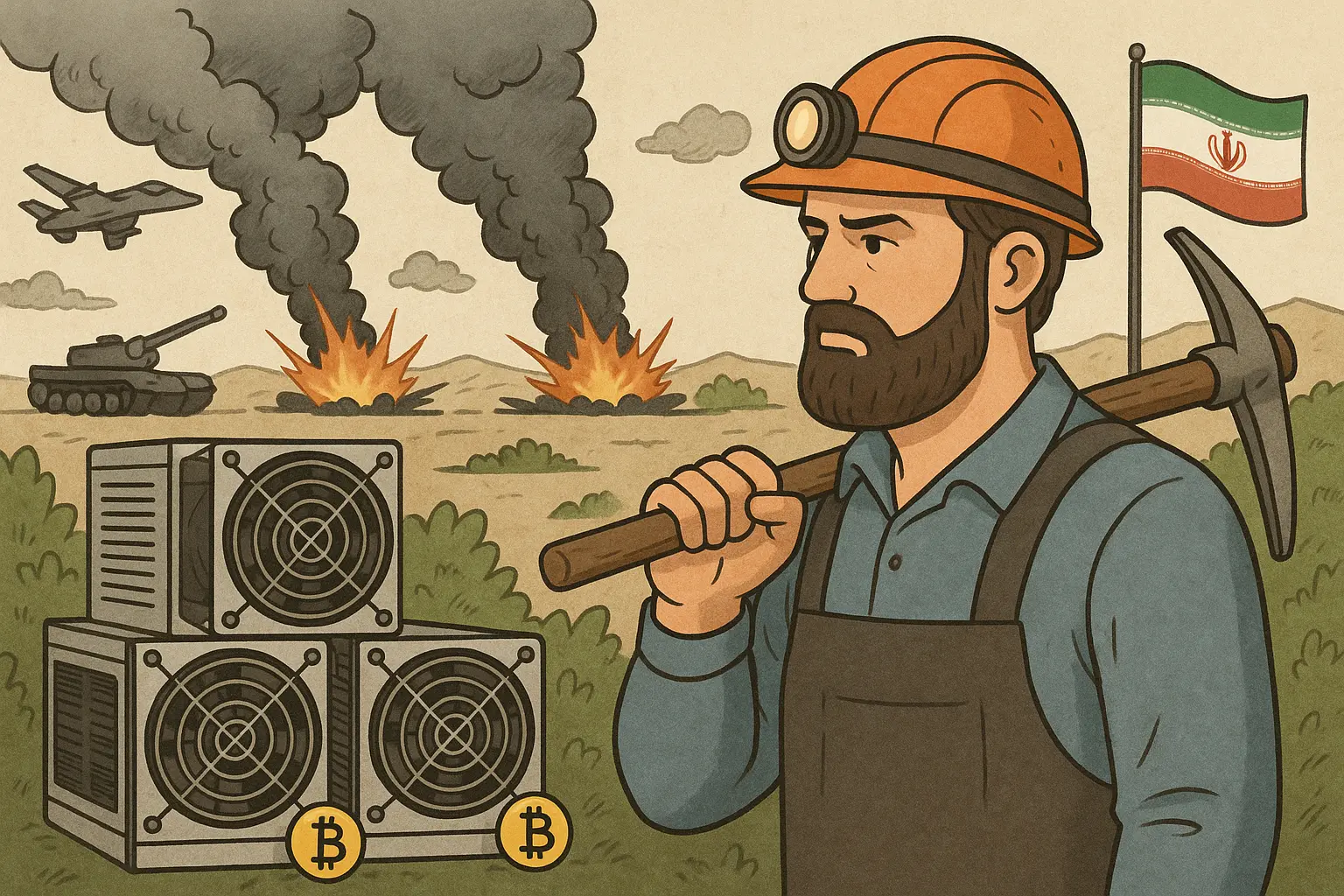
Industry analysts and mining operators agree that the escalation of military actions by the US and Israel against Iran is unlikely to cause significant disruptions to the global Bitcoin mining network, countering rumors circulating on social media platforms. Wolfie Zhao, Research Director at TheMinerMag, stated, “I believe this will not have any major impact on Bitcoin.” He denied claims that power outages triggered by the Iran conflict would materially affect the Bitcoin network.
Social Media Rumors vs Reality: Iran’s Hashrate Share Is Seriously Exaggerated
After the US and Israel launched the first strikes against Iran, panic spread rapidly on X platform. One widely circulated tweet warned: “If the Iranian regime collapses, ‘billions of dollars worth of Bitcoin will be sold off or lost forever,’ ‘5% of the global hashrate will disappear overnight,’ ‘427,000 mining machines will stop operating.’” However, industry data contradict these claims.
Ethan Vera, COO of Luxor Technology, estimates Iran’s actual share of global Bitcoin hashrate is less than 1%, far below the 5% figure circulated in rumors. “If there is a disruption, block times will not be significantly affected, and there will be no impact on the security of the Bitcoin network,” he pointed out.
Key Data on Iran Conflict and Bitcoin Mining Hashrate:
- Iran’s Global Hashrate Share: Less than 1% (Ethan Vera estimates), industry considers the 5% figure to be seriously exaggerated.
- Bitcoin Hashrate Data: About 986.19 EH/s after the first strikes on Feb 28; peaked at 1.1361 ZH/s on March 1; dropped slightly below 1 ZH/s on Tuesday morning.
- Hashrate Resilience: Even if Iran’s entire hashrate disappears, the impact on Bitcoin block times would be minimal.
- Historical Comparison: China’s comprehensive mining ban in 2021 caused a short-term global hashrate drop of over 50%, but Iran’s hashrate scale is not comparable.
- Mining Structure: Iran’s mining industry has long faced structural challenges such as unstable power supply, high equipment import costs, and complex regulations.
Vulnerability of Iran’s Crypto Ecosystem and Capital Outflows During Crisis
Although Iran legalized cryptocurrency mining in 2019, its development has been hampered long-term by unstable electricity, high import costs, and regulatory complexities. Chainalysis reported in January that Iran’s crypto activities are highly correlated with domestic and international political events, estimating that by 2025, Iran’s broader crypto economy could reach $7.78 billion, with a significant portion linked to state-affiliated entities.
Elliptic, a blockchain analytics firm, reported that within minutes after the US and Israel’s initial strikes, crypto asset outflows from Iranian exchanges surged by 700%, reflecting that ordinary Iranians view crypto assets as a tool to hedge against local currency volatility.
Analysts point out that the market volatility in Bitcoin caused by the war stems from overall risk sentiment shifts and geopolitical uncertainty, rather than supply chain disruptions from Iran’s mining activity interruptions.
Frequently Asked Questions
Why won’t the Iran conflict significantly impact Bitcoin’s hashrate?
Iran’s actual share of global Bitcoin hashrate is estimated to be below 1%, far less than the 5% rumor circulating on social media. Even if Iran’s entire hashrate disappears, it would not materially affect Bitcoin block times or network security, unlike the 2021 Chinese mining ban which caused a short-term global hashrate drop of over 50%.
Why are the rumors about a 5% hashrate collapse on social media wrong?
Iran’s mining industry has long faced structural issues such as unstable power and high equipment import costs, limiting its scale. Industry analyst Ethan Vera estimates Iran’s actual hashrate share to be less than 1%. Even if it vanished completely, the technical impact on the Bitcoin network would be negligible.
What is the real impact of the Iran conflict on the crypto market?
The true market impact comes from changes in risk sentiment and geopolitical uncertainty, not supply chain shocks. The 700% surge in crypto asset outflows from Iranian exchanges within minutes after the strikes indicates local residents are using crypto to hedge against domestic currency risks, rather than signaling a major disruption to global mining operations.
Disclaimer: The information on this page may come from third parties and does not represent the views or opinions of Gate. The content displayed on this page is for reference only and does not constitute any financial, investment, or legal advice. Gate does not guarantee the accuracy or completeness of the information and shall not be liable for any losses arising from the use of this information. Virtual asset investments carry high risks and are subject to significant price volatility. You may lose all of your invested principal. Please fully understand the relevant risks and make prudent decisions based on your own financial situation and risk tolerance. For details, please refer to
Disclaimer.
Related Articles
Pakistan’s government: The format of the U.S.-Iran negotiations is still unclear, and we have already made preparations to coordinate and facilitate a middle-ground resolution
Gate News: On April 11, an authoritative Pakistani government source said that although the United States and Iran had already confirmed that talks would be held on that day, the format of the negotiations is currently still undecided. The source said that the two sides have made a number of arrangements for the talks, including a “face-to-face” format and a “back-to-back” format. Pakistan has been prepared to facilitate the two sides for face-to-face talks, and also to conduct negotiations in a “back-to-back” manner by transmitting information through Pakistan as an intermediary. (Xinhua News Agency)
GateNews1h ago
Iran has announced the composition of the U.S. negotiation delegation, consisting of 71 people, including the speaker and the foreign minister.
Iran announced on April 11 a 71-member delegation for negotiations with the United States. The delegation is led by Speaker of Parliament Kalibaf. Members include Foreign Minister Aragchi and multiple experts. The U.S. delegation has 300 members, covering multiple areas such as security.
GateNews2h ago
Bank of America research report: The global economy’s dependence on oil has fallen to one-third of what it was in the 1970s. Huatai Securities says gold’s safe-haven appeal has stopped working
A U.S. bank research report said that since the 1970s, the global economy’s reliance on oil has declined, and the oil required now is only one-third of that at the time, with economic resilience strengthening. In addition, Haitong Securities’ analysis found that gold did not exhibit safe-haven characteristics; after experiencing a pullback due to geopolitical shocks, it rebounded.
GateNews2h ago
Bitcoin Posts Its Strongest Weekly Gain Since October 2025: CPI Cooldown and US-Iran Ceasefire Provide a Double Boost, Lifting the Price to $73K
Bitcoin’s weekly gain this week reached nearly 7%, marking the strongest single-week performance since October 2025, as the U.S. core CPI data came in below expectations and a ceasefire agreement between Iran and Israel boosted market sentiment. The price briefly broke through $73,000. Market expectations have intensified that the Federal Reserve may start cutting rates sooner, and technical indicators show volatility compression, suggesting that significant price swings may be ahead. In the short term, attention should be paid to the ceasefire negotiations and the Federal Reserve’s policy direction.
ChainNewsAbmedia4h ago
White House official: Trump privately admitted that the Strait of Hormuz will be difficult to fully reopen in the short term
Gate News message, April 11, according to Reuters, a senior U.S. White House official said that skepticism is pervasive inside the White House. The official said that during recent conversations with his advisers, Trump seems to have acknowledged that the Strait of Hormuz is unlikely to fully reopen in the short term. However, at the same time, on Thursday Trump posted on social media that oil supplies will be restored soon, but provided no further details.
GateNews6h ago
Iran's Speaker of Parliament: If the U.S. side is staging a show for negotiations, Iran is already prepared to defend its rights
Gate News message. On April 11, Iranian Islamic Parliament Speaker Qalibaf said in a statement delivered in Islamabad, Pakistan’s capital, at around 1 a.m. local time on the 11th that Iran is sincere about negotiations with the United States, but does not trust the U.S. side. The reason is that the parties’ previous negotiations “have always ended in failure and betrayal.” Qalibaf said that if the U.S. side tries to use this round of talks to put on a show, Iran is prepared to defend its own rights.
GateNews6h ago


