The measures seek to fully integrate crypto exchanges into the established financial system and protect the identity information of the institution’s customers. The Central Bank states that this will promote “transparency, comparability, and predictability of information provided to the market.”
Brazil Issues Resolution Including Crypto Brokerages to Comply With Bank Secrecy Laws
Brazil is moving to integrate crypto exchanges into its financial ecosystem.
The National Monetary Council and the Central Bank of Brazil recently approved Resolution No. 5,280, which brings new compliance rules for virtual asset service providers in the country.
The resolution, which states that virtual asset service providers (VASPs) will be considered financial institutions under the Brazilian Bank Secrecy Act, seeks to establish an equivalent regulatory treatment for all exchanges operating in the local financial system and the mechanisms needed to protect it.
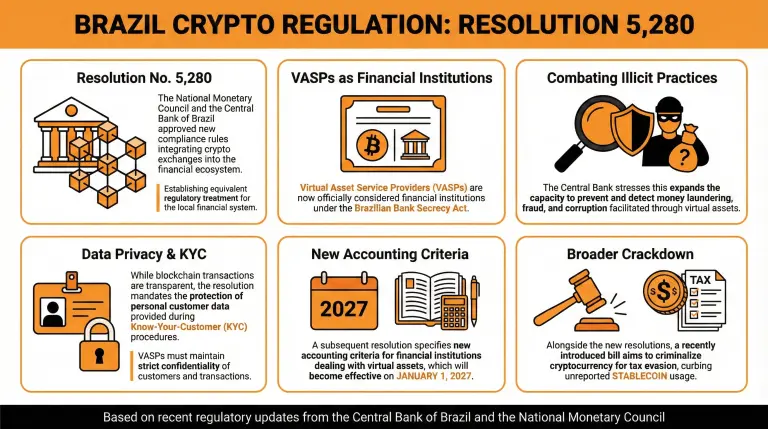
The Central Bank of Brazil stressed that this move “expands the capacity to prevent, detect, and combat illicit practices—such as money laundering, fraud, corruption, and other irregularities—that may be facilitated through the use of virtual assets.”
While blockchain transactions are transparent, given the nature of these structures, experts like Tiago Severo stressed that the identification and personal data of customers, provided when completing Know-Your-Customer (KYC) procedures, is what this resolution seeks to protect.
At the same time, it increases the responsibility of these institutions, which will have to take into account already established provisions regarding the confidentiality of their customers and their transactions.
In a subsequent resolution, the two institutions also approved a new resolution that specifies the accounting criteria that financial institutions dealing with virtual assets must follow.
The central bank states that regulatory clarity will contribute to investor confidence, assigning a clearer role to VASPs about the duties these institutions should fulfill.
The bank secrecy measure is already being applied, while the new accounting rules for financial institutions are set to become effective on January 1, 2027.
Recently, a bill criminalizing cryptocurrency for tax evasion was introduced into Congress, aiming to curb the usage of stablecoins for unreported payments and transactions.
FAQ
- What recent resolution has Brazil approved regarding crypto exchanges?
Brazil approved Resolution No. 5,280, integrating crypto exchanges into its financial ecosystem as virtual asset service providers.
- How does Resolution No. 5,280 affect virtual asset service providers (VASPs)?
VASPs will now be classified as financial institutions under the Brazilian Bank Secrecy Act, requiring compliance with new regulations.
- What is the goal of this regulatory change by the Central Bank of Brazil?
The aim is to enhance the detection and prevention of illicit practices, including money laundering and fraud, associated with virtual assets.
- When will the new accounting rules for financial institutions dealing with virtual assets take effect?
The new accounting criteria for financial institutions will become effective on January 1, 2027.
Disclaimer: The information on this page may come from third parties and does not represent the views or opinions of Gate. The content displayed on this page is for reference only and does not constitute any financial, investment, or legal advice. Gate does not guarantee the accuracy or completeness of the information and shall not be liable for any losses arising from the use of this information. Virtual asset investments carry high risks and are subject to significant price volatility. You may lose all of your invested principal. Please fully understand the relevant risks and make prudent decisions based on your own financial situation and risk tolerance. For details, please refer to
Disclaimer.
Related Articles
Texas Lt. Gov. lists crypto, prediction markets in charges for lawmakers
Texas Lieutenant Governor Dan Patrick has prioritized studying prediction markets and cryptocurrency regulations for the upcoming legislative session, aiming to address gambling loopholes and evaluate the state's crypto policies and AI's workforce impact.
Cointelegraph31m ago
Federal Reserve Governor Waller Warns About Stablecoin Risks, Emphasizing the Need to Strengthen Reserve Oversight and Enforcement Mechanisms
Federal Reserve Board Governor Michael Barr emphasized that stablecoins must develop under strict regulation, warning that a lack of safeguards could repeat the history of problems caused by private currencies. He noted that while the GENIUS Stablecoin Act has provided an initial framework, it needs stronger enforcement and oversight to ensure the safety and liquidity of reserve assets and to prevent potential financial stability risks.
GateNews35m ago
Cardano founder questions the U.S. CLARITY Act: may take 15 years to implement and could be politicized to curb innovation
Cardano founder Charles Hoskinson expressed strong doubts about the “Digital Asset Market CLARITY Act,” saying the bill could have long-term negative effects, stifle innovation in the industry, and warning that its complex structure may further drive industry consolidation, favoring established projects.
GateNews37m ago
Clarity Act ‘not a gatekeeper’ for crypto innovation, WisdomTree exec says
WisdomTree believes that pending U.S. crypto legislation, like the Clarity Act, won't hinder its innovation in digital assets. The company has a history of early involvement in crypto and aims to enhance regulated investment products on blockchain, focusing on tokenized assets.
CoinDesk2h ago
Schiff Warns Strategy Ad May Trigger Lawsuits over Bitcoin Risks
Schiff Flags Legal Risks in STRC Promotion
Peter Schiff criticized Strategy’s recent advertisement and questioned its portrayal of financial outcomes linked to STRC stock. He argued that the campaign presents an overly optimistic lifestyle narrative tied to investment performance, and that such mes
CryptoBreaking3h ago
Massachusetts city to weigh crypto ATM ban, citing financial risks
The city council of Haverhill, Massachusetts is set to consider a ban on cryptocurrency ATMs following a proposal for an ordinance introduced on March 17.
According to Haverhill City Council’s agenda, the government body is scheduled to review a crypto ATM ordinance introduced by Mayor Melinda
Cointelegraph5h ago


