


OpenAI is turning AI into a nuclear arms race that ordinary people can't afford to play.
Author: Nancy, PANews
Last night, the air in Silicon Valley was filled with the smell of burning money.
$110 billion in funding, an $840 billion post-money valuation—OpenAI’s latest deep-water bomb not only shattered the ceiling for private tech companies but also pushed the global AI race into an extremely brutal “folding space.”
This is no longer a romantic story about tech startups but a game of national destiny, computing power dominance, and the future of civilization.
A Hundred Billion Dollars Pouring into AI, OpenAI Becomes the Most Expensive Experiment
In tech history, OpenAI has set a shocking fundraising record.
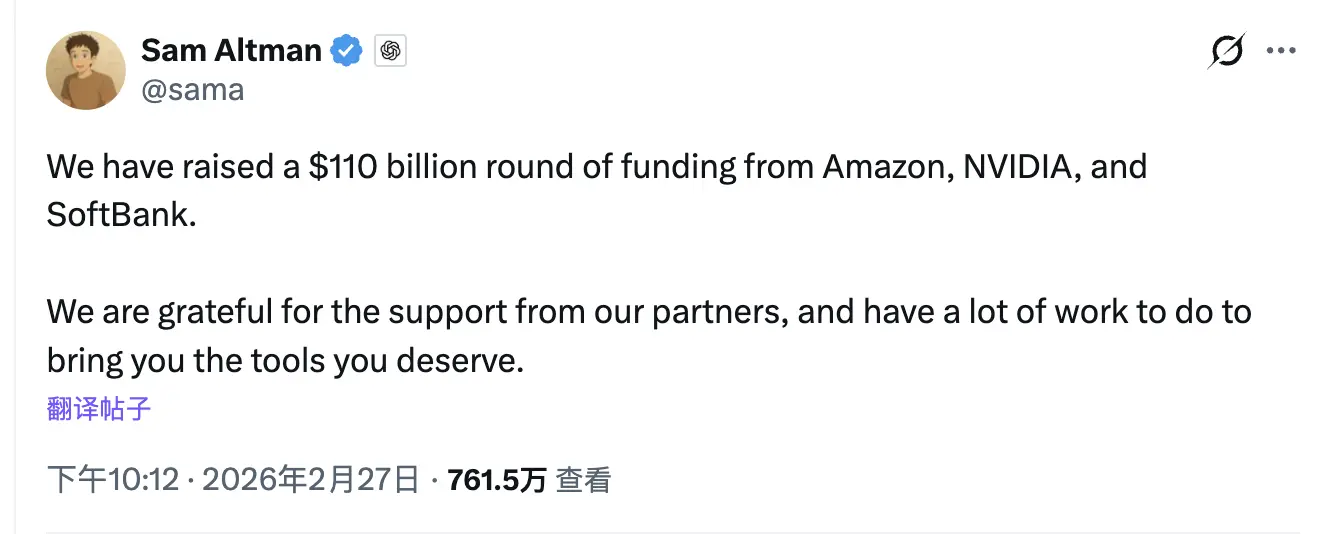
On February 27, OpenAI announced a successful $110 billion new round of funding at a $730 billion valuation, directly pushing its post-money valuation to $840 billion. Compared to last year’s $40 billion funding, this round has multiplied several times, setting a record for private tech company funding. Capital’s bet on it has shifted from “betting on the future” to “locking in the future early.”
What does $110 billion mean?
This number exceeds the annual GDP of countries like Kenya, Venezuela, Luxembourg, and Panama. Even Saudi Arabia, the global oil giant, has an annual GDP of about $1 trillion. One round of funding for OpenAI is roughly one-tenth of Saudi Arabia’s yearly output.
This amount is roughly equal to Nvidia’s entire annual revenue, nearly half of SpaceX’s current valuation, and exceeds the combined funding of internet giants like Uber, Didi, Alibaba, ByteDance, Tencent, Meituan, and others during the golden age of the internet.

In the AI landscape, a single funding round of $110 billion is undoubtedly a watershed moment, instantly changing the entire industry’s fundraising game rules. By 2025, total funding for AI startups will surpass $200 billion, setting a new record, and OpenAI alone took more than half of that in just one night.
Such a scale of funding intensifies the arms race in AI. Industry leaders must follow with larger-scale funding or risk falling behind in computing power, models, and talent. But expanding funding also brings higher valuation pressures and performance expectations. When large amounts of capital are concentrated, the funding window will inevitably narrow sharply, reducing valuation negotiation space for small and medium AI companies, prolonging survival cycles, increasing industry consolidation risks, and potentially leading to valuation bubbles, resource monopolies, and decreased innovation vitality.
From this perspective, when capital bets such enormous sums, AI is no longer just a narrative in technology but truly becomes the main asset of the capital era, turning into a battlefield for giant capital games.
Capital Gambling on AGI, Three Giants Dominate
The main backers writing this $110 billion check are Amazon, Nvidia, and SoftBank, pooling computing power, channels, and funds.
But this isn’t just a simple financing round. It’s more of a strategic gamble on the prospects of AGI, deeply tied to technology, computing power, and commercial interests.
The most generous investor in this round is Amazon, which is both a key investor in OpenAI and a long-term strategic partner.
Out of a total commitment of $50 billion, the first $15 billion has been confirmed, with the remaining $35 billion to be allocated in the coming months based on specific conditions. These include achieving or reaching AGI milestones or advancing an IPO by the end of the year. Additionally, both parties signed an 8-year expansion agreement worth $100 billion.
This model of exchanging capital for future computing needs and technological priority, similar to OpenAI’s previous partnership with Microsoft, is noteworthy. OpenAI and Microsoft have special clauses: if AGI is achieved, Microsoft will lose access to related technology (Note: In the new agreement signed in 2025, Microsoft’s IP rights to models and products are extended to 2032).
SoftBank has committed $30 billion, to be paid in three installments in April, July, and October 2026. This staged arrangement is seen as a risk hedge. SoftBank’s role in this funding isn’t just about money. Market sources say OpenAI expects to raise about $10 billion more from investors before March, including sovereign wealth funds and investment institutions, potentially boosting its valuation to $850 billion. Many of these potential investors are likely to enter through SoftBank.
SoftBank’s founder, Masayoshi Son, has been betting heavily on AI in recent years, publicly declaring that “the AI revolution is the most exciting and dynamic frontier of the future.” At the end of 2024, Son visited Trump’s Mar-a-Lago estate, promising to invest $100 billion in the US, and last year announced participation in the “Stargate” project, a $500 billion AI infrastructure investment in the US, serving as chairman. SoftBank is responsible for financial commitments, while OpenAI handles operations. To support OpenAI, Son even “tearfully” sold off Nvidia stock last year to fund additional investments, making SoftBank one of OpenAI’s largest external investors.
Nvidia, which had long been expected to invest, finally committed $30 billion, replacing the previously agreed $100 billion long-term cooperation plan, and allowing OpenAI to preempt Nvidia’s capacity, creating an exclusive “internal cycle” system. Outside competitors would have to queue for graphics cards until 2030 just to buy hardware.
This cycle is seen as a typical vendor financing model—tech giants locking in long-term cooperation through capital binding. In this AI race, capital is no longer just a financial tool but a chip to lock in computing resources and seize discourse power.
Racing in Technology and Capital, IPO Considerations at the Right Moment
Behind the massive capital injection is not only a collective bet on the AGI track but also recognition of OpenAI’s business growth.
According to official disclosures, OpenAI’s flagship product ChatGPT currently has over 900 million weekly active users, up from about 200 million 18 months ago; individual subscription users have surpassed 50 million, a record high, with a paid penetration rate over 5%; paid commercial users exceed 9 million, including many enterprises and government agencies using ChatGPT or building products based on OpenAI API.
However, behind rapid growth is the increasing cash burn. In 2025, OpenAI’s revenue was about $13 billion, with cash expenses of $8 billion, meaning it burns roughly $0.62 of cash for every dollar earned. According to The Information, internal forecasts disclosed to investors project a cumulative cash burn of $115 billion by the end of 2029, with profitability not expected until 2030. Meanwhile, OpenAI recently disclosed plans to invest about $600 billion in computing infrastructure by 2030.
This means that if profitability can’t be achieved quickly, OpenAI’s “money-burning speed” will force it to rely on continuous capital infusion to survive.
More critically, OpenAI’s once-impregnable moat is beginning to loosen.
Data from mobile analytics firm Apptopia shows that ChatGPT’s market share has fallen from 69.1% in January 2025 to 45.3% in 2026. During the same period, Google Gemini’s market share rose from 14.7% to 25.2%; Elon Musk’s Grok increased to 15.2%, up from just 1.6% last year.
Profitability issues and fierce competitors await resolution, and an IPO may become OpenAI’s “lifesaver.”
Currently, OpenAI’s IPO timeline is approaching. The Wall Street Journal recently cited sources saying OpenAI is preparing for a Q4 2026 listing and has engaged Wall Street investment banks, recruiting a CFO and investor relations head. Its founder, Sam Altman, has recently disclosed that he will consider going public at the right time. If successful, this would be one of the most significant tech IPOs of 2026.
This means Sam Altman is blindly rushing on the IPO tightrope. It’s not just a race of technology but a high-stakes game of patience with capital.
That IPO at year’s end might be the peak of this AI bubble or the true beginning of the AGI era. But before that, everyone is holding their breath at this most expensive gambling table, waiting for the cards to be revealed.