


13 Billion Debt Looms: Wu Jihan's BitDeer Is Fighting a No-Exit AI War
Author: Rhythm
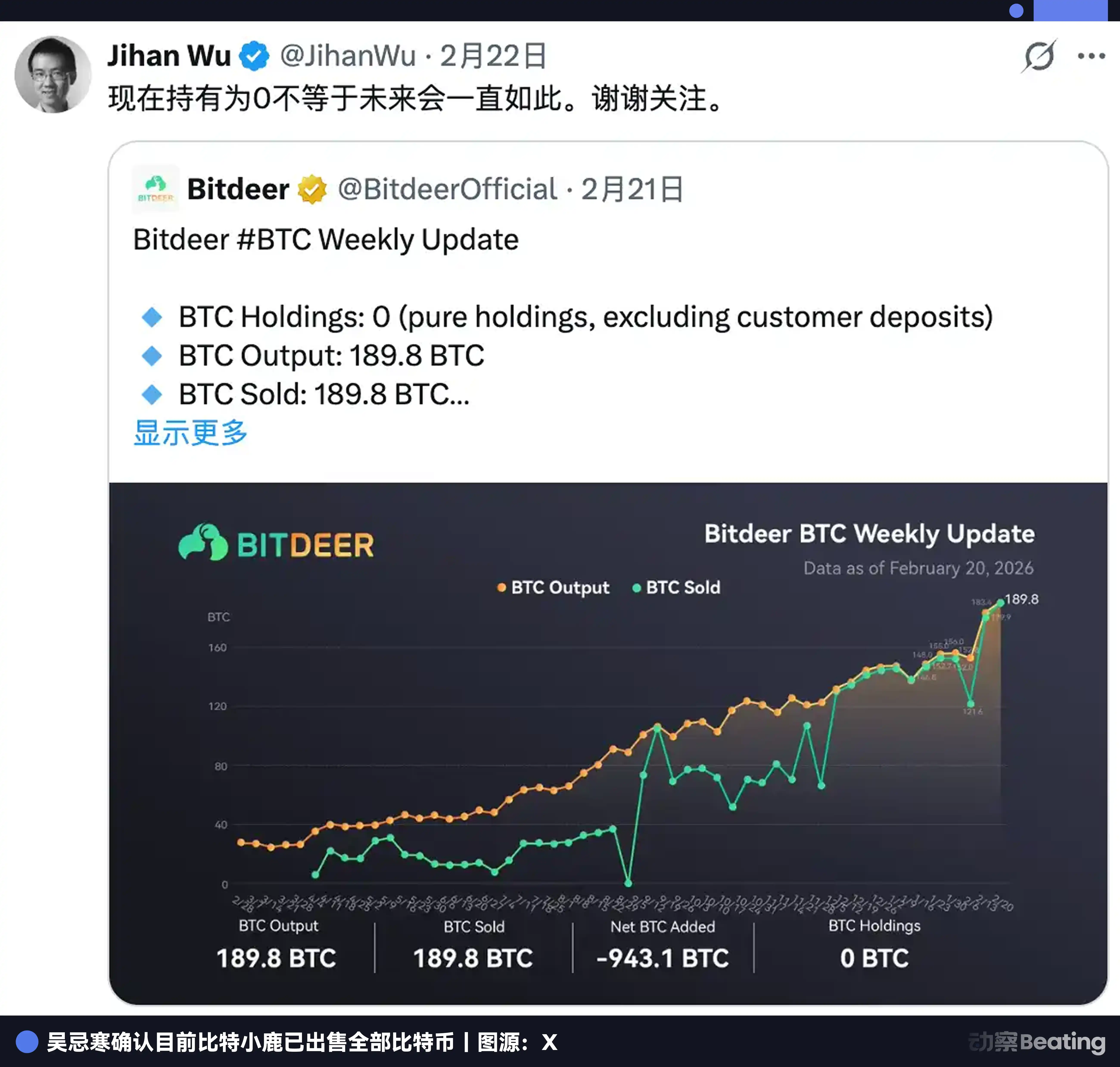
On February 20, 2026, Bit Deer posted a weekly production update on X: that week, they mined 189.8 BTC and sold it. Remaining stock: 943.1 BTC, sold all at once.
Bitcoin balance: 0.
In fact, Bitcoin mining has always been a form of time arbitrage from day one.
Using today’s electricity and machines to exchange for tomorrow’s Bitcoin. No processing in garages, no customers, no branding. The investment is the current cost, betting on future prices. If the judgment is correct, time helps you make money.
This logic has run for over a decade. Now, Wu Jihan is changing the goal of this logic.
The target has shifted from coin price to the long-term price of computing power demand under AI and climate change. The method has shifted from using electricity to buy coins to borrowing money to buy land. The arbitrage object has changed, but the arbitrage structure remains the same.
In the same week they cleared out Bitcoin, Bit Deer also completed a $325 million new debt issuance.
According to Bitdeer’s financial report, as of December 31, 2025, the company’s on-balance-sheet debt was $1 billion. So, total debt is about $1.3 billion.
The debt is real, the land purchases are real, but the outcome of this tough battle may not be revealed until 2029.
1. Companies that don’t want to do AI mining aren’t good companies
Bit Deer was founded in 2018, starting as a mining machine sharing platform. Now it’s one of the world’s largest listed mining companies, with a self-mined hash rate of 63.2 EH/s, the largest among publicly listed miners, accounting for about 6% of the entire Bitcoin network’s hash rate.
But now, Wu Jihan no longer wants to sell hash power; he wants to focus on electricity.
Looking at Bit Deer’s financials, as of early 2026, the company’s global electricity pipeline totals 3,002 MW, with 1,658 MW already online, and 1,344 MW under construction or pending. Microsoft and Google’s single large data centers are usually between 100 and 300 MW.
In other words, 3,002 MW is equivalent to the power demand of 10 to 30 Google mega data centers bundled into one company. So, on paper, Bit Deer’s pipeline looks very impressive.
The main use of the $1.3 billion debt is to lock in land assets worldwide for the AI data center transformation.
The first is Rockdale, Texas, with 563 MW (including 179 MW expansion), already operational, mainly for mining. This is their traditional business, with stable cash flow.
Next is Clarington, Ohio, with 570 MW, a 30-year lease, power contract signed, originally planned to be completed in Q2 2027, targeting HPC/AI core stations. This is the core of the entire AI transformation plan. It’s also the biggest risk right now, which we will detail later.
Then there’s Tydal, Norway, with 175 MW, converting the mine into an AI data center, expected to be completed by the end of 2026, providing 164 MW of effective IT load. Hydropower resources, with competitive energy costs. The renovation cost is much lower than new construction. It’s currently the fastest progressing and least risky card.
These three—land, electricity, and data centers—are called “the most difficult assets to replicate” in the AI industry. Bit Deer has accumulated these through ten years of mining operations.
A rarely mentioned point: SEALMINER. Bit Deer is not only building data centers but also developing its own mining chips. The SEAL series has reached the third generation, with SEAL03 achieving 9.7 joules per TH, and the A3 Pro mass-produced in September 2025, now among the top tier globally. SEAL04 aims for 5 joules per TH, which, if achieved, will surpass all mass-produced miners on the market. The gross profit margin of self-developed chips exceeds 40%, far higher than mining itself.
This is a replay of what Wu Jihan did at Bitmain: from buying other people’s shovels to making his own.
2. How much debt has been borrowed, and how much can AI bring in?
To develop AI, by the end of 2025, Bit Deer’s on-balance-sheet debt exceeded $1 billion. Plus, a new $325 million bond in February 2026, bringing total debt over $1.3 billion.
In less than two years, multiple rounds of financing. In May 2024, Tether invested $100 million, becoming the second-largest shareholder, with warrants allowing an additional $50 million. Three months later, the first convertible bond of $150 million was issued at an 8.5% annual interest rate. In November of the same year, a second issuance of $360 million at a 5.25% rate.
In November 2025, a package deal: $400 million in convertible bonds plus 148.4 million shares, two supporting tranches. In February 2026, another $325 million in convertible bonds plus 43.5 million shares, with $135 million used to buy back the earliest debt maturing in 2029, extending repayment to 2032.
Totaling over $1.4 billion. The funds are used for mining machines, data centers, AI infrastructure, plus rolling over debt extensions.
However, each time they issue debt, Bit Deer’s stock price drops 10% to 17%. This has become a market reflex. But luckily, the company still manages to raise funds each time.
The core of the debt structure is convertible bonds. The new debt maturing in 2032 has an initial conversion price of about $9.93, a 25% premium over the same issuance price of $7.94. When the stock price reaches that level, bondholders will convert to shares instead of taking cash. The company doesn’t need to repay the money, only see the stock price rise.
The logic of convertibles is betting that the stock price will go up. This itself is a gamble on whether the AI narrative will be recognized by the market. With an average interest rate of 5% on $1.3 billion, annual interest costs exceed $65 million. But in 2025, AI/HPC cloud revenue was less than the interest expense for half a year.
Currently, this interest is entirely rolled over by issuing more debt. It’s impossible to say there’s no pressure.
Given such heavy investment, it must be based on more objective returns. So, how much profit can Bit Deer actually generate from AI?
The AI business currently earns about $10 million a year, less than 2% of total revenue. For a company valued at nearly $2 billion, this is almost negligible.
But this won’t be the end.
Bit Deer’s GPU count increased from 584 to 1,792 in three months, tripling. Utilization rate dropped from 87% to 41%, mainly because the machines are too fast, with B200/GB200 still in testing phases and not yet generating revenue. Power is ready, machines are being installed, but revenue has yet to catch up.
How high is the ceiling?
Roth/MKM estimates that with full HPC capacity deployment, annual revenue potential is $850 million. The management is more aggressive: investing all 200 MW into AI cloud could generate over $2 billion annually, three times the total mining revenue in 2025.
But both figures rely on three assumptions: on-time completion, securing hyperscaler-level long-term contracts, and full GPU utilization.
None of these conditions have been met yet.
This is the battle Bit Deer is fighting: mining to support AI, AI making promises, but whether those promises materialize depends on execution over the next two to three years.
3. The real challenge is how narrow the time window is
$1.3 billion in debt sounds risky. But Bit Deer’s debt structure is designed to be more resilient than it appears.
High-leverage companies usually fail for the same reason: debt matures all at once, cash flow is insufficient, and they are forced to sell assets.
Bit Deer has scheduled the maturities of three tranches of convertible bonds for 2029, 2031, and 2032.
In a way, this deliberately creates a buffer. By the time the first batch matures, Tydal and Clarington should be operational; by the second, AI revenue should be substantial; by the third, the company’s future state will be clearer, with market judgment. These three points are opportunities for renegotiation.
But convertible bonds buy time, and Wall Street doesn’t automatically buy into this. Keefe Bruyette cut the target price from $26.50 to $14.00. The current stock price is about $8. The market’s message is clear: the transformation story depends on actual revenue.
All this pressure, however, gives Wu Jihan what he needs most—and what is also the cruelest: time.
The smooth path might look like this: by the end of 2026, Tydal’s renovation completes, the 164 MW hydropower data center in Norway goes online, and European clients start paying. In 2027, Clarington wins the lawsuit, Ohio’s 570 MW project begins construction, and major US clients follow. By 2028-2029, these core assets are fully operational, revenue approaches $1 billion, and analysts revalue Bit Deer with an AI infrastructure premium instead of a mining discount. The first batch of debt matures in 2029, and bondholders will likely prefer to convert to stock rather than take cash.
At each of these critical points, Wu Jihan must hit the timing perfectly.
Then there’s Clarington.
In the same industrial park in Ohio, there’s a steel manufacturer called American Heavy Plate Solutions, which signed a 30-year lease for 9.9 acres in 2018. They sued Bit Deer: building AI data centers would interfere with shared electricity, roads, railways, and communication lines, violating restrictions. They seek a court order to permanently block Bit Deer from starting construction.
Clarington’s pipeline is 42% built. If blocked, the entire timeline must be rewritten.
So, the biggest single risk for Bit Deer now isn’t debt or stock price—it’s a steel plant.
Mining operations aren’t idle either. In February 2026, Bitcoin network difficulty surged 14.7%, the largest jump since May 2021. With the same electricity costs, fewer coins are mined. Q4 gross margin dropped from 7.4% a year earlier to 4.7%. The mining leg is slowly thinning.
The worst-case scenario is clear: Clarington’s lawsuit delays two years, construction halts; Tydal’s delay causes GPU utilization to stay at 41%; in 2029, the first debt matures, cash is insufficient, forcing refinancing, further diluting stock, and making conversion thresholds harder to reach.
Both paths are real possibilities.
4. What if all Bitcoin is sold? Then what?
A tradition in the mining community: holding coins is faith, a testament to Bitcoin’s long-term value.
MARA holds 53,250 BTC, Riot holds 18,000 BTC, Strategy holds 710,000 BTC. The more they hoard, the more the market perceives their belief.
Bit Deer now holds zero.
The official explanation: selling coins provides liquidity for land purchases. That’s reasonable. Peers are heading in the same direction: Riot sold $200 million worth of Bitcoin for AI expansion, Bitfarms is abandoning the “Bitcoin company” label, MARA is deploying HPC.
But there’s a more fundamental shift beyond identity.
From day one, the mining industry has bet on one thing: that in the future, some asset will be worth more than today’s costs. Ten years ago, mining bet on coin prices rising. Now, buying land bets on explosive growth in computing demand.
The object has changed, but the logic of time arbitrage remains.
Wu Jihan’s real gain is positioning himself so that “no matter who wins, I get paid electricity bills.”
He’s not betting on a specific track; he’s blocking the entry point. Amazon doesn’t bet on which internet company will win, it just rents servers to everyone. AT&T doesn’t care what you talk about on the phone, only whether you make calls.
From selling products to selling services to collecting rent, industry evolution has always followed this path.
The only difference is whether you actively pursue it or are pushed into it.
Wu Jihan has spent over a billion dollars to buy this window. He’s waiting for AI to generate profits, while keeping pace with debt repayment.
Related Articles
Segregated Witness (SegWit) Explained: Upgrade That Redefined Bitcoin for Mass Adoption