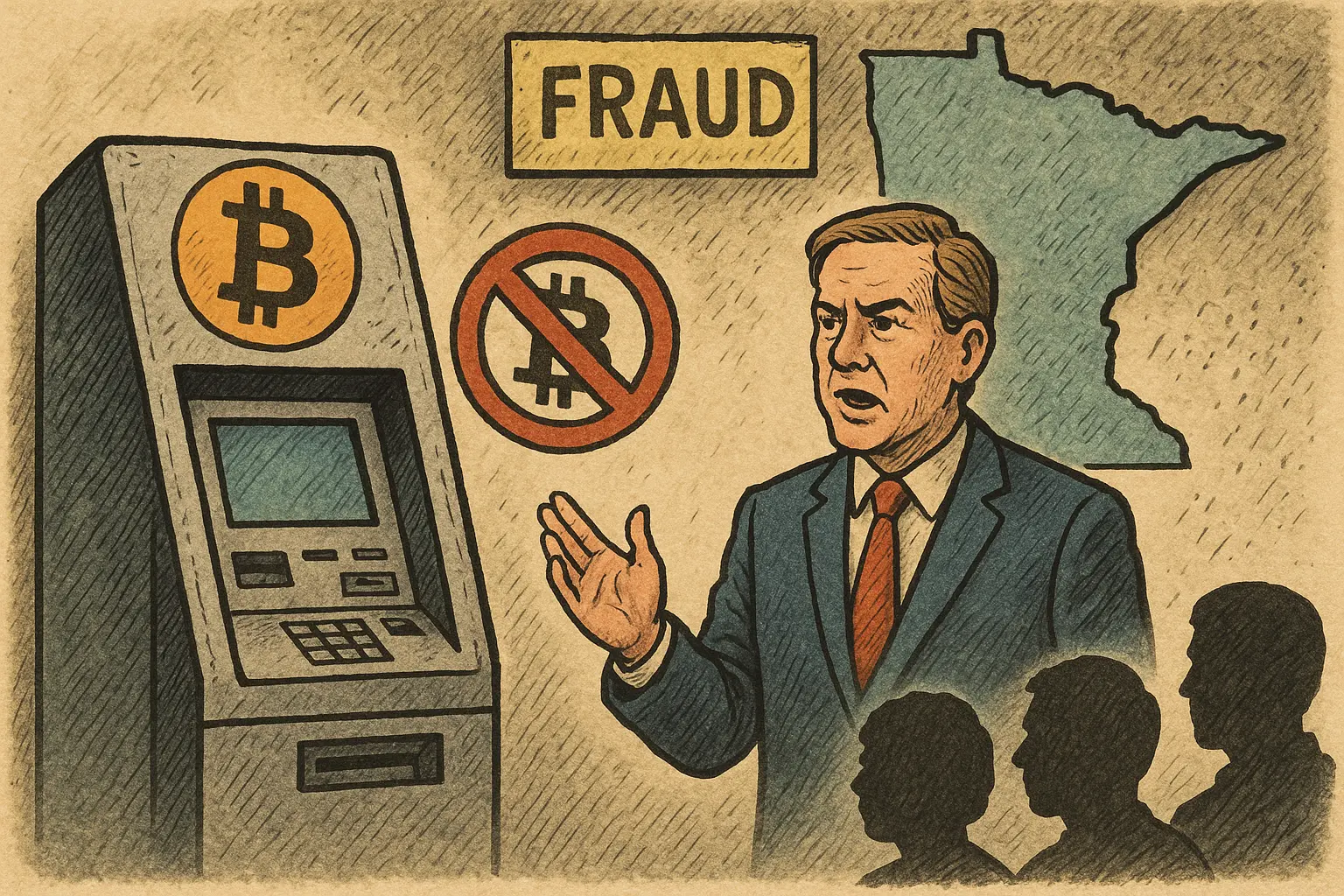
U.S. Rep. Erin Koegel of Minnesota introduced HF 3642 bill this week, which proposes a complete ban on all physical machines in the state that allow users to buy cryptocurrencies with cash. If passed, Minnesota will become the first state in the nation to implement a state-level blanket ban on Bitcoin ATMs, following the nationwide ban introduced by New Zealand last year. There are currently about 430 such machines in Minnesota.
HF 3642 Act: Legislative logic from elder victimization to full-scale legislation
This is not the first time Minnesota has regulated Bitcoin ATMs. In 2024, the state has passed a regulatory framework that stipulates a daily transaction cap of $2,000 for new customers, a refund mechanism, and a business licensing system. However, the continued increase in fraud cases has prompted lawmakers to turn to more aggressive blanket ban options.
During Thursday’s legislative hearing, law enforcement officials provided several typical cases describing elderly victims being lured into by scammers posing as government officials or technical support workers to continuously transfer money through Bitcoin ATMs. A detective testified that a resident sent Bitcoin to scammers ten times in six months, losing 50% of his monthly income as a result, and was eventually found in a trance at a gas station and had to rely on government assistance. A city police chief pointed out in a written statement: “The ability of law enforcement to recover funds after they have been transferred is extremely limited.”
The core point of contention in the HF 3642 bill
Legislative purpose: Responding to the rising public safety needs of seniors affected by Bitcoin ATM scams
Scope of the ban: All physical machines that allow users to purchase cryptocurrencies with cash are prohibited, regardless of whether the operator is compliant
The first case in the United States: If passed, it will be the first state-level blanket ban in the United States, following New Zealand’s national ban model
Scale of loss: Bitcoin ATM fraud losses across the United States reached $3.33 billion last year, with about 430 machines in Minnesota
Rural community impact: Lawmakers note that millions of dollars may have flowed out of rural communities
Bitcoin Depot’s lawsuit and industry compliance pressure are heating up across the board
The proposed legislation in Minnesota is a microcosm of the regulatory tightening the Bitcoin ATM industry in the United States as a whole. Bitcoin Depot, North America’s largest Bitcoin ATM operator, announced this week that it will proactively strengthen its compliance process by requiring customers to provide personally identifiable information starting with every transaction.
However, just before that, Massachusetts Attorney General Andrea Campbell filed a lawsuit this month, accusing Bitcoin Depot of knowingly facilitating cryptocurrency scams and “removing fraud prevention safeguards to enrich its own pockets.” Bitcoin Depot denies the allegations, emphasizing compliance and consumer protection as its core business principles.
Additionally, the Arizona Attorney General has issued an urgent warning, stating that Arizona residents lost more than $1.77 million in 2024 due to cryptocurrency ATM scams. This series of events shows that the Bitcoin ATM industry is facing unprecedented regulatory and legal pressure, and how to effectively prevent fraud while maintaining business has become a key issue for the industry’s survival.
Frequently Asked Questions
What is the content of the Minnesota HF 3642 bill?
The HF 3642 bill proposes a blanket ban on all physical machines within Minnesota that allow users to purchase cryptocurrencies with cash. Previously, Minnesota had established relevant regulatory frameworks in 2024, including a daily transaction limit of $2,000 for new customers, a refund mechanism, and a business licensing system, but fraud cases continue to rise, prompting lawmakers to seek tougher solutions.
Why is Minnesota considering a blanket ban instead of further regulation?
Testimony from law enforcement officials at legislative hearings reveals that existing regulatory frameworks are ineffective in deterring seniors from continued scams. Scammers impersonate government or technical support personnel to trick victims into continuous transfers, and once the funds are transferred through Bitcoin ATMs, the chances of law enforcement recovering them are extremely low.
How is Bitcoin Depot Responding to Regulatory Pressure?
Bitcoin Depot has announced that it will make it mandatory for customers to provide personally identifiable information starting with every transaction. However, the Massachusetts Attorney General has filed a lawsuit against him, accusing him of knowingly facilitating cryptocurrency scams. The company denies the allegations, emphasizing that compliance and consumer protection are core business principles.
Disclaimer: The information on this page may come from third parties and does not represent the views or opinions of Gate. The content displayed on this page is for reference only and does not constitute any financial, investment, or legal advice. Gate does not guarantee the accuracy or completeness of the information and shall not be liable for any losses arising from the use of this information. Virtual asset investments carry high risks and are subject to significant price volatility. You may lose all of your invested principal. Please fully understand the relevant risks and make prudent decisions based on your own financial situation and risk tolerance. For details, please refer to
Disclaimer.
Related Articles
The ECB supports transferring regulatory powers—such as those over crypto asset service providers—uniformly to the ESMA.
The European Central Bank supports transferring regulatory authority over cross-border financial market participants such as crypto-asset service providers to the European Securities and Markets Authority, with the aim of strengthening the integration of the EU capital markets and their competitiveness; the related proposals will be subject to legislative talks between member states and the European Parliament.
GateNews1m ago
Put the Genius Act into action! The U.S. will bring stablecoin issuers under regulation and require the ability to freeze transactions for “anti-money laundering capabilities.”
The U.S. Department of the Treasury classifies stablecoin issuers as financial institutions, requiring them to comply with anti–money laundering regulations and designating U.S. residents with no criminal record as compliance officers. The new requirements grant issuers the authority to freeze transactions, emphasizing the protection of the financial system and the promotion of technological development. However, regulatory pressure and political power struggles still remain, and the outlook for the market in the future is still to be seen.
CryptoCity8m ago
Caixin: Polymarket’s use of USDC settlement creates legal risk for participants within China
The article discusses legal disputes involving Polymarket prediction markets, especially the unclear boundary between insider trading and gambling. It emphasizes that using USDC for settlement exposes Chinese participants to legal risk, and it mentions the “End Prediction Market Corruption Act” proposed by a U.S. senator, which prohibits certain government officials and their family members from participating in prediction market trading.
GateNews16m ago
Crypto rumor: If Taiwan’s special act passes, USDT withdrawals will be banned! Crypto City walks you through rebutting each piece of panic-mongering fallacy
Some users on Threads claim that Taiwan’s special legislation will ban USDT trading, saying it is actually fear-based marketing. Experts emphasize that the draft allows overseas stablecoin transactions and urge people to choose regulated exchanges to avoid scams and risks. The government will legally penalize underground coin traders that are not registered to operate. The public should stay rational and not believe online rumors.
CryptoCity50m ago
A certain CEX has been approved for a Federal Reserve master account, raising concerns about systemic risk and transparency
A cryptocurrency exchange became the first CEX to be approved for a Federal Reserve master account, but the account is restricted—access is limited to the Fedwire payment system, and it cannot earn interest. This move has sparked concerns about financial risk and transparency in the U.S., and regulatory experts warn it could affect financial stability. The exchange said it is complying with anti–money laundering requirements.
GateNews1h ago
Japan revises the Financial Instruments and Exchange Act; crypto assets are formally included as financial products
The amendment to the Financial Instruments and Exchange Act passed by the Japanese government first clearly defines cryptocurrency as a financial instrument, and introduces an insider trading prohibition and an obligation to disclose annual information. This marks a new stage in cryptocurrency regulation. It is expected to take effect in 2027 and establishes core rules such as prohibiting insider trading, mandatory disclosure, and enhanced penalties. In addition, the plan includes reducing cryptocurrency tax rates and opening the door to ETFs, to promote market transparency and investor protection.
ChainNewsAbmedia3h ago


