The bill, introduced by Federal Deputy Tabata Amaral, amends the current regulation and establishes the crime of cryptocurrency tax evasion, aiming to curb the rising volume of remittances and settlement alternatives using dollar proxies, including stablecoins.
Brazil Aims To Criminalize Undeclared Stablecoin Transactions In New Bill
Brazil is taking measures to tighten its grip on rising volumes of crypto outflows, especially those involving stablecoins, by imposing penalties on undeclared cryptocurrency transactions.
Bill 746/2026, introduced by Federal Deputy Tabata Amaral, explicitly defines the crime of cryptocurrency tax evasion, getting stablecoin exchanges outside a gray zone classified as a loophole by some regulators and government officials.
The crime of foreign currency tax evasion is defined in Brazilian regulation as “carrying out an unauthorized exchange operation, with the purpose of promoting the evasion of foreign currency from the country.”
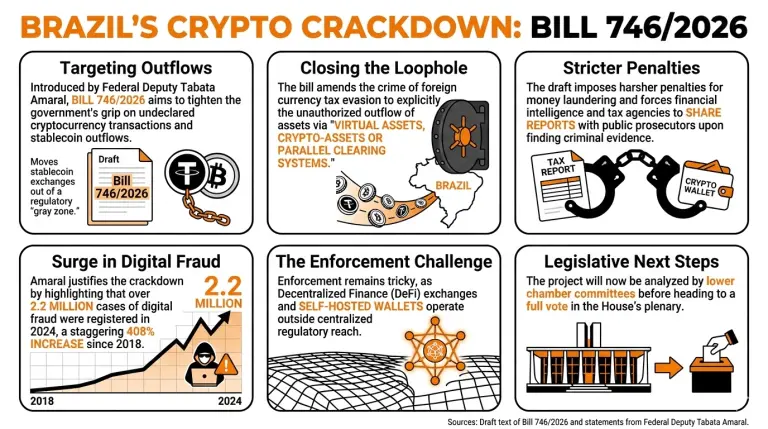
The new bill proposes to amend part of this definition, including a new paragraph that extends this crime to “anyone who, in any capacity, promotes, without legal authorization, the outflow of currency or foreign exchange abroad, or maintains undeclared deposits abroad, including through the use of virtual assets, crypto-assets or parallel clearing systems.”
The draft also imposes harsher penalties for money laundering involving crypto assets, forcing financial intelligence units and tax agencies to share reports with the public prosecution if they identify criminal evidence.
Amaral justifies these changes by stating that economic crime is transforming in Brazil, highlighting that during the last decade, crime has migrated to include digital and crypto assets, partnering with corporate structures to obfuscate money laundering and tax evasion crimes.
Over 2.2 million cases of digital fraud were registered in 2024, an increase of 408% since 2018. Amaral states that this growth has been “fueled by the feeling of anonymity and the difficulty of tracking virtual assets.”
As with other measures targeting crypto assets, its degree of applicability will be key, as decentralized finance exchanges and self-hosted wallets might be outside regulatory reach, given that they are not managed by centralized authorities that could deliver information about their owners.
The project will now be analyzed by the committees in the lower chamber. If approved, it will be directed for a full vote in the House’s plenary.
FAQ
- What measures is Brazil taking to address crypto outflows?
Brazil is introducing Bill 746/2026 to impose penalties on undeclared cryptocurrency transactions, particularly focusing on stablecoins.
- What does Bill 746/2026 define as tax evasion?
The bill specifies that crypto tax evasion includes unauthorized exchange operations aimed at evading foreign currency regulations, extending this to virtual assets.
- What penalties does the new bill propose?
It introduces harsher penalties for money laundering involving crypto assets and mandates financial intelligence units to report findings to public prosecution.
- Why are these regulations necessary, according to Deputy Amaral?
Amaral highlights a significant rise in digital fraud, with over 2.2 million cases reported in 2024, driven by the anonymity of virtual assets and their growing use in economic crimes.
Disclaimer: The information on this page may come from third parties and does not represent the views or opinions of Gate. The content displayed on this page is for reference only and does not constitute any financial, investment, or legal advice. Gate does not guarantee the accuracy or completeness of the information and shall not be liable for any losses arising from the use of this information. Virtual asset investments carry high risks and are subject to significant price volatility. You may lose all of your invested principal. Please fully understand the relevant risks and make prudent decisions based on your own financial situation and risk tolerance. For details, please refer to
Disclaimer.
Related Articles
Cambodian lawmakers propose severe prison time for crypto scammers
Cambodia's parliament passed legislation targeting compounds used to defraud victims through scams, including those involving cryptocurrency.
In a Friday notice, the Senate of the Kingdom of Cambodia announced that the chamber had unanimously approved the draft law with no amendment, with 58
Cointelegraph12m ago
Trump fires Pam Bondi, puts pro-crypto Todd Blanche in charge of the DOJ
President Trump has fired Pam Bondi and replaced her with Todd Blanche as interim U.S. Attorney General --- handing control of the Justice Department to the official who dismantled the DOJ's crypto enforcement unit in April 2025 and holds up to $485,000 in personal digital asset holdings.
Cryptonews40m ago
Kalshi hires Carter, a former staffer to former U.S. President Obama, as a policy adviser
The prediction market platform Kalshi in the United States has hired Carter, a former aide to President Obama, as a policy adviser to strengthen ties with the government and address regulatory challenges. Carter’s addition symbolizes Kalshi’s proactive outreach in political circles, while also drawing attention to legal disputes and concerns about insider trading by political figures. Prediction market data is increasingly becoming an important reference for tracking social trends.
ChainNewsAbmedia1h ago
Cambodia passes its first anti–tech scam law, strengthening law enforcement regulations to combat online telecom fraud
Cambodia’s National Assembly passed the “Anti-Technology Fraud Law” at the end of March, aiming to crack down on online scams and human trafficking. The law establishes dedicated offenses, with severe penalties and life imprisonment. The new law expands the scope of law enforcement, targeting acts such as “pig butchering” scams, and responds to international pressure to repair its image. The government has pledged to shut down illegal scam centers by the end of April.
ChainNewsAbmedia2h ago
Kalshi onboards ex-Democratic strategist amid legal troubles
Kalshi announced the hiring of Stephanie Cutter, a former advisor to President Obama, to strengthen its relationships in Washington, D.C. amid scrutiny and lawsuits regarding its prediction markets.
Cointelegraph3h ago
Trump’s empty crypto adviser seat, Vance takes on an anti-fraud role
The White House no longer has a dedicated crypto policy leader following Trump's appointment of JD Vance as "Fraud Czar." This shift comes after David Sacks's departure, leaving crypto legislation stalled. The focus on fraud enforcement contrasts with the lack of crypto policy leadership during a crucial legislative period.
TapChiBitcoin8h ago


