
MicroStrategy (MSTR) purchased 592 Bitcoin on February 23 at an average price of approximately $67,286, spending about $40 million, which increased its total Bitcoin holdings to 717,722 coins with an overall average cost of $76,020 per coin. However, this purchase did not support a continued rise in MSTR’s stock price. The Chaikin Money Flow (CMF) indicator is currently near zero, indicating that institutional investors have not yet followed with increased holdings.
Latest Buy Signal Fails to Boost Institutional Confidence
MicroStrategy has traditionally used continuous Bitcoin accumulation as a market signal of long-term conviction, which often boosts investor sentiment. However, after the February 23 purchase announcement, MSTR’s stock price continued to decline along the bear flag pattern that began on February 19, rather than showing the expected confidence rebound.
On February 24, MSTR’s stock price fell over 9%; on February 25, boosted by Bitcoin’s rebound from $64,500 to $69,400 (a 2.5% increase), MSTR briefly rose to $137, but quickly dropped as Bitcoin retreated. This movement again confirms MSTR’s high correlation with Bitcoin—when Bitcoin stalls or weakens, MSTR’s decline tends to be amplified.
CMF Approaching Zero: Key Shift in Institutional Capital Signals
The CMF combines price and volume to measure the actual buying and selling activity of large investors like institutions. A CMF above zero indicates institutional accumulation, while below zero indicates outflows.
From January 12 to February 23, MSTR’s stock price declined, but CMF rose countertrend, forming a bullish divergence—suggesting institutional investors quietly increased holdings during market weakness, ultimately driving about a 33% rebound from February 5 to 25.
However, after the February 23 Bitcoin purchase announcement, the CMF trend shifted markedly, now hovering near zero. This suggests that institutional investors are currently uncertain about MSTR’s direction and have not increased their holdings in response to the company’s continued Bitcoin accumulation. This structural divergence—“buying Bitcoin but not following with stock purchases”—weakens the bullish case.
Technical Analysis: Bear Flag Breakdown and Downside Targets
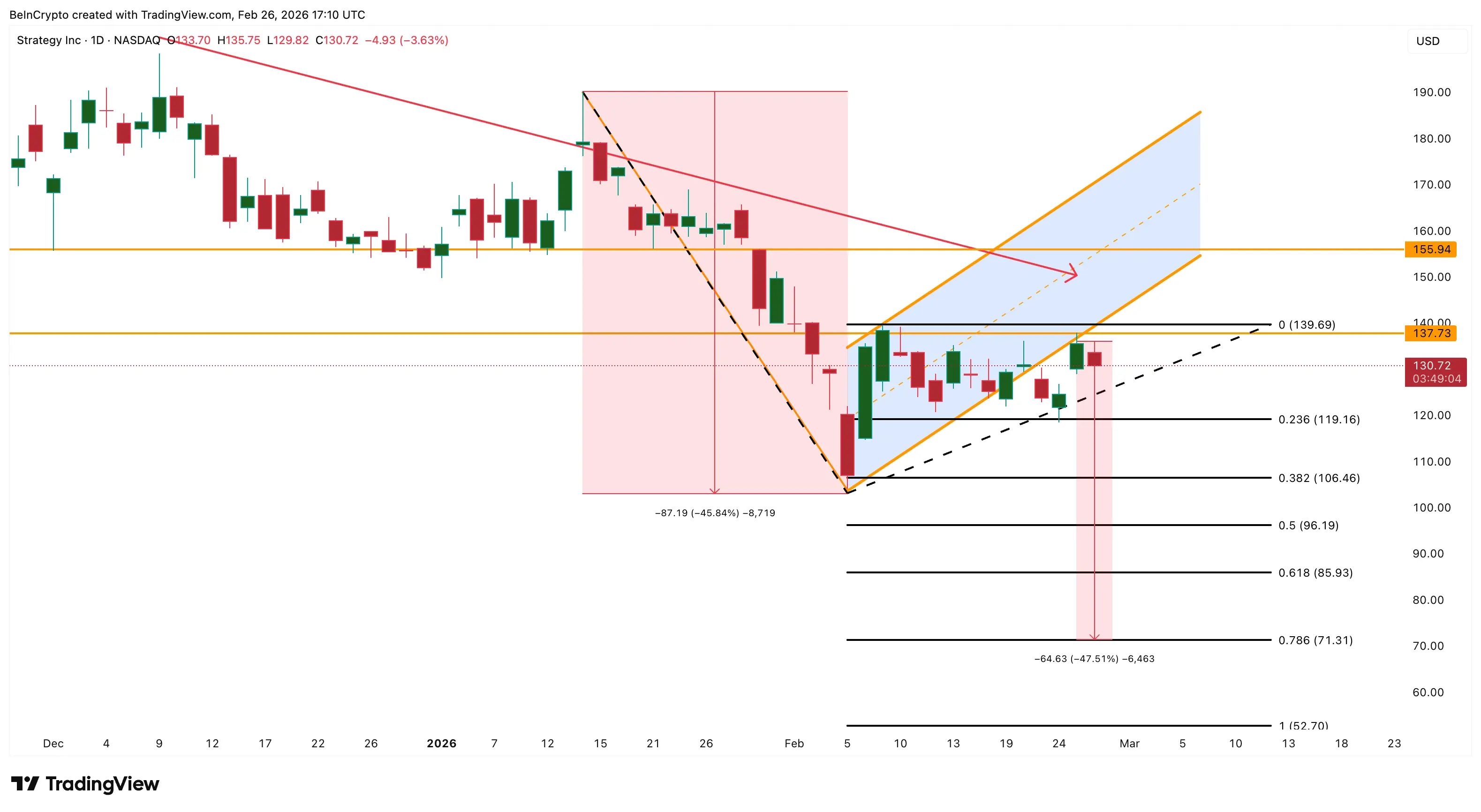
(Source: TradingView)
From a technical perspective, MSTR faces multiple pressures:
-
Bear Flag Breakdown: The bear flag pattern, formed after a larger downtrend and a brief consolidation, typically signals a new wave of strong decline upon breakdown. MSTR has completed its bear flag breakdown.
-
Bearish RSI Divergence: Between December 9 and February 25, MSTR’s price formed lower highs, while RSI formed higher highs, indicating weakening momentum. A similar divergence in January led to a 45% plunge.
-
Key Support Levels Moving Lower: The first support is at $119; if broken, next support is at $106, then $85.
-
Fibonacci Technical Target: Based on the 0.786 retracement level and extreme point projections, the full downside technical target points to approximately $70–$71, over 45% below current levels.
-
Reversal Conditions: MSTR needs to recover above $139 for a preliminary bullish signal; a confirmed breakout above $155 could break the overall bearish structure and suggest a potential trend reversal.
Frequently Asked Questions
Q: Why hasn’t MicroStrategy’s continued Bitcoin accumulation supported MSTR’s stock price?
The valuation of MSTR already includes a high premium for its Bitcoin holdings, meaning the marginal effect of additional purchases is diminishing. When Bitcoin’s overall trend weakens, MSTR’s leveraged nature causes its price to decline more sharply than Bitcoin itself. Additionally, the CMF approaching zero indicates institutional investors are not increasing their MSTR stock holdings, which is a core reason the stock cannot sustain a rebound.
Q: What does the CMF approaching zero signify for the market?
A CMF near zero indicates that institutional capital is currently in a wait-and-see mode regarding the stock—neither actively accumulating nor selling. After the prior bullish divergence triggered a 33% rebound, the rapid return of CMF to zero shows that institutional confidence has waned, serving as a key technical warning.
Q: Is the $70 downside target credible?
The $70 target is based on Fibonacci 0.786 retracement and extreme point calculations, derived after the bear flag breakdown and the loss of the $85 support. Historically, similar RSI divergences in MSTR have led to sharp declines of around 45%, indicating some reliability. However, the actual path depends on Bitcoin’s overall trend and institutional investor behavior moving forward.
Disclaimer: The information on this page may come from third parties and does not represent the views or opinions of Gate. The content displayed on this page is for reference only and does not constitute any financial, investment, or legal advice. Gate does not guarantee the accuracy or completeness of the information and shall not be liable for any losses arising from the use of this information. Virtual asset investments carry high risks and are subject to significant price volatility. You may lose all of your invested principal. Please fully understand the relevant risks and make prudent decisions based on your own financial situation and risk tolerance. For details, please refer to
Disclaimer.
Related Articles
Ethereum Approaches Cycle Low as Bitmain Indicates Violent Belief
The article explores Ethereum's potential market bottom, highlighting its correlation with past S&P 500 trends and significant institutional investment by Bitmain. Despite mixed market sentiment, historical patterns suggest possible recovery.
CryptoBreaking18m ago
Analyst: If Bitcoin falls below the $66,000 support level, it may trigger a 10%-20% correction
Gate News reported that on March 20, Chartered Market Technician (CMT) Aksel Kibar stated on March 21 that the lower support boundary of Bitcoin's potential rising wedge formation is located at 66,000, and a breakdown below this level could trigger a bearish reversal. Aksel Kibar pointed out that rising wedges, as a classic technical pattern, typically appear at the end of uptrends, signaling price momentum exhaustion. Historical data shows that after similar downside breakdowns are confirmed, the average pullback ranges from 10%-20%.
GateNews1h ago
Bitcoin Slips Below $70,000 as Fed Rate Pause and Oil Surge Pressure Markets
Bitcoin declined to $70,000 due to steady interest rates from the Federal Reserve and rising energy prices, leading to $600 million in liquidations and increased market volatility, particularly affecting altcoins.
CryptoBreaking2h ago
XRP Climbs 3% Past $1.47 as Breakout Extends on Bitcoin-Led Rally
Key Takeaways
XRP broke above $1.426 resistance after months of consolidation, jumping to $1.47 on surging volume
Trading volume spiked over 250% during the move, indicating strong participation in the breakout
Activity on the XRP Ledger continues climbing, with tokenized real-world assets
CryptoBreaking2h ago
BTC down 0.65% in 15 minutes: Large spot selling orders dominate short-term pullback, panic sentiment intensifies volatility amplification
2026-03-20 13:45 to 2026-03-20 14:00 (UTC), BTC declined 0.65% within 15 minutes, with price range fluctuating between 69795.3 to 70399.4 USDT, reaching an amplitude of 0.86%. Market volatility intensified in the short term, trading activity increased, and investor attention rose.
The main driver of this price movement was concentrated large-scale active selling in the spot market. During this period, major trading platforms saw multiple large sell orders exceeding 100 BTC each, with sell orders accounting for 52% of volume, directly driving prices downward.
GateNews3h ago


