Author: bootly, Bitpush News
The Ethereum Foundation (EF) once again stands at a crossroads of personnel upheaval.
Tomasz Stańczak, Co-Executive Director of the Ethereum Foundation, announced that he will step down at the end of this month. This comes just 11 months after he and Hsiao-Wei Wang jointly succeeded the long-time leader Aya Miyaguchi in March last year, forming a new leadership core.

His successor will be Bastian Aue. Very little public information is available about him; his X account was registered only eight months ago, with almost no record of public statements. He will continue to co-lead the organization that controls core resources and strategic direction of the Ethereum ecosystem alongside Hsiao-Wei Wang.
This seemingly sudden personnel change is actually the inevitable result of internal conflicts within the Ethereum Foundation, external pressures, and strategic transformation intertwined.
Taking on the Role in a Year of Turmoil
To understand Stańczak’s departure, we must first look back at the context when he took office.
Early 2025, the Ethereum community was in a state of anxiety. At that time, following the US elections, the cryptocurrency market was generally bullish, Bitcoin repeatedly hit new highs, and competing chains like Solana were gaining momentum. Meanwhile, Ethereum’s price performance was relatively weak, and the Foundation itself was under criticism.
Criticism was primarily directed at then-Executive Director Miyaguchi. Developer communities complained that the Foundation was seriously out of touch with frontline builders, that there were conflicts of interest in strategic directions, and that efforts to promote Ethereum were insufficient. Some questioned whether the Foundation was too “laid-back,” adopting a “coordinator” rather than a “leader” stance, which was seen as causing Ethereum to lose its first-mover advantage.
As the “central bank” of Ethereum, the Foundation was expected to act decisively rather than remain passive.
Amid this wave of public opinion, Miyaguchi stepped back into a board role. Stańczak and Wang were suddenly thrust into the spotlight.
Stańczak was not an outsider. He is the founder of Nethermind, one of the core execution clients in the Ethereum ecosystem, playing a key role in infrastructure development. He is technically skilled, entrepreneurial, and has a deep understanding of community pain points.
In his own words, the initial instructions he received upon taking office were clear: “The community is calling out — you’re too chaotic — you need to be more centralized and accelerate to respond to this critical period.”
What did he do in that year?
The partnership of Stańczak and Wang indeed brought visible changes.
First, organizational efficiency. The Foundation cut 19 staff members, streamlined its structure, and tried to shed its bureaucratic image. The strategic focus shifted back to Layer 1, explicitly prioritizing mainnet scaling over Layer 2 fragmentation. The upgrade pace accelerated, with more decisive progress on EIPs.
Second, attitude adjustments. The Foundation began releasing a series of videos on social media, proactively explaining Ethereum’s technical roadmap and development directions. This “outreach” approach contrasted with the previous relatively closed and mysterious image.
Strategically, Stańczak pushed exploration into new areas: privacy protection, responses to quantum computing threats, integration of artificial intelligence with Ethereum. Especially in AI, he clearly saw trends like “agent-based systems” and “AI-assisted discovery” reshaping the world.
Financially, the Foundation started discussing more transparent budget management and fund allocation strategies, attempting to address external concerns about the efficiency of treasury use.
Vitalik Buterin commented on Stańczak: “He has greatly improved the efficiency of several departments within the Foundation, making the organization more agile in responding to the outside world.”
The Subtext of the Departure Statement
Less than a year in, why leave?
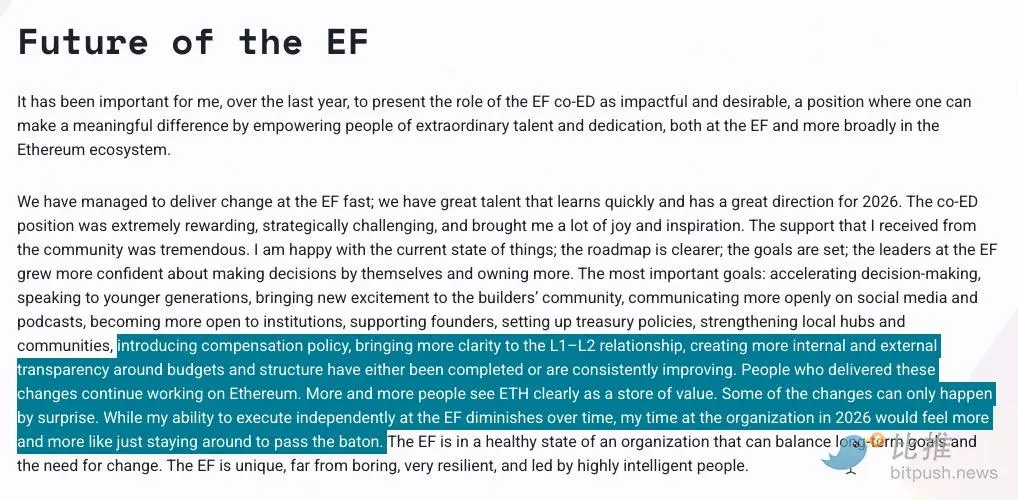
Stańczak’s departure statement is quite candid and somewhat thought-provoking. He provided several key points:
First, he believes that the Ethereum Foundation and the entire ecosystem are “in good health.” The time has come for a transition.
Second, he wants to return to “hands-on product building,” focusing on the integration of AI and Ethereum. He said his current mindset is similar to when he founded Nethermind in 2017.
Third—and most intriguingly—he stated: “The Foundation’s leadership is increasingly confident in their decision-making and control over more matters. Over time, my ability to independently execute within the Foundation has diminished. If I stay longer, by 2026 I will mostly be waiting to hand over the baton.”
This reveals two implications: one, that the new leadership team has developed self-motivation and no longer needs his constant involvement; two, that his actual influence may be shrinking—something that doesn’t sit well with someone used to direct action and entrepreneurial drive.
He also mentioned, “I know many ideas about agent-based AI are still immature or even useless, but it’s these experimental games that define the innovative spirit of early Ethereum.”
This somewhat subtly criticizes the current state: as the organization matures and decision-making becomes more “steady,” does the wild, experimental spirit risk being lost?
Stańczak’s departure appears to be a personal choice on the surface, but behind it lies the long-standing dilemma faced by the Ethereum Foundation.
Since its inception, the organization has been in an awkward position. In theory, Ethereum is decentralized, and the Foundation shouldn’t be a central authority issuing commands. But in reality, it controls substantial funds, core developer resources, and ecosystem coordination discourse, objectively playing a dual role akin to a “central bank” and a “regulatory authority.”
This identity paradox has led to a long-standing dilemma: doing too much invites accusations of centralization; doing too little invites criticism of inaction. Miyaguchi’s era leaned toward a “coordinator” role, which was criticized as weak; Stańczak’s attempt to shift toward an “executor” role improved efficiency but naturally concentrated organizational power.
His departure exposes this tension: as the organization becomes more efficient and decisive, the personal space for founding team members shrinks. For an ecosystem that must balance “decentralization” with “market efficiency,” this internal friction is almost unavoidable.
What kind of person is Bastian Aue, who replaces Stańczak?
Very little public info. He described himself on X as responsible for “difficult-to-quantify but critical work” at the Foundation: assisting management decisions, communicating with team leads, budget considerations, strategic planning, setting priorities. His low-profile style contrasts sharply with Stańczak’s entrepreneurial image.
Aue stated in his acceptance: “My decision-making is based on principles related to certain attributes of what we are building. The Foundation’s mission is to ensure that truly permissionless infrastructure—centered on the cypherpunk spirit—can be established.”
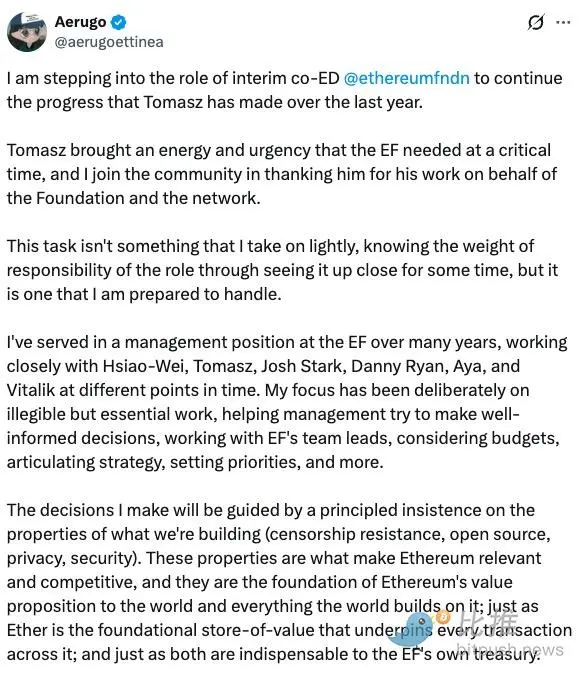
This sounds more like Miyaguchi’s style: emphasizing principles, spirit, and coordination rather than dominance.
Does this mean the Foundation will shift back from “aggressive execution” to “principled coordination”? We’ll have to wait and see.
Ethereum’s Uncertainty
Stańczak’s departure coincides with a series of major proposals under discussion at Ethereum. According to him, the Foundation is about to release several key documents, including the “Lean Ethereum” plan, future development roadmap, and DeFi coordination mechanisms.
The “Lean Ethereum” proposal has been jokingly called “Ethereum’s weight-loss era”—aiming to simplify the protocol, reduce burdens, and make the mainnet more efficient.
These strategic documents will profoundly influence Ethereum’s development path in the coming years. The change in core leadership at this critical juncture adds uncertainty to the implementation of these proposals.
On a broader level, Ethereum faces multiple challenges: competition from high-performance chains like Solana, Layer 2 fragmentation issues, new narratives around AI and blockchain integration, and the overall market sentiment affecting ecosystem funding and attention.
On the very day Stańczak announced his departure, ETH briefly dropped below $1,800. If it falls further, an awkward reality emerges: the total return on ETH holdings may fall below the interest rate of cash in US dollars.
To put it more painfully: in January 2018, ETH first hit $1,400. Adjusted for US CPI inflation, that amount would be roughly equivalent to $1,806 in February 2026.
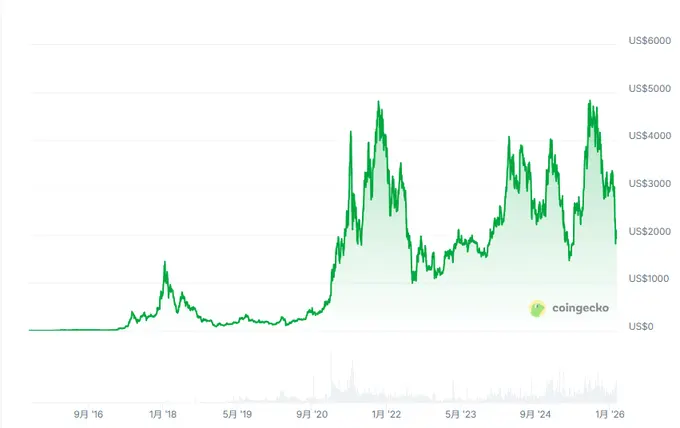
In other words, if an investor bought ETH in 2018 and held it without staking, after eight years, they would not only have made no profit but would have underperformed simply holding cash in a bank account.
For the true believers who have trusted ETH all along, the real question may not be “who wins the ideological battle,” but “how much longer can this last?”
The only certainty is that this core organization, which controls one of the most important ecosystems in crypto, is still searching for its position in a rapidly changing industry—and that this journey will undoubtedly be turbulent.


