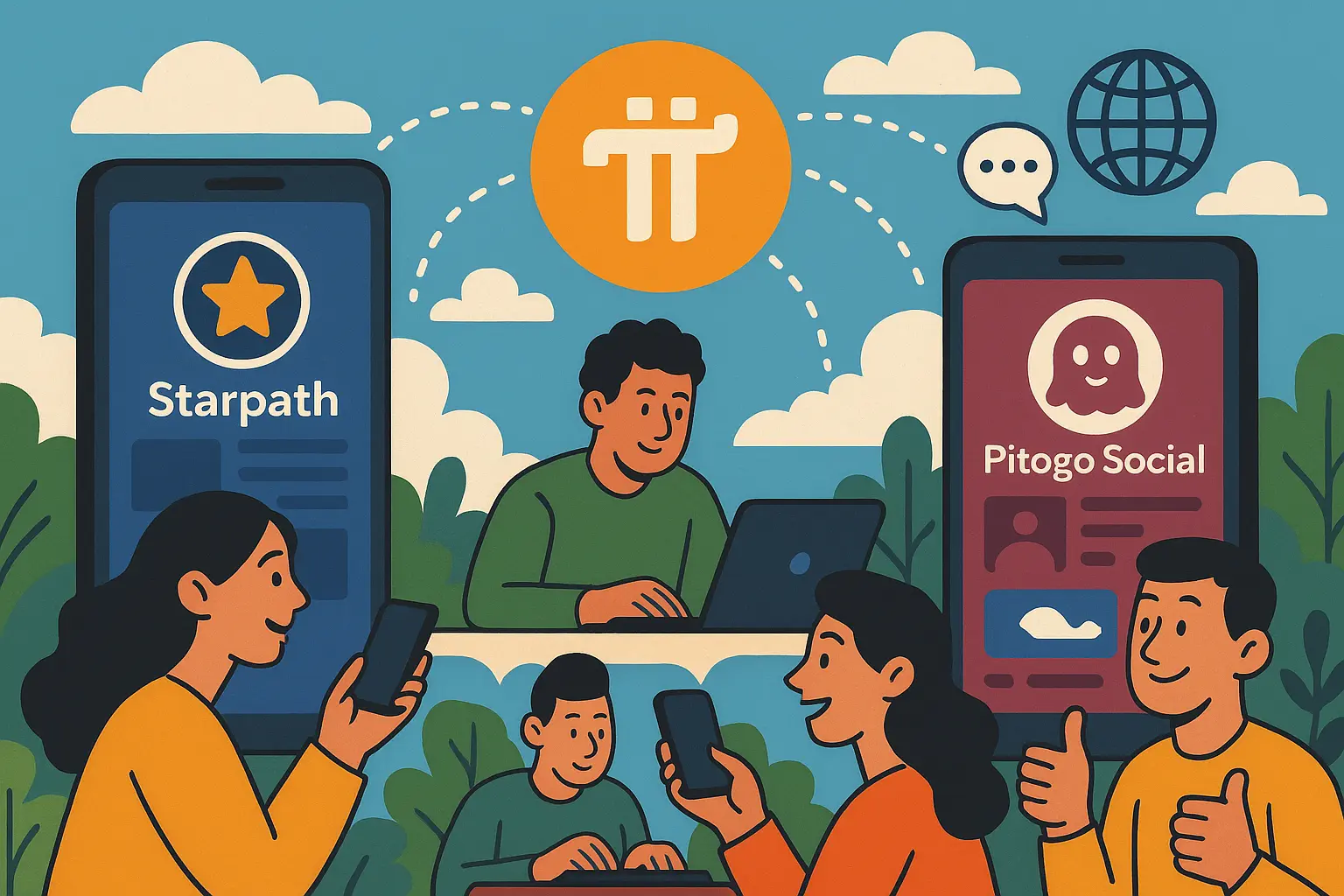
Pi Coin launches the Starpath and Pitogo Social testnets. Starpath is an AI chatbot that helps users learn about blockchain and Web3 features. Pitogo Social creates a robot-free community platform where users can post content and earn active points. 16 million users have migrated to the mainnet, with a total of 35 million registered users.
Starpath AI Chatbot: Pi Users’ Web3 Learning Assistant
Starpath is a chatbot-style application designed specifically for the Pi testnet. It helps users learn blockchain fundamentals and experience various Web3 functions. The app also allows developers to test small practical tools before launching on the mainnet. Users can interact with the chatbot to explore different features and tools. Since the app runs in Pi Network’s test environment, it does not involve any real asset loss. This setup provides developers with a safe testing space.
From a functional design perspective, Starpath serves as an educational gateway within the Pi ecosystem. For millions of new blockchain users on Pi, concepts like blockchain wallets, smart contracts, and decentralized applications are unfamiliar. Starpath lowers the learning barrier through a conversational interface, allowing users to ask AI questions as if talking to a real person and receive instant, easy-to-understand explanations. This interactive learning experience far surpasses reading lengthy technical documents.
Interestingly, some updates indicate that users can create simple applications or chatbot tools using small amounts of Pi. This means Starpath is not just an educational tool but also a low-code development platform. Users can create basic applications through conversational commands without mastering complex programming languages. This “everyone is a developer” vision aligns with Pi Network’s inclusive philosophy.
The Starpath team states that user feedback will help improve the app. Every interaction influences future development, which will eventually be released on the mainnet. This release also demonstrates how Pi Network integrates artificial intelligence into its ecosystem. This incremental development and community co-creation model is one of Pi Network’s distinguishing features from other blockchain projects.
Strategically, the launch of Starpath paves the way for practical applications of Pi Coin. When users learn how to use wallets, trade in decentralized apps, and participate in DeFi protocols via the AI assistant, they will naturally become active users once the mainnet is live. This early user education significantly reduces onboarding friction and barriers after the mainnet launch.
Pitogo Social: A Real Social Experiment Without Bots
Meanwhile, Pitogo Social has also joined the testnet. This app aims to create a social platform designed specifically for Pi users. The platform emphasizes meaningful interactions rather than endless scrolling. Users can interact with others, post content, and earn active points. Its goal is to encourage genuine engagement rather than passive browsing.
The biggest selling point of Pitogo Social is its promise to create a “bot-free environment.” In today’s social media ecosystem, bot accounts, fake interactions, and algorithm manipulation are major issues. Twitter and Facebook are flooded with bot accounts that generate fake traffic and spread spam, damaging authentic user experience. Pitogo Social claims to focus on real users and community-driven content, which is highly appealing in principle.
However, technically achieving a “bot-free” environment is a huge challenge. Pitogo Social may leverage Pi Network’s KYC system as a first line of defense, since all Pi users must pass identity verification to migrate to the mainnet. Accounts created after KYC are more likely to be genuine than anonymous registrations. Additionally, the platform might use behavioral analysis algorithms to detect abnormal posting frequency, interaction patterns, and content similarity, automatically flagging suspicious bot accounts.
The active points system provides economic incentives for user participation. Users who post high-quality content, receive genuine interactions, or help manage the community can earn points. These points could be exchanged for Pi or platform-specific benefits in the future. This “participation as mining” model combines social behavior with economic value, a typical design in Web3 social platforms.
This app is developed by a team with long-standing involvement in the Pi ecosystem. They previously launched a travel-related token on the testnet. Now, they are expanding into social media. Their continuous entrepreneurial efforts within the ecosystem show Pi Network is cultivating a group of native developers focused on the Pi ecosystem. This is crucial for the long-term health of the ecosystem.
Three Key Innovations of Pitogo Social
Real Identity Verification: Based on Pi Network’s KYC system, ensuring each account is linked to a real user
Economic Incentives: Reward high-quality content creation and community contributions with active points
Anti-Algorithm Manipulation: Emphasize meaningful interactions over endless scrolling, counteracting the negative effects of attention economy
Product-wise, Pitogo Social aims to strike a balance between centralized giants like Twitter and Facebook, and decentralized protocols like Lens Protocol and Farcaster. It leverages blockchain-based identity verification and economic incentives while offering a user experience similar to traditional social platforms. Whether this “middle ground” approach succeeds depends on attracting enough active users to generate network effects.
Testnet Expansion and Mainnet Migration: 16 Million vs. 35 Million
As the Pi 幣 testnet ecosystem continues to grow, the launch of these applications marks ongoing development. Pi Network currently has over 35 million users, many of whom are eagerly awaiting the mainnet launch. However, with increasing utility, approximately 16 million users have migrated to the mainnet, meaning only about 45.7% of registered users have completed migration.
This migration rate highlights a core challenge for Pi Network: many users are unable to migrate due to KYC failures or technical barriers, leaving their Pi locked in the testnet. For these users, testnet applications like Starpath and Pitogo Social offer continued participation opportunities and serve as a form of compensation for their patience.
The rollout of testnet apps has multiple strategic implications. First, it provides developers with a safe environment for testing. Bugs and performance issues identified in the testnet can be fixed before mainnet launch, avoiding real losses. Second, it offers users early experience, helping them develop habits and familiarity. When the mainnet goes live, users can immediately engage without a steep learning curve.
The launch of new applications gives users more reasons to stay active and helps developers test real-world scenarios before official release. This process allows the team to identify issues early and improve performance. Recent Pi Coin news also mentions faster account migration and ongoing protocol upgrades, all aimed at preparing for broader network adoption.
Based on timing, the expected launch of Starpath and Pitogo Social in February suggests the mainnet timeline is accelerating. If these apps complete thorough testing and fixes within the next one to two months, it could pave the way for the full mainnet opening in Q2 2026. For the Pi community waiting for years, this would be a major milestone.
Currently, the focus remains on building practical tools. The addition of Starpath and Pitogo Social indicates the testnet ecosystem is growing steadily. This signals a shift toward real-world applications rather than just mining and speculation. Practical utility is fundamental to Pi Coin’s long-term value.
Disclaimer: The information on this page may come from third parties and does not represent the views or opinions of Gate. The content displayed on this page is for reference only and does not constitute any financial, investment, or legal advice. Gate does not guarantee the accuracy or completeness of the information and shall not be liable for any losses arising from the use of this information. Virtual asset investments carry high risks and are subject to significant price volatility. You may lose all of your invested principal. Please fully understand the relevant risks and make prudent decisions based on your own financial situation and risk tolerance. For details, please refer to
Disclaimer.


