Bitcoin developers largely dismiss quantum computing as a near-term threat to network security, according to an index of public statements compiled by Nic Carter.
Carter’s Index Shows Bitcoin Developers Largely Unmoved by Quantum Computing Warnings
Nic Carter, a general partner at Castle Island Ventures and co-founder of Coin Metrics, assembled comments from Bitcoin developers to assess how seriously they view quantum risks compared with claims circulating in broader crypto discussions. His compilation suggests that most developers see quantum-related concerns as speculative rather than imminent.
The index published to Substack draws from forum posts, mailing lists, and public discussions in which developers responded to questions about whether advances in quantum computing could compromise Bitcoin’s cryptography. In most cases, developers characterized such scenarios as highly theoretical, emphasizing the absence of practical quantum machines capable of breaking elliptic curve cryptography at scale.
Carter has been flagging quantum-related risks for an extended period and has argued that Bitcoin developers are effectively “Sleepwalking” toward a future quantum reckoning. On Wednesday, he released the index and said on the social media platform X, “ Bitcoin developers are not concerned about quantum risk – with receipts.” He further added:
My piece profiles the attitudes of about 40 different Bitcoin developers in their own words, if you disagree with how I’ve characterized your view shoot me a DM or email and I’ll update it.
Several developers cited the long timelines typically associated with quantum breakthroughs, arguing that even meaningful progress would likely be gradual and publicly visible. That visibility, they said, would give the network time to respond through standard upgrade processes rather than emergency interventions.
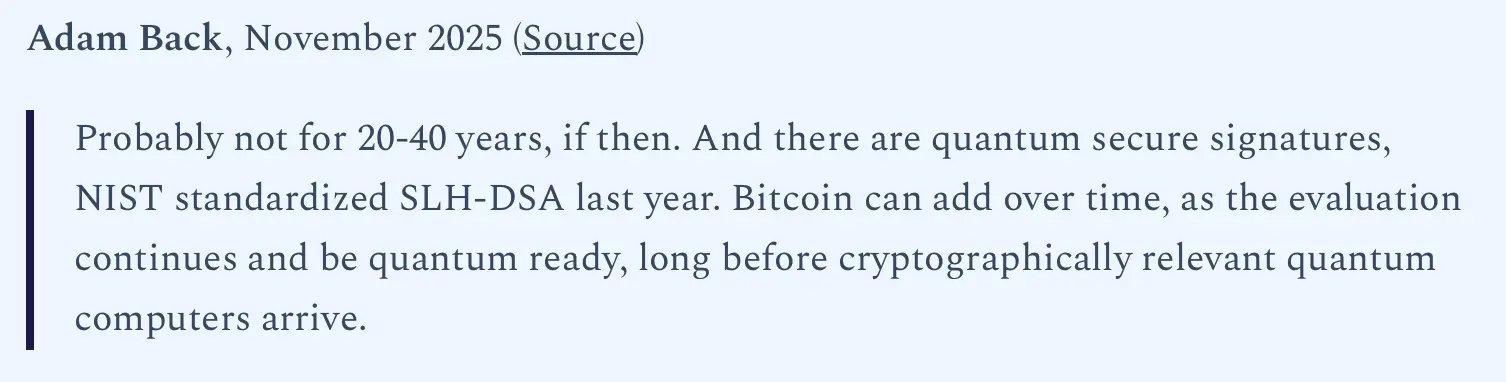 Screenshot from Nic Carter’s compilation of developer statements.
Critics of this stance argue that Bitcoin’s decentralized governance model could slow reaction times if a genuine quantum threat emerges. They point out that Bitcoin relies on a relatively small group of contributors to propose and review changes, raising concerns about whether the network could coordinate quickly enough under pressure.
Screenshot from Nic Carter’s compilation of developer statements.
Critics of this stance argue that Bitcoin’s decentralized governance model could slow reaction times if a genuine quantum threat emerges. They point out that Bitcoin relies on a relatively small group of contributors to propose and review changes, raising concerns about whether the network could coordinate quickly enough under pressure.
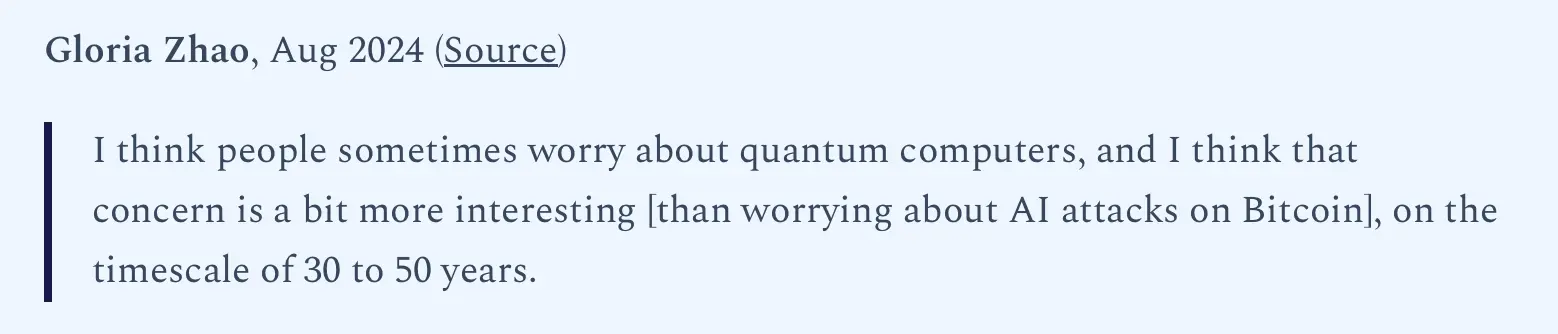 Screenshot from Nic Carter’s compilation of developer statements.
Some researchers and commentators have warned that quantum computers could eventually derive private keys from exposed public keys, potentially allowing attackers to spend coins without authorization. These warnings often cite dormant or reused addresses as hypothetical points of vulnerability if cryptographic assumptions were to fail.
Screenshot from Nic Carter’s compilation of developer statements.
Some researchers and commentators have warned that quantum computers could eventually derive private keys from exposed public keys, potentially allowing attackers to spend coins without authorization. These warnings often cite dormant or reused addresses as hypothetical points of vulnerability if cryptographic assumptions were to fail.
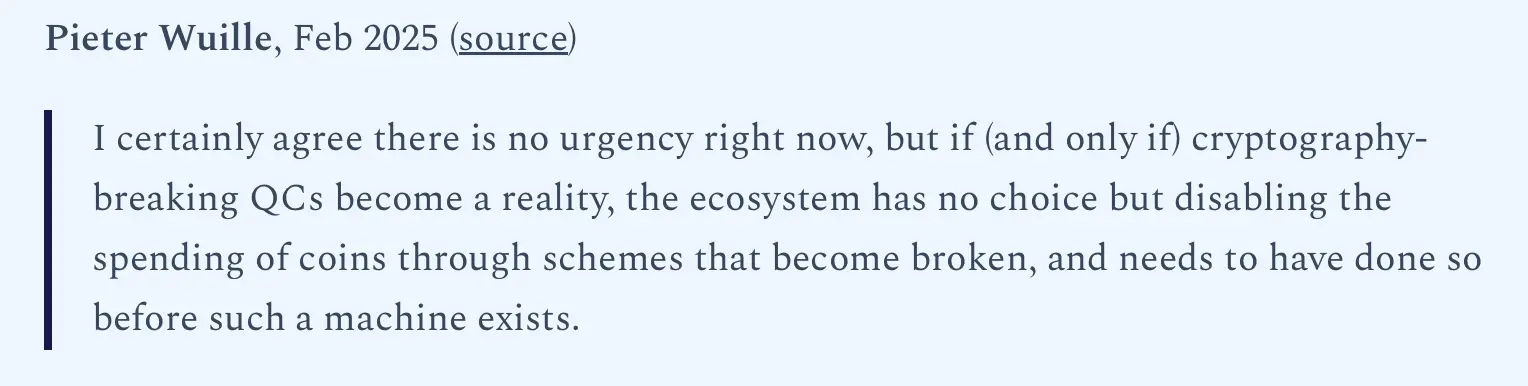 Screenshot from Nic Carter’s compilation of developer statements.
Carter’s compilation shows that many developers push back on these claims, noting that Bitcoin already minimizes key exposure by default and that users can further reduce risk through best practices. Developers also emphasized that theoretical vulnerabilities do not automatically translate into real-world exploitability.
Screenshot from Nic Carter’s compilation of developer statements.
Carter’s compilation shows that many developers push back on these claims, noting that Bitcoin already minimizes key exposure by default and that users can further reduce risk through best practices. Developers also emphasized that theoretical vulnerabilities do not automatically translate into real-world exploitability.
The discussion has also touched on potential protocol upgrades, including proposals such as BIP360, which would introduce quantum-resistant cryptographic schemes. While some developers view such proposals as prudent long-term research, Carter’s index indicates that most do not see an immediate need to prioritize them.
Developers referenced in the index often stressed trade-offs involved in major cryptographic changes, including increased transaction sizes, performance considerations, and compatibility with existing infrastructure. These costs, they argued, should be weighed against realistic threat models rather than speculative scenarios.
The debate reflects a broader tension within Bitcoin’s development culture, which historically favors conservative changes and extensive peer review. From this perspective, the absence of urgency around quantum risks aligns with Bitcoin’s incremental approach to protocol evolution.
Also read: Wintermute Founder Casts a Cold Eye on Crypto’s Direction
Carter framed the index as an observational snapshot rather than an endorsement of any position, highlighting the gap between public anxiety about quantum computing and the views expressed by those maintaining the software. He noted that the compilation is intended to inform discussion, not settle it.
As quantum research continues to advance, the question of when, or whether, Bitcoin should adopt quantum-resistant cryptography remains unresolved. For now, Carter’s findings suggest that most developers believe existing safeguards and long timelines leave room for measured responses rather than immediate action.
FAQ ❓
- What did Nic Carter analyze?
Carter compiled public statements from Bitcoin developers addressing quantum computing risks to the network.
- Are Bitcoin developers worried about quantum attacks?
Most developers cited in the index view quantum threats as theoretical and not an immediate concern.
- Could Bitcoin upgrade to resist quantum computing?
Proposals such as BIP360 exist, but developers generally see them as long-term research rather than urgent fixes.
Carter is a general partner at Castle Island Ventures and a co-founder of Coin Metrics.
Disclaimer: The information on this page may come from third parties and does not represent the views or opinions of Gate. The content displayed on this page is for reference only and does not constitute any financial, investment, or legal advice. Gate does not guarantee the accuracy or completeness of the information and shall not be liable for any losses arising from the use of this information. Virtual asset investments carry high risks and are subject to significant price volatility. You may lose all of your invested principal. Please fully understand the relevant risks and make prudent decisions based on your own financial situation and risk tolerance. For details, please refer to
Disclaimer.
Related Articles
Over the past 7 days, a certain exchange’s BTC wallet balance fell by 5.03%, and a certain CEX’s reserve assets saw net outflows of more than $143 million
Over the past 7 days, among the top 10 exchanges by BTC wallet balance, one exchange had the largest decline of 5.03%, while Gate had the largest increase of 2.54%. In terms of reserve assets, the top three net outflows were from a certain CEX, another CEX, and a third CEX, while Gate’s net inflow exceeded $103 million.
GateNews13m ago
Bitcoin Drops Below $69k: Trump’s Final Ultimatum to Iran Triggers Risk-Off Selling
Bitcoin fell to $685,000 on April 7, down about 2% for the day. Driven by concerns over the Middle East situation, risk-off sentiment has increased. With the market under pressure and international oil prices rising, the crypto market has faced headwinds, and investors lack confidence in a Bitcoin rebound. In the short term, macro events will continue to affect Bitcoin’s price action.
GateNews19m ago
The five major giants control the billion-dollar crypto market: BlackRock is driving the Bitcoin ETF landscape, and competition on Wall Street is intensifying
By 2026, the U.S. crypto asset management market landscape is gradually taking shape, and major institutions use compliant tools such as ETFs to manage more than $100 billion in assets. BlackRock leads, followed closely by Fidelity and Grayscale, while Bitwise and Galaxy compete with differentiated strategies. Meanwhile, Morgan Stanley’s Bitcoin ETF application could reshape the market landscape, shifting the competitive focus to where the capital flows and the product structure.
GateNews25m ago
IMF Warns Global Imbalances Are Worsening: Tariffs May Fail or Push Capital Flows Toward Bitcoin and Stablecoins
Research by the International Monetary Fund shows that tariffs have a limited effect in regulating global trade deficits, and that the real influencing factors are macroeconomic policies. As global imbalances expand and financial risks rise, market structures may adjust, and crypto assets could become a tool for hedging uncertainty.
GateNews29m ago
Schwab Wealth Management opens Bitcoin and Ethereum trading: 38.9 million users enter, disrupting the crypto market landscape
Traditional finance giant Charles Schwab plans to launch “Schwab Crypto” in the second quarter of 2026, offering spot trading of Bitcoin and Ethereum to 38.9 million customers. This model will lower the investment threshold, change the previous way investors indirectly allocate to crypto assets, and meet market demand. Meanwhile, with low fees and a large customer base, Schwab may disrupt existing crypto platforms, and in the future it may also roll out stablecoin products to build a digital asset ecosystem.
GateNews38m ago
Big data is coming this Thursday: whether Bitcoin can hold $67k depends on the Fed’s signals
This week, the U.S. will release four macroeconomic data points, including the FOMC meeting minutes and CPI data, which could determine whether Bitcoin can hold the $67k level. Bitcoin is currently trading in a range around $69k, with a 23% decline year-to-date. Market sentiment is subdued, and institutional capital support is limited, resulting in weaker demand—making this a key moment in the long-versus-short battle.
GateNews41m ago


