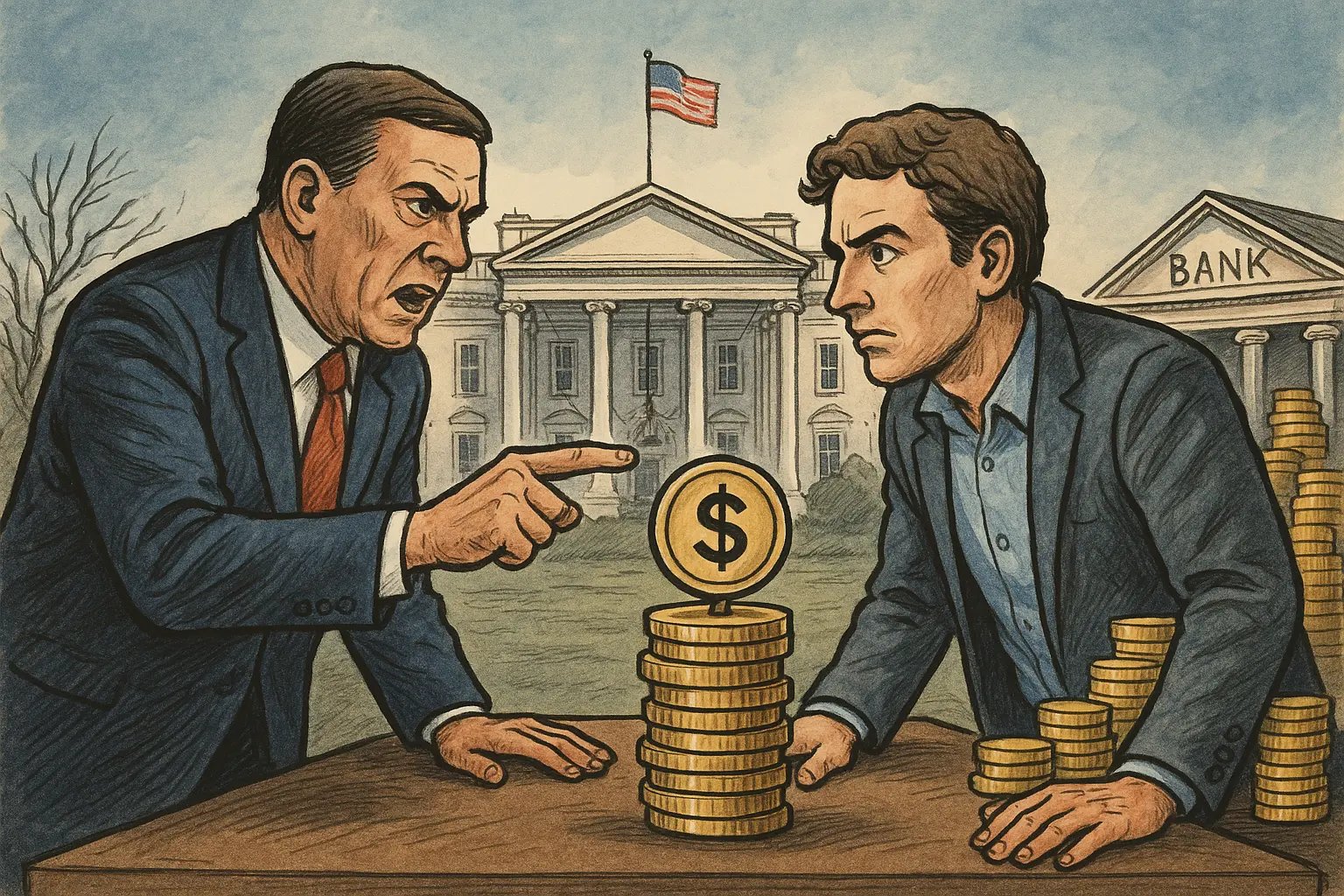
The White House demands resolution of the stablecoin yield controversy by the end of February, or market structure legislation will collapse. Banks estimate that in an extreme scenario, deposit outflows could reach $6.6 trillion, and Standard Chartered predicts a $500 billion outflow by 2028. The core issue: whether exchanges can offer rewards for stablecoins. Banks advocate banning anti-volatility savings products, while Coinbase states Congress retains the authority to grant third-party rewards. A three-way compromise: activity-based rewards, reserves stored in community banks, and retail bans on institutional access.
Extreme Scenario: $6.6 Trillion in Deposit Outflows
Stablecoins have crossed a threshold, turning hypothetical risks into quantifiable risk exposure. As of early February 2026, the total market cap of stablecoins is approximately $305 billion. This figure is sufficient for banks to simulate deposit outflow scenarios and for regulators to worry about financial stability. According to DeFiLlama data, the total market cap of stablecoins grew from less than $50 billion in 2021 to about $305 billion in early 2026, a more than sixfold increase over five years.
Standard Chartered estimates that by the end of 2028, U.S. bank deposits could outflow by about $500 billion, closely tied to the adoption of stablecoins. The bank explicitly states that this trend depends on whether third parties can offer interest. If platforms like Coinbase are permitted to pay 4-5% yields on stablecoin holdings, while bank savings accounts offer only 0.5-1%, rational savers will transfer large amounts of funds. A $500 billion outflow would represent roughly 2.7% of total U.S. bank deposits, which, while not causing systemic crises, could severely damage small and medium-sized banks.
The Banking Policy Institute cites a Treasury Department estimate that, under certain assumptions, deposit outflows could reach as high as $6.6 trillion. This is a high-end stress scenario designed to persuade the public, assuming all stablecoin holders receive yields significantly higher than bank deposits. $6.6 trillion would constitute about 35% of the $18.61 trillion in U.S. commercial bank deposits, and if it occurs, it would be a seismic shock to the financial system.
Comparison of Three Scenarios: Stablecoins and Bank Deposits
Baseline Scenario: $305 billion in stablecoins, 1.6% of deposits (current)
Gradual Scenario: $500 billion outflow, 2.7% of deposits (Standard Chartered forecast)
Extreme Scenario: $6.6 trillion outflow, 35% of deposits (Treasury stress test)
This structural conflict is not a minor obstacle on the road to crypto-friendly regulation. Instead, when the scale of digital dollars becomes large enough to threaten the core business model of deposit-taking, a fundamental clash occurs. Banks rely on cheap deposits, paying very low interest to attract deposits, then lending or investing at higher rates to earn spreads. If stablecoin platforms can offer returns close to Treasury yields, the banks’ cheap deposit base will evaporate, collapsing their profit models.
Coinbase vs. Banking: Zero-Sum Game
The technical debate centers on whether exchanges, wallets, or other intermediaries can pass on Treasury yields as “rewards” to stablecoin holders. Stablecoin issuers earn returns by holding reserves (e.g., short-term Treasuries and overnight bonds). However, under congressional frameworks, issuers are prohibited from directly paying interest to holders. This ban is intentional: legislators want to distinguish paying stablecoins from deposit accounts.
Banks argue that allowing exchanges or affiliated companies to offer similar rewards would circumvent this intent. The American Bankers Association and the Banking Policy Institute urge senators to “close loopholes,” asserting that any third-party payments linked to stablecoin balances effectively turn these into savings products. The logic is: if holding stablecoins yields returns, consumers will treat them as savings tools rather than payment instruments, blurring the line with bank deposits.
Coinbase and crypto industry groups counter that Congress explicitly reserved the ability for third parties to offer legitimate rewards. The Blockchain Association’s letter states that the stablecoin framework GENIUS prohibits issuers from participating, but leaves room for platforms to design incentives related to usage, trading, or other activities. The argument is: Coinbase is not an issuer; it’s a distribution platform and should have the right to design its own reward mechanisms.
This is not mere semantics but a dispute over who has the authority to digitally pass Treasury yields to consumers, and whether doing so outside the banking system constitutes unfair competition or legitimate product innovation. It’s a zero-sum game: if Coinbase wins, banks will lose deposits; if banks win, Coinbase’s business model is constrained. Both sides are acutely aware of the stakes and are unwilling to back down.
Three Possible Compromises
If Coinbase, banks, and other stakeholders reach consensus this month, the CLARITY Act can advance. However, it’s almost certain that the final version will be a compromise neither side fully favors. The most likely compromise is establishing a “activity-based rewards” safe harbor. Currently discussed language in the Senate mainly revolves around banning rewards solely for holding stablecoins, while allowing activity-linked rewards such as payments, trading, loyalty programs, and settlement.
The bill will define “only for holding” strictly, prohibiting marketing based on annual percentage yields, but allowing behavioral incentives. Platforms may shift from “deposit USDC and earn 4%” to “trade or route payments and earn rebates.” This legal language creates distinctions in theory, but the practical effect may be similar: users still receive some form of reward, just packaged differently.
A second option involves “reserves stored in community banks” as a trade-off. The compromise discussion includes requiring stablecoin reserves to be held in community banks. This is a political and industry policy move: turning stablecoins into a new distribution channel for bank assets and liabilities, rather than replacing bank balance sheets. Banks, by custodianship of stablecoin reserves, can still profit, reducing competitive threats.
A third approach would differentiate between retail and institutional investors. The bill could prohibit offering similar yield rewards to retail investors while allowing institutional investors to receive fee rebates or settlement incentives under disclosure and capital rules. This would steer stablecoin growth toward enterprise-to-enterprise settlement, collateral, and capital operations rather than consumer savings substitutes.
If no consensus is reached, broader digital asset market structure legislation will likely fall apart this year, and crypto regulation will fragment into enforcement actions by various agencies rather than comprehensive legislation. This fragmented regulation is the least desirable outcome for the crypto industry, reintroducing the uncertainty of the Biden era.
Disclaimer: The information on this page may come from third parties and does not represent the views or opinions of Gate. The content displayed on this page is for reference only and does not constitute any financial, investment, or legal advice. Gate does not guarantee the accuracy or completeness of the information and shall not be liable for any losses arising from the use of this information. Virtual asset investments carry high risks and are subject to significant price volatility. You may lose all of your invested principal. Please fully understand the relevant risks and make prudent decisions based on your own financial situation and risk tolerance. For details, please refer to
Disclaimer.
Related Articles
Nasdaq plans to speed up the process for adding large IPOs to its indexes, with the new rules taking effect on May 1
Nasdaq will roll out new rules on March 30 to speed up the process of adding newly listed large companies to the Nasdaq 100 index and shorten the waiting time. The new rules will take effect on May 1 and are intended to promote the IPO processes of technology companies such as SpaceX and OpenAI.
GateNews1h ago
US Traditional Exchange “On-Chain 3-Part Refrain”: Tokenization Is Reshaping Collateral, Trading, and Margin
Author: Jae, PANews
When Bitcoin is still sitting uncertainly around the $70,000 mark, Wall Street—the global financial heart—has completed three resonances within 48 hours.
Three giants controlling the flow of global capital—NYSE, Nasdaq, and CME Group—have successively announced upgraded plans for business tokenization. Nasdaq is developing a tokenized collateral management solution, the NYSE and Securitize are collaborating to develop a tokenized securities platform, and CME Group has rolled out institutional “tokenized cash” settlement services.
With the three top exchanges moving on three fronts at once, and leveraging blockchain technology, they have carried out a deep overhaul of the world’s liquidity “pipeline.”
When traditional Wall Street incumbents actively embrace tokenization, the rules of the global capital markets game are being rewritten.
Goodbye to T+1, Nasdaq uses tokenization to put $35 billion in collateral to work
$35 billion—this is what Nasdaq estimates is “sleeping” in global fi
区块客1h ago
Trump: Is in talks with Iran's “new government”; if they don't restart the Strait of Hormuz, they will completely destroy Iran's oil fields and power grid
According to the latest post by U.S. President Donald Trump on the social media platform Truth Social, the United States is conducting serious negotiations with Iran’s “new, more rational government,” and it has already made major progress. Trump issued a tough warning: if an agreement cannot be reached as soon as possible and the immediate restart of the Strait of Hormuz is not carried out, the U.S. military will completely destroy Iran’s oil wells, power plants, and energy lifelines such as Kharg Island.
(Background: Oil prices break 100! Trump says negotiations are near the end—“will take Iran’s oil,” analysts warn: Bitcoin’s bottom may test $46,000)
(Additional background: “Doomsday Doctor” Nouriel Roubini: Trump is very likely to “escalate the war with Iran”! Inflation’s rebound could force the Fed and the European Central Bank to raise rates)
Has the geopolitical situation in the Middle East reached a decisive moment? U.S. President Donald Trump’s latest post on his social media platform Truth
動區BlockTempo1h ago
Bitcoin ETF sees nearly $300 million in outflows in a single week! Global crypto funds end a streak of 4 weeks of inflows
Due to the impact of the Iran conflict and inflation expectations, investors’ risk appetite declined, leading to nearly $300 million in net outflows from U.S. Bitcoin spot ETFs last week. Global crypto funds also saw a reduction of $414 million in net inflows. Ether was hit the hardest, with outflows reaching $222 million; year-to-date it still shows negative net growth, while Bitcoin continues to maintain positive net inflows this year.
区块客1h ago
TradFi Fall Alert: NG (Natural Gas) Falls Over 4%
Gate News: According to the latest Gate TradFi data, NG (Natural Gas) has dropped by 4% in a short period. Current volatility is significantly higher than recent averages, indicating increased market activity.
GateNews1h ago


