Losses at CrossCurve underline the high risk of cross-chain bridges during periods of rising crypto attacks.
CrossCurve halted user activity after an attack targeted its cross-chain bridge. The incident forced developers to investigate a smart contract flaw. Partner protocols and and security firms issued warnings as funds were traced on-chain.
User Interactions Halted as CrossCurve Examines Contract Weakness
CrossCurve confirmed on Sunday that its cross-chain bridge was targeted by attackers. The team linked the incident to a flaw in one of the bridge’s smart contracts. Users were asked to pause all activity while developers began reviewing the issue.
Because assets are held across multiple smart contracts, moving them between networks increases risk when a single component fails.
⚠️ URGENT Security Notice
Dear users,
Our bridge is currently under attack, involving the exploitation of a vulnerability in one of the smart contracts used.
Please pause all interactions with CrossCurve while the investigation is ongoing.
We appreciate your patience and… pic.twitter.com/yfo1KvWoDd
— CrossCurve (@crosscurvefi) February 1, 2026
Curve Finance addressed its community shortly after the incident. Users with exposure to CrossCurve pools were advised to reassess their positions and decide whether to withdraw voting support. The statement urged careful judgment when interacting with external protocols during unstable conditions.
Early checks found damage limited to the bridge, with no issues detected across other protocol components. Alerts went out quickly, while the team kept access paused and tracked the movement of stolen funds.
Protocol Calls for Asset Returns After On-Chain Review
After tracing on-chain activity, the team found that funds from the exploit had moved into 10 wallet addresses. CrossCurve said it could not confirm whether those wallets belonged to the attackers and saw no clear hostile behavior at that point. Even so, the protocol acknowledged that users lost funds due to the exploit.
In response, project officials appealed directly to recipients to return the assets. The team described the transfers as improper and asked for cooperation. To support recovery efforts, CrossCurve activated its SafeHarbor WhiteHat policy, offering a reward of up to 10% of recovered funds if the rest is returned.
Details included a direct contact email for coordination. An alternative option allows anonymous returns through a designated wallet address. The team said recovered funds would be returned to affected users after review.
Moreover, CrossCurve shared a contact email to help coordinate the return of funds. A separate wallet address was also provided for those who prefer to send assets back without revealing their identity. After verification, the team said it plans to distribute recovered funds to affected users.
Recent Breaches Expose Ongoing Risks in Decentralized Finance
Crypto attacks have increased across the industry, with the CrossCurve incident adding to a growing list of breaches. Security firm CertiK recorded nearly $400 million in losses in January 2026, with more than 40 major incidents reported.
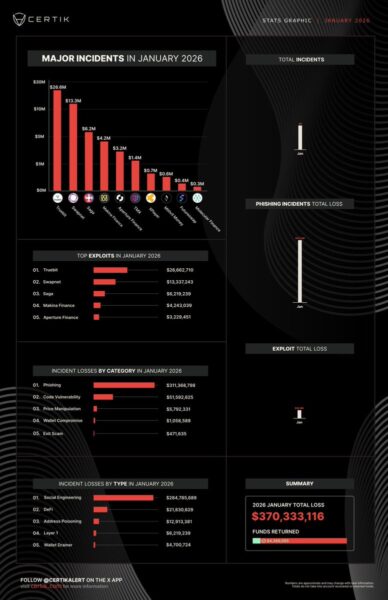
_Image Source: _X/CertiK
Cross-chain systems face a higher risk because they handle large amounts of funds and rely on complex structures. Recent incidents show how fast damage can spread once an exploit begins.
Other victims during the same period included Swapnet, which lost $13 million. Saga and Makina Finance reported losses of $6.2 million and $4.2 million. Step Finance also suffered a breach that drained several treasury and fee wallets, moving more than 261,000 SOL.
Losses across 2025 passed $1 billion, marking the worst year on record for crypto theft. The CrossCurve case adds another reminder of ongoing security gaps within decentralized finance.
Disclaimer: The information on this page may come from third parties and does not represent the views or opinions of Gate. The content displayed on this page is for reference only and does not constitute any financial, investment, or legal advice. Gate does not guarantee the accuracy or completeness of the information and shall not be liable for any losses arising from the use of this information. Virtual asset investments carry high risks and are subject to significant price volatility. You may lose all of your invested principal. Please fully understand the relevant risks and make prudent decisions based on your own financial situation and risk tolerance. For details, please refer to
Disclaimer.
Related Articles
Ripple Clarifies: No Official Telegram as Scam Accounts Rise - U.Today
RippleX warns of increasing impersonation accounts on Telegram posing as Ripple representatives, emphasizing that Ripple does not have an official channel and urging XRP users to verify communications. The XRP Ledger is seeing record growth, with over 7.7 million holders, supported by favorable SEC regulations.
UToday33m ago
BONK.fun Restarts After Domain Hijacking, Confirms $30,000 in Damages
BONK.fun has resumed operations after a recent domain takeover incident that caused $30,000 in user losses. The attack, attributed to a third-party vendor's vulnerability, involved phishing tactics. Despite recovering the domain, risks remain as some antivirus software still flags it, and the BONK token price continues to decline.
TapChiBitcoin2h ago
Husband accuses wife of stealing over 2,000 bitcoins! Judge: The plaintiff has a very high chance of winning.
The UK High Court recently heard a Bitcoin theft case in which plaintiff Ping Fai Yuen accused his separated wife Fun Yung Li of stealing Bitcoin from his hardware wallet through secret surveillance, valued at approximately $176 million. Audio recordings and search warrant evidence supported the plaintiff's claims. The court maintained the asset freeze order but rejected certain claims. The judge found the plaintiff had an extremely high likelihood of success and recommended expediting the trial date.
区块客2h ago
FBI: Fake TRC20 FBI Token Scam Emerges, User Privacy and Security Sound New Alarms
The US FBI's New York office warned blockchain users to be vigilant if they receive TRC-20 tokens claiming to be associated with the FBI, and to avoid disclosing personal information. This scam uses a fake FBI identity to pressure victims into submitting data and directs them to phishing websites in order to commit asset fraud.
区块客8h ago
NFT Whale Under Attack Continues Moving Funds
Arkham reported that stolen funds were moved for the first time since March 6, 2026, with nearly $1 million DAI transferred. The theft stemmed from a violent attack on Ethereum NFT whale Sillytuna, resulting in $23.6 million stolen. Over $7 million remains traceable, illustrating a rise in real-world crypto thefts.
TapChiBitcoin9h ago
South Korea's National Tax Service Plans to Complete Selection of Virtual Asset Custodian Service Providers in the First Half of the Year
Gate News - On March 21, South Korea's National Tax Service plans to complete the selection of virtual asset custodian service providers in the first half of this year. This initiative stems from a virtual asset theft incident that occurred last month, when the National Tax Service accidentally leaked mnemonic phrase information while announcing the results of an on-site investigation, resulting in the seized virtual assets being stolen twice.
GateNews11h ago


