An onchain analyst argues that Bitcoin developers are more actively addressing quantum computing risks than headlines suggest, with discussions accelerating in 2025 and highlighted by the first Quantum Bitcoin Summit in San Francisco.
Data Shows a Shift in Focus
Onchain analyst Willy Woo has entered the debate regarding bitcoin’s readiness for the looming quantum threat, claiming that significantly more work is happening behind the scenes than headlines suggest. While admitting that the initial response from bitcoin developers was slow, Woo insists the pace has accelerated, particularly during the second half of 2025.
“ Bitcoin dev response to quantum risks started in Jan. 2025 and accelerated midyear; we also saw the first Quantum Bitcoin Summit in July in SF,” Woo noted.
In a post on X, Woo shared archives from the bitcoin developers mailing list to support his argument. The data reveals that the share of messages discussing quantum resistance has consistently remained above 10% since June 2025, with October and November being the only exceptions.
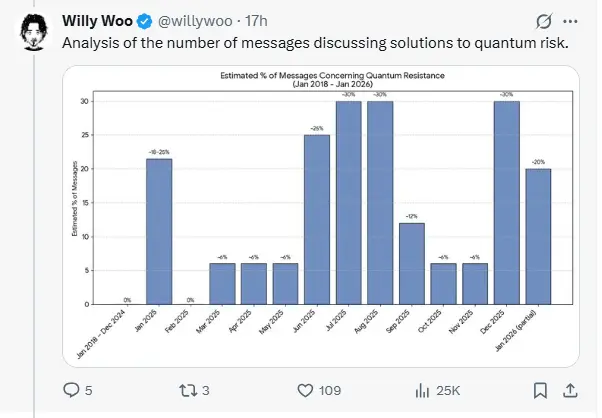
This defense comes amid growing alarm regarding the vulnerability of bitcoin addresses to quantum computing. Some analysts suggest these fears are already weighing on the market, contributing to bitcoin’s inability to break above the $100,000 mark for several weeks. Crypto advocate Nic Carter suggested that bitcoin’s recent price stagnation reflects a market waking up to long-term quantum risks. While developers may view the threat as distant, Carter argues institutional investors now see it as a legitimate “headwind.”
Read more: Is Quantum Computing Casting a Shadow Over Bitcoin’s Price?
This sentiment is gaining traction in traditional finance. Christopher Wood, a strategist at Jefferies, recently removed bitcoin from a recommended pension portfolio, citing the “existential technological threat” of quantum computing. On the other hand, Sergio Ermotti, the CEO of the financial services giant UBS, stated that bitcoin must overcome the quantum threat to maintain its long-term credibility as a store of value.
To counter the narrative of inaction, Woo’s analysis highlighted an “explosion” of technical discussions in 2025, following a period of near-total silence between 2018 and 2024.
The primary focus of these discussions—often exceeding 100 messages per thread—revolves around the vulnerability of ECDSA/Schnorr signatures to Shor’s algorithm. Key points of the current developer consensus include implementing voluntary transitions rather than forced protocol changes. There is an agreement to prioritize the maturity of the National Institute of Standards and Technology (NIST) post-quantum cryptography standards before integration.
Woo characterized the current atmosphere not as one of panic, but as “proactive engineering for a distant-but-real threat.”
FAQ ❓
- What is the quantum threat to bitcoin? Quantum computing could break Bitcoin’s cryptographic signatures, risking address security.
- How are developers responding? Bitcoin devs accelerated work in 2025, with discussions topping 10% of mailing list activity.
- Why is the market concerned? Analysts say quantum fears are weighing on Bitcoin’s price, stalling it below $100,000.
- What solutions are being explored? Developers favor voluntary transitions and NIST post‑quantum standards before protocol integration.
Disclaimer: The information on this page may come from third parties and does not represent the views or opinions of Gate. The content displayed on this page is for reference only and does not constitute any financial, investment, or legal advice. Gate does not guarantee the accuracy or completeness of the information and shall not be liable for any losses arising from the use of this information. Virtual asset investments carry high risks and are subject to significant price volatility. You may lose all of your invested principal. Please fully understand the relevant risks and make prudent decisions based on your own financial situation and risk tolerance. For details, please refer to
Disclaimer.
Related Articles
BTQ Study Finds Quantum Bitcoin Mining Would Require Star-Level Energy, Cites Signature Vulnerability as Bigger Threat
BTQ Technologies Corp. published a research paper on April 8, 2026 establishing the first end-to-end physical cost estimate for using quantum computers to mine Bitcoin.
CryptopulseElite33m ago
ETH Gains on BTC—Altcoin Season Index Vaults Higher as Crypto Frenzy Escalates
Following Jan. 30, 2025, blockchaincenter.net’s Altcoin Season Index reveals a 28.26% leap, vaulting from a low of 46 to its present tally of 59—a numerical crescendo hinting that the fabled ‘ Altcoin Season’ inches toward fruition. Across social media platforms like X, crypto-focused commentators n
Coinpedia50m ago
Strategy Signals Bitcoin Supply Shock With 2.2x New BTC Supply Acquired and 24,675 BTC Gain
Strategy Inc. accelerates bitcoin accumulation beyond network issuance, highlighting tightening supply dynamics as treasury performance metrics show rising BTC yield, gains, and sustained large-scale buying pressure.
Key Takeaways:
Strategy Inc. reported acquiring 94,470 BTC in 2026,
Coinpedia1h ago
Hyperscale Data first-quarter consolidated revenue increased by about 80% year over year to $45 million
Hyperscale Data expects its consolidated revenue for the first quarter of 2026 to reach $43 million to $45 million, up 72% to 80% compared with the same period in 2025. The growth is primarily driven by contributions from its Gresham and Ault Lending subsidiaries.
GateNews1h ago
SEC acknowledges mistaken enforcement in crypto, 95 companies face cumulative penalties of $2.3 billion
The U.S. Securities and Exchange Commission (SEC) acknowledges that its prior enforcement actions against the crypto industry have had shortcomings, emphasizing that the focus should not be on the number of cases. Since February 2025, seven crypto cases have been withdrawn, with the goal of adjusting policy. The new chair, Atkins, is pushing for regulatory innovation, proposing a “safe harbor” mechanism designed to give compliant space to startup crypto projects and aiming to reshape the industry’s compliance path.
GateNews1h ago


