
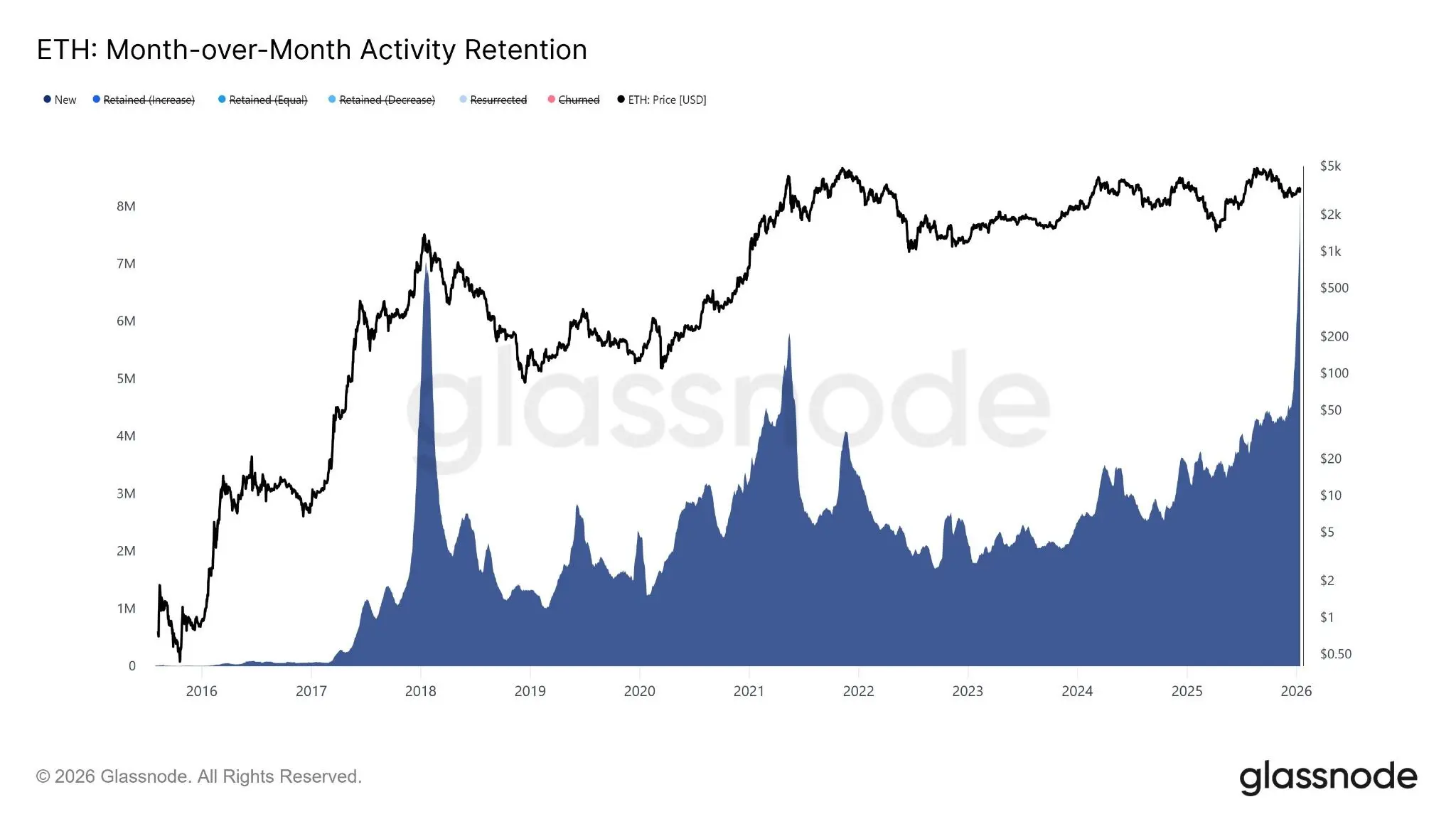
According to Glassnode's Thursday report, Ethereum's “Active User Retention Rate” has nearly doubled over the past month, with new active addresses skyrocketing from 4 million to 8 million, daily transaction volume soaring to a record high of 2.8 million, a 125% increase year-over-year. Over the past year, active addresses have increased from 410,000 to over 1 million, mainly driven by a surge in stablecoin usage and layer 2 scaling solutions reducing transaction fees.
Glassnode Data Reveals a New Wave of Ethereum Users
(Source: Glassnode)
The Glassnode report indicates that compared to last month, the “Active User Retention Rate” among new users has sharply increased, “indicating a surge in the number of first-time interacting addresses over the past 30 days.” This reflects a large influx of new wallets into the Ethereum network, “not just driven by existing participants.” Active user retention measures how many users remain active over time, essentially showing whether users stay to continue using the network rather than disappearing after a single interaction.
This month, the number of newly active addresses jumped from slightly over 4 million to about 8 million, a figure extremely rare in Ethereum's history. The monthly growth of 4 million means that over 130,000 new addresses join and remain active daily, a growth rate far exceeding the average of recent years. As the industry’s most authoritative on-chain analysis platform, Glassnode’s data covers multiple dimensions, including address activity, transaction volume, and holdings distribution, making this report highly reliable.
Looking at a longer timeframe, data from Etherscan shows that over the past year, the number of active addresses on the Ethereum network has more than doubled, from approximately 410,000 accounts last year to over 1 million as of January 15. This sustained growth indicates that Ethereum is not a short-term hype but is building a long-term user base. The increase from 410,000 to 1 million represents about 590,000 new active users in a year, users who are not just one-time participants but continue to engage with the network.
The surge in active user retention is highly significant for Ethereum. In the crypto space, many projects can attract large numbers of users in the short term, but the real test is whether these users stay. High retention rates mean users have found real use cases and value on Ethereum, rather than being attracted solely by short-term hype. Glassnode’s data shows that this wave of new users is not only entering the network but also continuing to use it, which is the best indicator of network health.
Daily Transaction Volume Hits Record High of 2.8 Million
Meanwhile, Ethereum’s daily transaction volume surged to a record high of 2.8 million on Thursday, a 125% increase compared to the same period last year. This number breaks all historical records since Ethereum’s launch in 2015, indicating an unprecedented peak in network usage. The spike in daily transaction volume reflects not only an increase in user numbers but also a rise in user activity, with each user performing more on-chain operations.
Macro-economic media Milk Road reported on Thursday that this is due to a surge in stablecoin usage on Ethereum, while transaction fees have plummeted. “This is the result of moving execution processes to layer 2 solutions while maintaining the security of layer 1 settlement. This is what a truly scalable financial infrastructure looks like.” While stablecoin usage hits all-time highs, fees are at historic lows, a rare inverse relationship that demonstrates the success of Ethereum’s scaling strategies.
Why have stablecoins become the core driver of this growth? As a bridge between the crypto world and fiat currencies, stablecoins are the main entry point for users into cryptocurrencies. The continued growth of stablecoins like USDT, USDC, and DAI on Ethereum makes cross-border payments, remittances, and DeFi lending more practical. When users can transfer with stablecoins at low cost and high speed, Ethereum’s practical value is greatly enhanced.
Three Major Effects of Layer 2 Scaling Reducing Fees
Cost Barrier Removal: Average transaction fees have dropped from peak levels of tens of dollars to a few cents, making small transactions feasible
Speed Improvement: Layer 2 solutions like Arbitrum and Optimism offer near-instant transaction confirmations
Enhanced User Experience: Low costs and high speeds attract traditional finance users into crypto
The maturity of Layer 2 technology is the key infrastructure behind this growth. While Ethereum mainnet (Layer 1) focuses on security and decentralization, Layer 2 solutions handle large volumes of transactions and periodically submit results back to the mainnet. This layered architecture allows Ethereum to achieve thousands of transactions per second without sacrificing security. Data from Glassnode confirms the success of this strategy, as transaction volume surges without network congestion or fee spikes.
Market Sentiment Turns Optimistic, Institutions Expect Breakthroughs
Market confidence and sentiment around Ethereum are improving. “Looking ahead, there are many reasons to be optimistic about Ethereum,” said Justin d'Anethan, Head of Research at Arctic Digital, to Cointelegraph. He added, “In the short term, some indicators that had been oversold have rebounded, suggesting prices could rise significantly, thanks to renewed inflows into ETFs, stablecoins, and native protocols.”
Nick Ruck, Director of LVRG Research, observed that Ethereum’s on-chain activity has surged, with daily transaction volume exceeding 2 million and staking nearing 36 million ETH. He commented, “These strong on-chain fundamentals, combined with ongoing ETF capital inflows and growing ecosystem optimism, could push ETH past current resistance levels in the short term. As institutional participation increases, liquidity tightens, and recent scaling upgrades have improved speed and reduced gas fees.”
All these active network activities and improved market sentiment should be positive for the blockchain token. Michaël van de Poppe, founder of MN Fund, said Thursday, “Ethereum is currently in a major compression phase, which is likely to break out next week.” From a technical analysis perspective, price compression often signals an imminent large move, and with such strong fundamentals, the breakout is usually upward.
Three Reasons Why Institutions Are Optimistic About Ethereum
Continued ETF Capital Inflows: Spot Ethereum ETFs provide compliant investment channels, with steady institutional capital inflow
Mature Staking Economics: 36 million ETH staked indicates confidence among long-term holders, reducing circulating supply
Ecosystem Expansion: Growth in DeFi, NFTs, stablecoins, and other applications creates real demand
Glassnode’s data provides solid on-chain evidence for these optimistic forecasts. As new users continue to pour in, transaction volumes hit new highs, and stablecoin usage soars, these are clear signals of a healthy network. Unlike price speculation, on-chain activity reflects genuine usage demand, and this demand-driven growth is more sustainable.
Related Articles
Ethereum Spot ETF saw net outflows of $41.9715 million yesterday, marking three consecutive days of capital outflows
March 22 News: Ethereum spot ETFs experienced a net outflow of $41.9715 million on March 20, marking the third consecutive day of capital outflows. Among these, BlackRock's Staked ETH ETF had a net inflow of $5.4658 million, while BlackRock's ETF ETHA saw a net outflow of $31.4508 million. Currently, Ethereum spot ETFs have total net assets of $12.328 billion, with cumulative net inflows of $11.729 billion throughout history.
GateNews25m ago
A certain whale withdrew 1,979 ETH from a certain CEX 1 hour ago, worth 4.16 million USD.
Gate News: On March 22, according to Onchain Lens monitoring, a whale withdrew 1979 ETH from a certain CEX 1 hour ago, valued at $4.16 million. Over the past month, the whale has cumulatively withdrawn 8662 ETH through the exchange, with a total value of $18.23 million.
GateNews40m ago
Resolv Attacker Spent 200,000 USDC to Mint 80 Million USR, Already Purchased 9,111 ETH
Onchain Lens detected that the Resolv attacker spent 200,000 USDC to mint 80 million USR and has already used it to purchase 9,111 ETH. The attacker is still converting USR to other cryptocurrencies and may continue to accumulate ETH.
GateNews41m ago
Attacker has bought in 4.55 million dollars of ETH
Gate News Report: On March 22, on-chain analyst Ai Auntie posted an analysis on X platform regarding the Resolve attacker's operations: 1. Minted 50 million USR tokens using 100,000 USDC; 2. Converted 35 million USR to wstUSR; 3. Continuously exchanged wstUSR for USDC and USDT; 4. Used USDT to purchase
GateNews1h ago
CFTC clarifies cryptocurrency margin rules: BTC and ETH capital deduction rate of 20%, permitting investment in the derivatives market
The U.S. Commodity Futures Trading Commission (CFTC) recently released an FAQ clarifying the rules for using cryptocurrencies as margin in derivatives markets, specifically setting capital deduction rates of 20% for Bitcoin and Ethereum and 2% for stablecoins. The pilot program will be limited to three coin types in the first three months, after which it will expand to additional cryptocurrencies and relax reporting requirements. Qualifying crypto assets may be used as margin, marking a gradual acceptance of blockchain assets within the U.S. financial system.
動區BlockTempo1h ago
Brother Maji Huang Licheng Opens 25x Leverage ETH Long Position Again, Holding 2200 Coins Worth $4.62 Million
Gate News: On March 22, Hyperbot data shows that the decline in the cryptocurrency market this morning led to the liquidation of all of Big Brother Machi Huang Lixuan's Ethereum long positions. One hour ago, Huang Lixuan opened a new Ethereum long position with 25x leverage, currently holding 2,200 ETH, valued at approximately $4.62 million, with an entry price of $2,091 and a liquidation price of $2,061.
GateNews1h ago


