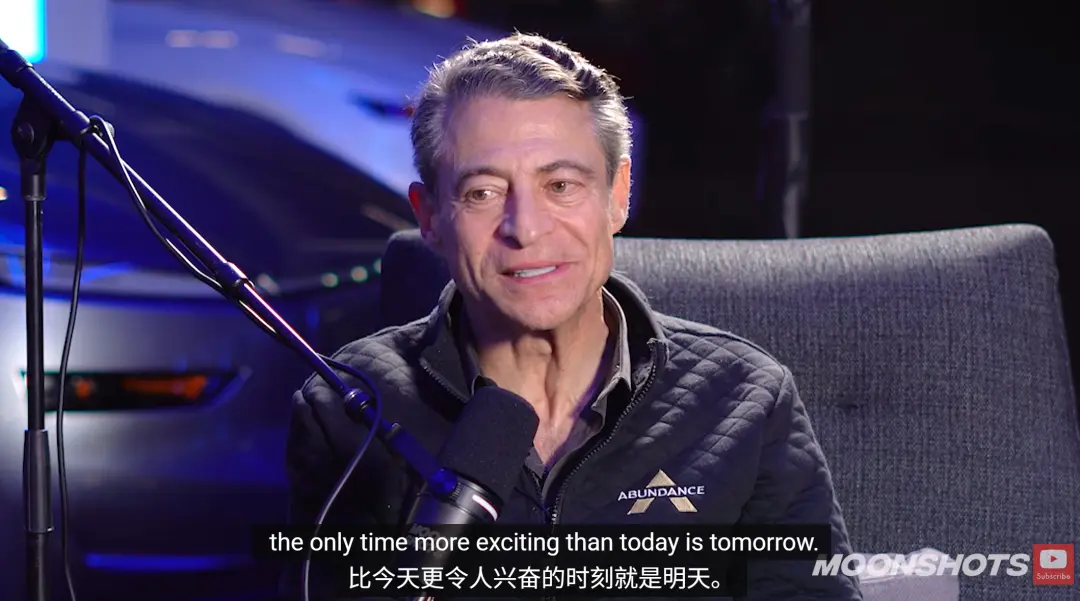
Video: Moonshots
Compiled by: Paradigm English
On January 6, 2026, Tesla founder Elon Musk was interviewed by renowned futurist and Singularity University founder Peter Diamandis( and investor Dave Blundin).
In this podcast titled “Moonshots#220,” the three engaged in an in-depth three-hour conversation. Musk clearly stated that 2026 will be the “Year of Singularity,” and elaborated on the industrial, technological, and economic foundations supporting this view, painting a future reshaped by technological revolution.
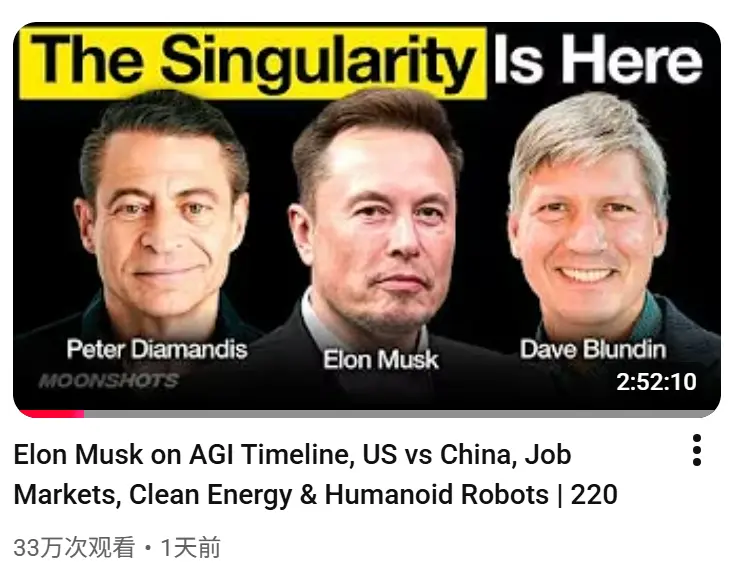
The discussion covers nearly 10 topics including artificial intelligence, societal changes in the workforce, energy development, education and talent, health and longevity, space exploration, innovation and entrepreneurship, with a total of 85,600 words, many of which contain insightful and visionary perspectives.
To help everyone quickly grasp the core points of the interview, I have organized and summarized the key content to share with you!
( 1. AI exceeds imagination, by 2030, intelligence level will surpass the total of all humans
Host Peter asked Musk, “Why are you so optimistic?”
Musk did not answer directly but instead offered a more shocking observation: “We are not heading toward the Singularity; we are already living in it.”
![])https://img-cdn.gateio.im/webp-social/moments-2d8afebaace512d1766a36713ea35e0e.webp###
He explained that the speed of AI progress has become so rapid that he is shocked several times a week—just when he thinks a breakthrough is impressive, a new shock appears two days later. This is the power of exponential growth.
Musk predicts that AGI (Artificial General Intelligence) will be achieved by 2026, and by 2030, AI’s intelligence level will surpass the sum of all human intelligence.
( 2. Disruption in healthcare, medical school will become meaningless
Facing the current shortage of doctors and excellent surgeons, Musk predicts that within three years, the Optimus robot will become a better surgeon than any human, and this will be a “scalable” application.
“Future, the best healthcare will basically be free,” Musk said.
Why so fast?
Musk attributes this to three exponential growth advantages of robotic doctors:
- First is the exponential increase in AI capability;
- Second is the exponential increase in chip performance;
- Third is the exponential increase in mechatronic dexterity.
Multiplying these three exponential curves results in a rocket-like explosion speed.
![])https://img-cdn.gateio.im/webp-social/moments-53f9d1d3685ac1bdc798fb606edf1d9d.webp###
Musk added that more importantly, there is the “recursive effect” of robots, meaning their experience can accumulate, and all robots share the same knowledge base.
10,000 robotic surgeons performing surgeries, each with the experience of 10,000 cases. They can precisely handle different patients, emergencies, complications, and even details under full-spectrum light such as infrared, ultraviolet, and X-ray; moreover, they won’t be distracted by a fight with family last night or suffer hand fatigue and mistakes after a 4-hour continuous surgery.
Musk believes that (attending medical school in the future) will be “completely meaningless—unless for social reasons.”
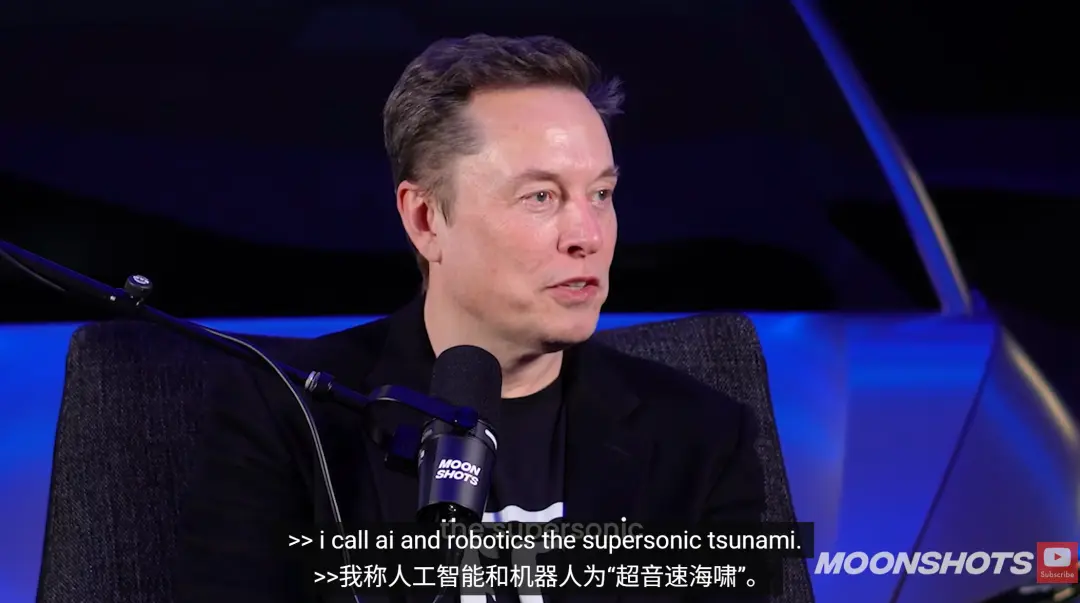
( 3. US-China AI competition, China’s computing power will far surpass other regions
Regarding the current AI competition, Musk confidently asserts: based on current trends, China will far surpass other regions in AI computing power.
![])https://img-cdn.gateio.im/webp-social/moments-8f00585e8eb083983bc7a1f77e93c001.webp###
He provides three key reasons:
(# 1) Electricity advantage crushes others
By 2026, China’s power generation will reach three times that of the US. Last year, China added 500 terawatt-hours of electricity, 70% of which came from solar energy. Musk couldn’t help but comment, “It’s like they listened to everything I said and immediately took action.”
)# 2) The chip performance gap is narrowing, Moore’s Law is dead
From 3nm to 2nm, chip performance has only increased by 10%, meaning Moore’s Law has failed. America’s chip advantage is diminishing, making it easier for China to catch up.
3) Unmatched execution capability
Musk admitted, “I’ve seen too many Chinese engineers; when demand is clear, their speed and scale of execution are unimaginable.”
He predicts that the final global AI competition will be among XAI, Google, and China.
![]###https://img-cdn.gateio.im/webp-social/moments-09ade1a21e444155b89314865987a724.webp###
( 4. Energy revolution, solar energy is the only answer
Regarding the prospects of solar energy, Musk’s attitude is extremely firm:
“Sun accounts for 99.8% of the mass of the solar system. Doing nuclear fusion on Earth is like making ice in Antarctica—there’s a giant free nuclear reactor 93 million miles above us. Why build a small one on Earth?”
He outlines a three-step plan to develop solar energy:
)# Step 1: Double the efficiency of existing power grids
Power plants have a lot of idle capacity at night, but peak electricity demand during the day is insufficient. The solution is to use Tesla’s Mega Pack batteries to store excess electricity at night and release it during peak hours, directly doubling energy throughput without building new power plants.
Step 2: Launch solar energy satellites into space
The environment in space, where AI satellites operate, is daylight 24 hours a day, making solar energy utilization most efficient. About 8,000 launches are needed, one per hour, to complete deployment over a year.
Step 3: Build satellite factories on the Moon
For larger-scale solar energy capture, launching satellites from Earth alone isn’t enough. Musk’s ultimate plan is to build factories on the Moon, use local materials to manufacture satellites, and directly send them into orbit from the Moon.
Musk emphasizes: “The future currency is essentially energy—once you have energy, you can drive AI, manufacture anything, and change the physical world.”
5. Economy and currency, money may become irrelevant in 10-20 years
This is one of the most disruptive views: “Don’t save for retirement.”
Musk explains that in 10-20 years, either we will no longer exist, or money will no longer be important.
Many worry that AI will cause mass unemployment, but Musk proposes a new concept—“Universal High Income” (UHI). This is not the government’s “Universal Basic Income (UBI),” but a deeper economic logical change:
AI and robots will increase the output of goods and services faster than the growth of money supply, causing prices to plummet and production costs to approach zero. When the output growth exceeds the money supply growth, prices will crash.
Because material resources will be extremely abundant, everyone can easily obtain the goods and services they want.
But he also warns that the next 3-7 years will be very turbulent:
We will experience radical change, social upheaval, and great prosperity simultaneously—an unavoidable transitional period. If none of this happens, it indicates a bigger problem—such as stagnation in AI development or societal collapse.
6. Careers and the future, work will become optional
Musk predicts that within less than 20 years, work will become optional, and AI and robots will turn work into a “hobby,” allowing people to freely pursue their interests.
He also worries about the declining global birth rate, believing that population decline is a major threat to civilization because “more people mean more consciousness, which helps humans understand the universe.”
7. Education and growth, learning is about returning to curiosity
Musk points out that traditional education models are dead.
Due to his own poor schooling experience, he does not like the current education system—“I find school very painful. Boring, and in South Africa, very violent.”
He believes that for years, the motivation driving him to keep learning has been “curiosity about the nature of the universe. I am just curious about the meaning of life and the reality we live in.”
With the rapid development of AI, he admits that AI can obviously become a personalized teacher. It has infinite patience and can answer all your questions. But you still need curiosity, still need to want to learn. He has already launched an AI personalized education pilot in El Salvador.
At the end of the interview, Musk also admitted that he was very pessimistic in the past, even suggesting slowing down AI development multiple times, but ultimately realized: instead of being a pessimistic spectator, it’s better to be an optimistic participant.
He sincerely sends everyone a message—turn hope into reality!
Let’s encourage each other!
![]###https://img-cdn.gateio.im/webp-social/moments-613b29ec2f4dd909a2f5796a0eb319d4.webp###