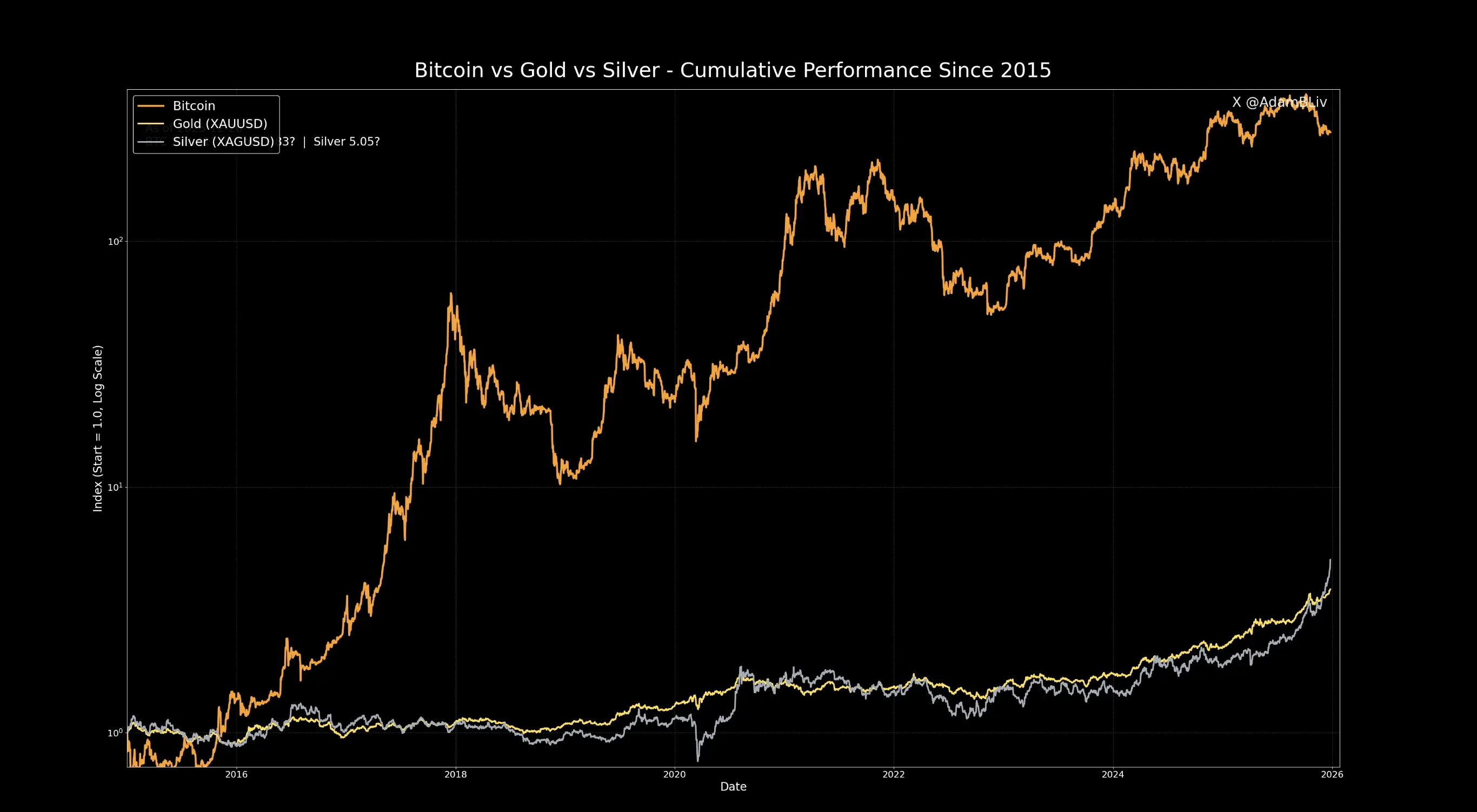
Since 2015, Bitcoin has achieved a cumulative increase of 27,701%, while silver rose by 405% and gold by 283% during the same period. However, Bitcoin critic Peter Schiff argues that the comparison should be made over the past four years rather than ten, claiming that Bitcoin’s era is over. The market responds that commodity prices tend to converge to production costs; when prices rise, output also increases, which in turn lowers prices unless supply is fixed.
Decadal Growth Comparison: The stark difference between Bitcoin’s 27,701% and Gold’s 283%
(Source: Adam Livingston)
Adam Livingston’s data provides a clear long-term perspective. Since 2015, Bitcoin’s cumulative gain has reached 27,701%, meaning an investment of $1,000 in Bitcoin in 2015 would be worth about $278,000 by 2025. In contrast, silver’s gain over the same period was 405%, turning $1,000 into $5,050; gold’s gain was 283%, turning $1,000 into $3,830. This hundredfold difference is astonishing.
Livingston wrote on X: “Even ignoring the first six years of Bitcoin’s existence, for those complaining about the time span, gold and silver have performed far worse than this top-tier asset.” This implies that Bitcoin’s early years (2009-2015) saw even more remarkable gains, and if calculated from Bitcoin’s inception in 2009, the increase would be astronomical. Choosing 2015 as the starting point is already a very conservative estimate.
However, gold advocate Peter Schiff is one of Bitcoin’s harshest critics. He counters that the comparison should be over the past four years rather than ten. “Times have changed. The era of Bitcoin is over,” Schiff said. The logic behind this argument is that Bitcoin entered a correction cycle after the bull market of 2020-2021, and its performance over the past four years has been less stable than gold. Schiff’s view reflects the typical stance of traditional finance (TradFi) investors: they prioritize short-term volatility and downside protection over long-term absolute returns.
The core of this debate lies in the choice of time frame. Long-term investors see ten years as a reasonable evaluation period, enough to span a complete economic cycle. Short-term traders believe four years better reflect the current market environment. Both perspectives have validity; the key depends on the investor’s risk appetite and investment goals.
Fixed Supply vs. Unlimited Mining: Structural Differences That Matter
(Source: Trading View)
Matt Golliher, co-founder of Orange Horizon Wealth, hits the nail on the head with his response. He points out that, in the long run, commodity prices tend to “converge” to production costs. “When prices rise, output also increases, which accelerates supply growth and pushes prices down. Of course, unless supply is fixed,” Golliher said. This statement precisely reveals the fundamental difference between Bitcoin and gold/silver.
Gold and silver supply are elastic. When prices increase, mining becomes economically viable for deposits that previously were not, leading to increased global output. Golliher added, “Some sources of gold and silver that were unprofitable a year ago are now very profitable at current prices.” This supply response mechanism automatically limits the long-term upward potential of prices.
In contrast, Bitcoin’s supply is permanently fixed at 21 million coins. No matter how high the price goes, no new Bitcoin deposits will be discovered or mined. This absolute scarcity is at the core of Bitcoin’s value proposition. When demand increases, supply cannot grow accordingly, making price appreciation the only balancing mechanism. This supply rigidity is extremely rare in economics; even land is not truly fixed in supply, as land can be reclaimed from the sea.
Three Structural Differences Between Bitcoin and Gold/Silver
Supply Elasticity: Gold and silver can be increased in response to price rises; Bitcoin’s supply is permanently fixed at 21 million coins.
Storage Costs: Gold and silver require physical storage and security; Bitcoin only needs digital wallets with almost zero cost.
Divisibility: Bitcoin can be divided down to eight decimal places; physical gold and silver are costly to divide.
These structural differences explain why, within the same ten-year timeframe, Bitcoin can achieve a hundredfold increase over gold and silver. When global wealth seeks a store of value, the fixed supply of Bitcoin can only be absorbed through price increases, whereas gold and silver can partly meet demand through increased production.
2025 Precious Metals Reach New Highs While the Dollar Plummets 10%
(Source: Barchart)
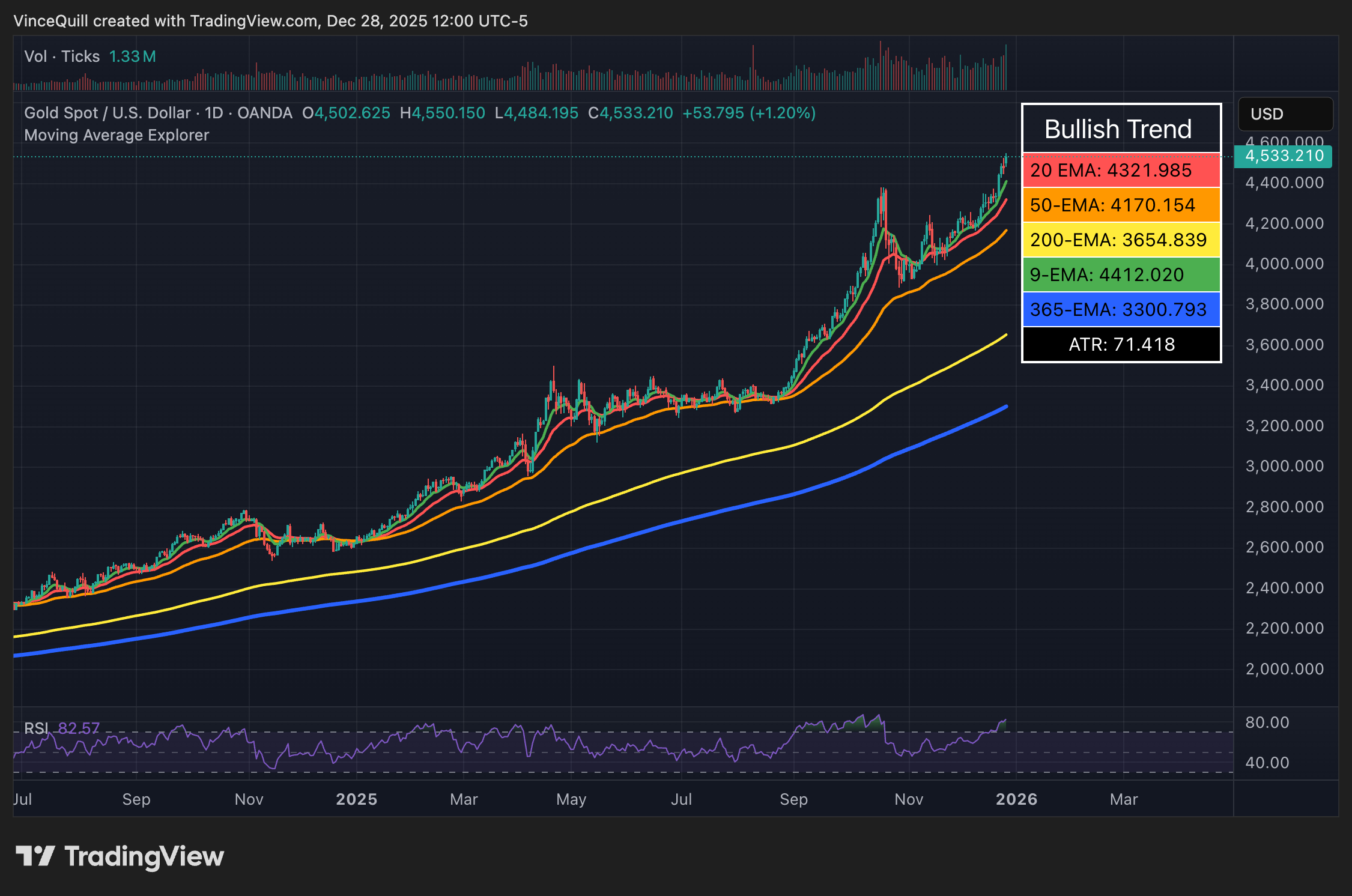
The debate between precious metals advocates and Bitcoin supporters over which asset is a better long-term store of value continues to intensify, while precious metals prices have experienced historic surges. In 2025, gold hit a record high of about $4,533 per ounce; silver also reached a historic high, approaching $80 per ounce. These figures seem impressive and support the arguments of gold and silver proponents.
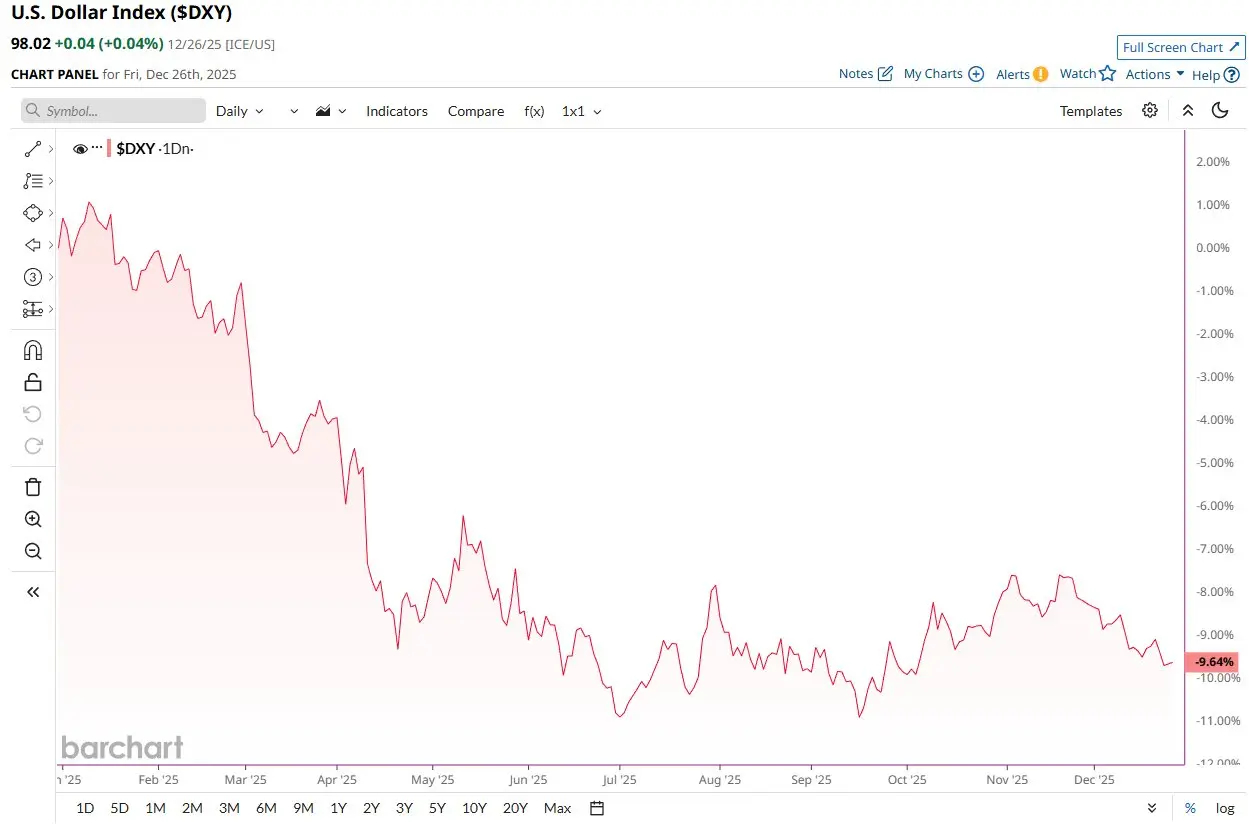
However, when viewed against the backdrop of a declining dollar, the picture changes. Media host Ethan Ralph reports that the dollar is heading into its worst year in a decade, with the US Dollar Index (DXY) falling nearly 10% in 2025. The DXY tracks the dollar’s strength relative to a basket of major fiat currencies, including the euro, yen, pound, Canadian dollar, Swedish krona, and Swiss franc. This means that dollar-denominated asset gains are partly just a reflection of dollar depreciation.
When the dollar depreciates by 10%, the nominal prices of gold and silver naturally rise, as more devalued dollars are needed to buy the same physical assets. This price increase is somewhat “artificial,” not a true increase in purchasing power. In contrast, even amid dollar depreciation, Bitcoin’s relative advantage over gold and silver remains significant.
Analyst Arthur Hayes states that dollar depreciation and the Federal Reserve’s inflationary monetary policies will be positive catalysts for the rising prices of scarce assets, including gold, silver, and Bitcoin. This macro environment benefits all scarce assets, but Bitcoin’s fixed supply makes it benefit the most. When traditional finance (TradFi) investors seek inflation hedges, Bitcoin, gold, and silver all benefit, but Bitcoin’s digital nature and global accessibility give it a distinct advantage.
The Time Frame Debate Reveals Fundamental Investment Philosophy Differences
Peter Schiff insists that the comparison should be over the past four years rather than ten. This argument reflects the risk management mindset of traditional finance investors. From 2021 to 2025, Bitcoin experienced extreme volatility, crashing from a peak of $69,000 to $16,000, then rebounding to the current $89,000. This rollercoaster movement unsettles many TradFi investors.
Gold and silver, during these four years, have been relatively stable. Although their absolute gains are less than Bitcoin’s, their volatility is much lower. For retirement funds, insurance companies, and other TradFi institutions, controlling volatility often matters more than absolute returns. This explains why Schiff advocates for a four-year time frame, as it highlights Bitcoin’s volatility risk.
However, this argument overlooks a key fact: long-term investors aim for wealth accumulation, not short-term stability. If one asset’s ten-year gain is a hundred times that of another, even with significant intermediate volatility, as long as investors can hold through the fluctuations, the final returns will far surpass those of stable but mediocre assets. This is the core argument of Bitcoin supporters: time can smooth out volatility, and long-term trends are what truly matter.


