On a cold morning during “Betwixmas” in December, the atmosphere around Bitcoin feels both familiar and strange.
Familiar, because the story still oscillates between excitement and anxiety. Strange, because the group of chart followers has changed from before.
Some are still veterans who experienced the peaks of 2017 and 2021; others are newcomers, exposed to Bitcoin through brokerage accounts or ETF codes, investors who have never had to learn about seed phrases.
Currently, Bitcoin trades around $88,000. A few years ago, this figure sounded impossible, and from a distance, it still does. But compared to the nearly $126,000 peak a few weeks ago and the subsequent drop, this price level feels like a cooling-off.
The decline was partly influenced by rising bond yields, tariffs, and capital outflows from ETFs, reminding us that Bitcoin now breathes the same air as global risk markets.
This leads to an important issue for 2026: if Bitcoin hits a new high next year, after establishing a peak in 2025, the emotional rhythm that the market relies on will change.
Traders call this the four-year cycle: halving occurs, supply decreases, the market rallies, then “drinks” after the peak. Everyone has their own version, but this timing pattern is almost like a metronome.
A new peak in 2026 will not just be a simple green candle. It signals that the old metronome is losing rhythm, and another factor is creating a “new beat.”
The old cycle and the 2026 test
The “four-year cycle” idea is based on a simple premise: each halving reduces new supply, tightening the market, raising prices, then the cycle exhausts itself and a deep correction “cleans out” leverage and excess.
Historically, prominent peaks tend to occur about 1–1.5 years after halving. In the classic scenario, halving is the spark, the rally is the fire burning, and the second year is when the fire subsides.
The difference in 2026 is its “incorrect” position on the calendar: the most recent halving is in 2024; the market peaked before halving, surprising many, then continued to rise in 2025. If Bitcoin hits another meaningful peak in 2026, the clean four-year cycle will become longer, with alternating corrections.
This affects all participants: retail investors time the bull market, founders watch funds, miners live or die by margins, and institutions must explain exposure levels in quarterly reports.
Necessary increase and the actual numbers
To reach a new peak, Bitcoin must surpass $126,000. From the current $89,000, that’s about a 42% increase.
By Bitcoin standards, this isn’t a “moonshot,” but it’s not easy either. On average, the market needs about 3% per month to hit this mark by the end of 2026, or nearly 6% monthly if aiming for mid-year.
Three main factors determine this possibility: interest rates, capital flows, and accessibility.
- Interest rates: When real yields rise, non-yielding assets must compete harder to attract capital.
- Capital flows: ETFs and ETPs enable large Bitcoin trades outside crypto exchanges, so a “risk-off” week by institutions can have a significant impact.
- Accessibility: New demand comes from distribution, platforms, compliance frameworks, and Bitcoin’s ease of purchase with just a click.
Actual supply and demand
After the 2024 halving, the network produces about 450 BTC per day, equivalent to $40 million daily, or roughly $15 billion annually.
If the market wants higher prices, someone must absorb this supply, and absorption must last long enough to matter. This is when ETFs become central in the 2026 discussion. Citi forecasts Bitcoin could reach $143,000 in 2026, based on ETF capital flows of around $15 billion—roughly matching the annual new supply value.
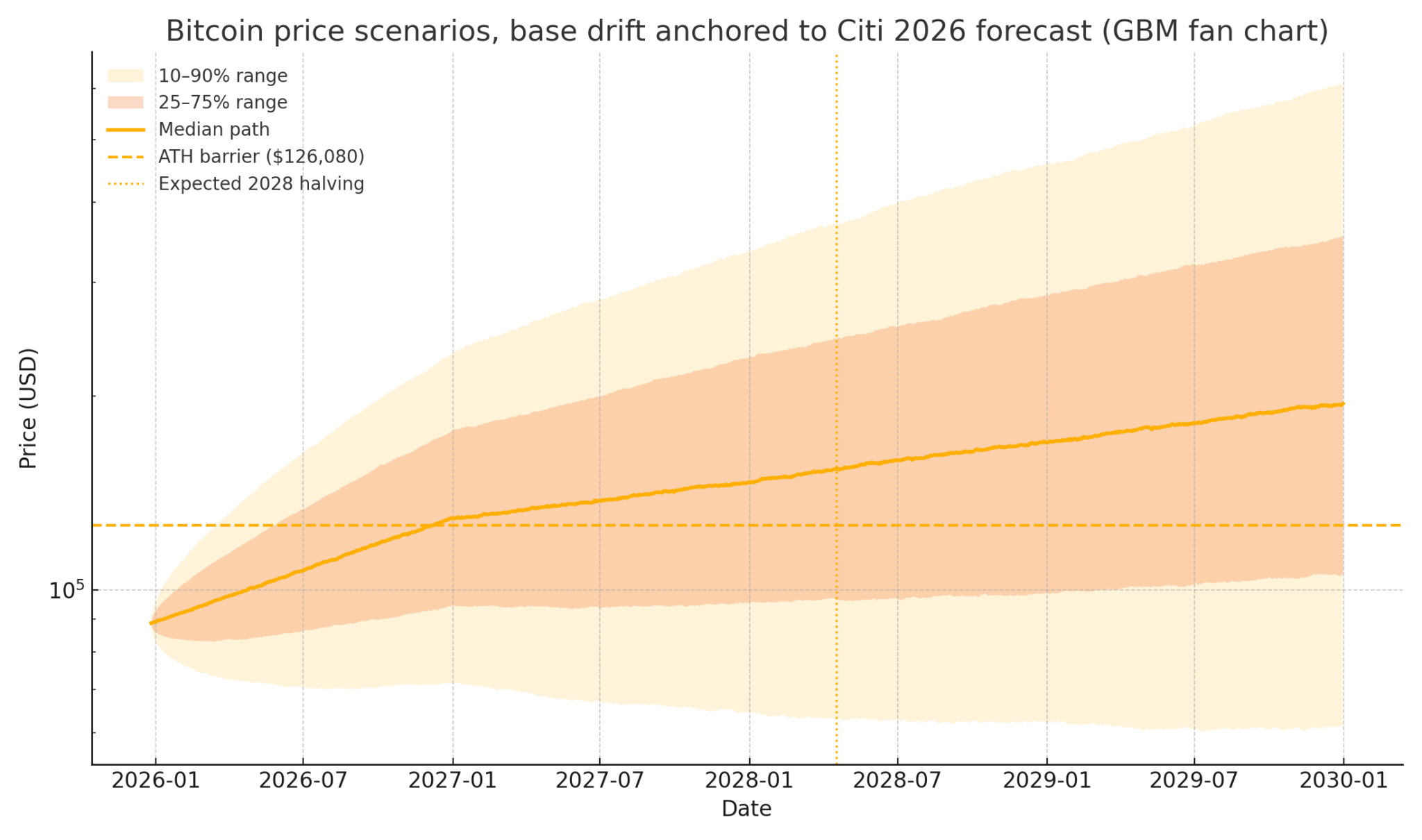 Even if Bitcoin’s long-term story is driven by halving events, the range of plausible scenarios quickly broadens. The dotted line marks the expected 2028 halving; the dashed line indicates the previous all-time high.## Stable interest rates and accessibility are key
Investors who once doubted Bitcoin now buy indirectly through ETFs, no longer caring about halving cycles but focusing on opportunity costs and portfolio yields.
To reach the 2026 peak, two things must happen:
- Real yields stop rising and start to decline, making non-yielding assets easier to hold.
- Bitcoin demand is strong enough to withstand high yields.
Accessibility – the “silent” factor
Buying Bitcoin is easier now thanks to ETFs. The next step is for brokerage platforms and banks to integrate crypto trading into familiar systems, expanding potential investor pools without requiring them to open crypto accounts.
This shifts demand structure: slow, steady capital flows that can sustain a trend rather than short-term “bubbles.”
Probabilistic model
Based on the $88,000 price, the $126,000 peak, and a 41% volatility, simulation suggests Bitcoin has about a 70% chance of reaching a new high in 2026.
This doesn’t require a perfect bullish path, just a sufficiently positive trend to turn random fluctuations into advantage.
If ETF flows persist long enough, their impact could surpass the halving schedule because they outpace new supply in USD value.
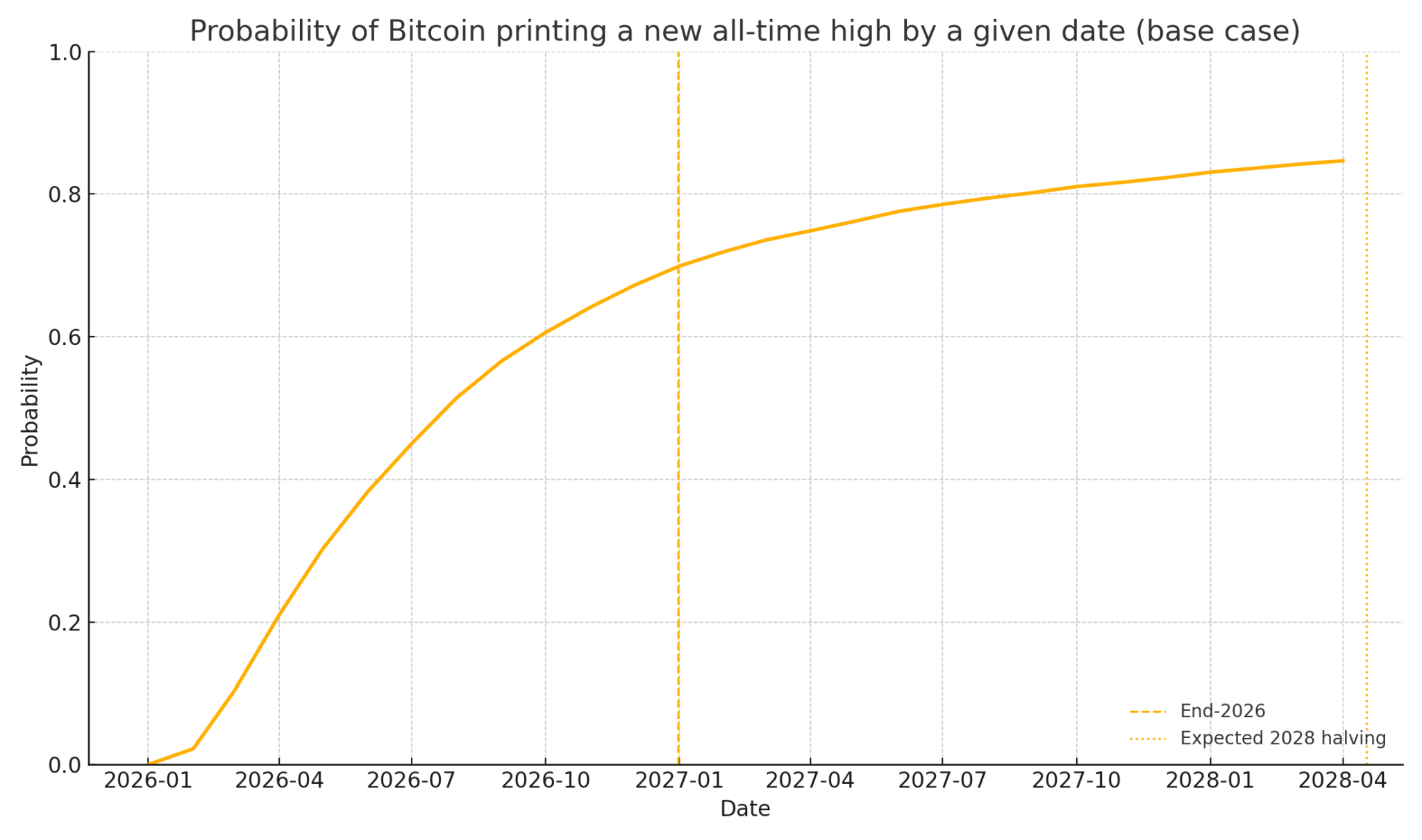 The longer the time horizon, the greater Bitcoin’s chances of reaching new highs. In this basic simulation, success rates increase significantly by 2027, then stabilize as the halving approaches.## Conditions to break the cycle
- Sustained capital inflow: net inflows through ETFs and ETPs last long enough to offset new supply and thaw frozen capital.
- Favorable macro environment: real interest rates stabilize or decline, risk appetite returns.
- Expanded access: brokerage platforms and banks broaden the investor base.
- Clear regulatory framework: the US with stablecoins, Europe with MiCA, helps crypto operate transparently.
- Bitcoin’s scarcity story gains a new milestone. Approaching 20 million BTC mined becomes a psychological marker for a market always seeking symbols. In previous cycles, halving dates were the main symbol. In a more mature cycle, milestones can overlap, and the story becomes a long journey rather than a single event on the calendar.
When these factors combine, the 2026 peak is no longer a matter of luck but an extension of structural shifts that began as the market shifted demand toward traditional financial channels.
What could happen near the 2028 halving
If Bitcoin truly breaks out again in 2026, the next phase will be much more interesting.
In the old cycle scenario, 2027 is often when the market “deflates,” prices weaken for a prolonged period, and everyone waits for the next halving as a preordained dawn.
Breaking the cycle would change this emotional rhythm.
The context also shifts. Corrections are no longer the end of an era but must be managed within a larger trend.
A reasonable expectation, if Bitcoin hits a meaningful new high in 2026, is that 2027 becomes a consolidation phase rather than a total “reset.” Volatility may narrow as institutional buyers dominate, and the market begins to operate more like a macro asset with its own crypto-specific catalysts, rather than an independent casino.
In that case, the 2028 halving will be less of a shock and more like a “committee” event—a milestone that allocators can plan for. The story revolves around continued tightening of supply while market access keeps expanding.
Such a market can still surge after halving or sell off sharply. The difference is that the driving forces are no longer just the cycle’s ritual but the interaction of liquidity, capital flows, and risk appetite.
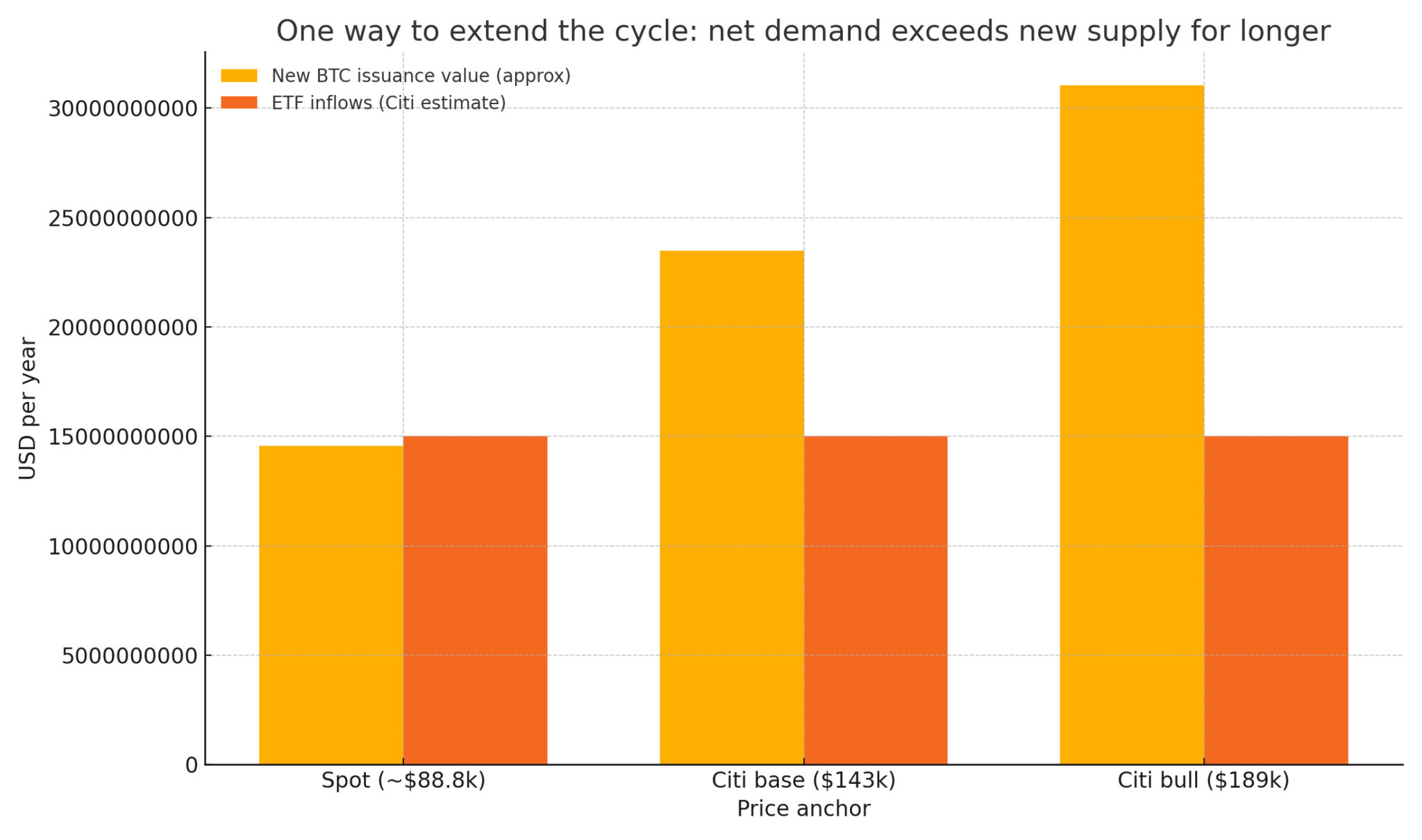 If capital inflows into ETFs remain large enough over time, they could be more influential than the halving schedule because they can outpace new supply in dollar terms.
And then, in 2029, when the story is about maturity
If we go further, 2029 begins to look like the moment when Bitcoin’s biggest question is about its identity.
In a world where access has become widespread and regulatory frameworks clearer, Bitcoin must prove its role when novelty wears off. Some will continue to see it as digital gold, others as a leveraged liquidity bet, and some as a strategic reserve asset—especially if signals from countries keep changing.
This is when the “human” element becomes crucial.
The fundamental change isn’t in the chart breaking a familiar pattern but in the fact that Bitcoin holders no longer share the same timeframes or reasons for ownership. Retail investors check prices on their phones during work, miners monitor margins, founders build businesses, and portfolio managers must explain themselves to boards—all influencing the market in different ways. This diversity can soften old extremes but still leave room for tension.
A new peak in 2026 will be a headline. The deeper story is the slow replacement of a legendary cycle with a more mature, complex engine.
If the market truly desires this scenario, 2026 must “earn” it: through sustainable capital flows, a macro environment no longer hostile, and continued expansion of access. Then, Bitcoin’s next peak will resemble less a four-year repeating event and more a milestone in a long, rugged journey deeper into mainstream adoption.


