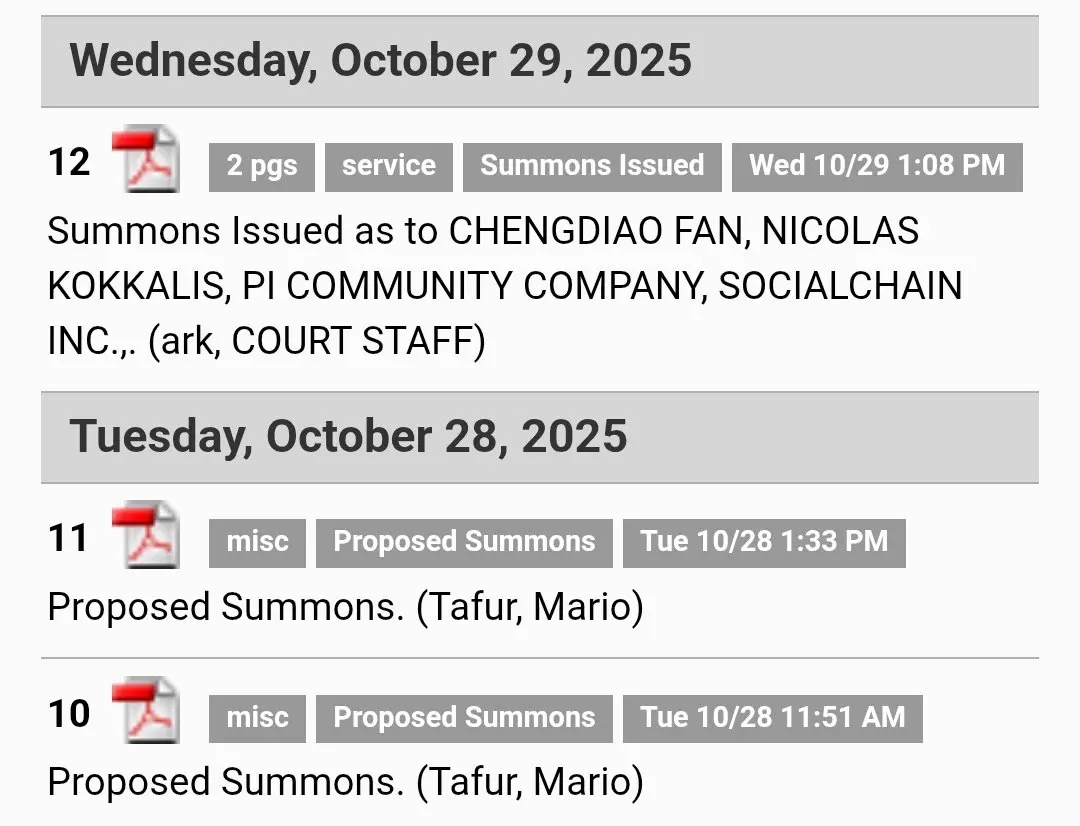
Arizona resident Harro Moen has filed a lawsuit in the Northern District of California accusing two founders of Pi Network, claiming unauthorized transfer of approximately 5,137 Pi coins and suffering a loss of $2 million as Pi’s price plummeted from $307.49 to $1.67. However, analysts state that the $307 figure is not the actual value of Pi coins but is derived from speculative quotes in the IOU market.
The $307 Price Myth: The Speculative Bubble in the IOU Market
(Source: X)
Moen believes that, based on his own calculation valuing each Pi token at $307, his total loss is nearly $2 million. He claims this figure reflects the “true value” of Pi during the project’s early stages. However, cryptocurrency analysts say that the pricing claims in the lawsuit are based on a misunderstanding.
Researcher Dr. Altcoin pointed out that since centralized exchanges began listing Pi IOU trading pairs, the price of Pi Network has never exceeded $3. He states that the $307.49 figure is not the real price of Pi coins but comes from the IOU market. Despite multiple warnings from the Pi core team advising users not to buy, some exchanges still sell unofficial Pi tokens on these markets. These prices are speculative, unregulated, and completely disconnected from Pi’s actual ecosystem.
The IOU (I Owe You) market is a gray area in the cryptocurrency space. When certain tokens are not officially launched or have restricted circulation, some exchanges offer IOU trading, allowing users to trade “promises of future delivery” tokens. The prices for these trades are entirely determined by supply and demand, often diverging sharply from real value. Pi’s IOU prices have indeed reached hundreds of dollars at times, reflecting speculative frenzy amid extreme scarcity, not genuine market value.
The Pi Network core team has repeatedly issued warnings, clearly telling the community not to participate in IOU trading because these transactions do not represent real Pi tokens and are not controlled by Pi Network. However, many users ignore these warnings and buy at high prices on the IOU market. When Pi officially launches and the price is far below the IOU quotes, these users suffer huge losses. Moen’s lawsuit is based on this misunderstanding, treating speculative IOU prices as the “real value” of Pi coins.
Three Reasons Why the $307 Claim Is Unsubstantiated
-
Never reached that price on legitimate exchanges: After Pi coins were listed on mainstream CEXs, the highest price never exceeded $3
-
IOU market does not reflect true value: IOU trading is OTC speculation with very low liquidity and severely distorted prices
-
Pi Network’s multiple warnings: Officially told users not to participate in IOU trading; Moen disregarded warnings and took risks
Token Theft Allegations: Dispute Over Wallet Security Responsibility
Moen’s second allegation involves the theft of 5,137 Pi coins. He claims these tokens were transferred without his permission and attributes responsibility to Pi Network. However, experts say this argument also has issues.
According to Dr. Altcoin, access to Pi wallets requires obtaining the user’s passphrase or recovery information. Without direct evidence that the Pi core team has accessed his wallet, this charge remains unsubstantiated. Wallet leaks are typically caused by phishing or scams—especially after Pi moved to the mainnet, with numerous impersonation phishing sites and fake wallet apps emerging.
Cryptocurrency wallet security relies on control of private keys: whoever holds the private key controls the assets. Pi Network uses a non-custodial wallet design, meaning the platform does not store users’ private keys. The advantage is that users have full control over their assets; the downside is that if private keys are leaked or lost, the platform cannot help recover them. If Moen’s private key was stolen via phishing sites or malware, responsibility should lie with the attacker and the user’s security awareness, not Pi Network.
He also argues that some of his tokens were never migrated from old mining apps to the mainnet, resulting in “liquidity issues” with his balance. Many global users have reported similar problems, and he is not unique in this regard. Analysts say that this alone is insufficient to support fraud claims. Migration delays could stem from technical issues, incomplete KYC verification, or user errors—common in large-scale system transitions—and do not constitute legal fraud.
Low Likelihood of Winning the Case but Highlights Transparency Issues
Crypto researchers currently believe this lawsuit is unlikely to succeed. The main dispute centers on IOU market prices, which Pi Network cannot control; additionally, wallet security issues are involved. Without direct evidence, these problems cannot be attributed to the company. Legally, the plaintiff must prove direct fraud or negligence, but the current evidence is insufficient.
The $307 price claim will almost certainly be dismissed by the court, as an experienced judge would recognize the difference between IOU markets and legitimate exchanges. The token theft allegations are hard to prove unless evidence shows Pi Network directly accessed the plaintiff’s wallet. The migration delay issue appears more as a technical support dispute rather than fraud. Overall, the chances of winning this case are very low.
However, analysts suggest the case could pressure the Pi core team into greater transparency, especially regarding migration timelines, user support, and mainnet progress. Since its launch, Pi Network has faced criticism for slow development and poor communication. The mainnet has yet to fully open after years of promises, with lengthy KYC processes and many tokens locked for extended periods, preventing trading. These issues do not constitute legal fraud but have affected user experience and community confidence.
This lawsuit also exposes deficiencies in Pi coin investor education. Many users do not understand the nature of the IOU market and mistake speculative prices for real value, making investment decisions without proper research. Despite multiple warnings from Pi Network, these warnings have not reached all users. Moving forward, Pi Network needs to invest more in user education, risk alerts, and technical support to prevent similar disputes.
From a broader perspective, this case reflects issues in the gray regulatory area of the cryptocurrency market. IOU markets operate on the fringes of law—they are neither regulated by traditional finance nor controlled by project teams but can cause substantial harm to users. Regulators should consider how to standardize such markets to protect ordinary investors unaware of the risks.
Disclaimer: The information on this page may come from third parties and does not represent the views or opinions of Gate. The content displayed on this page is for reference only and does not constitute any financial, investment, or legal advice. Gate does not guarantee the accuracy or completeness of the information and shall not be liable for any losses arising from the use of this information. Virtual asset investments carry high risks and are subject to significant price volatility. You may lose all of your invested principal. Please fully understand the relevant risks and make prudent decisions based on your own financial situation and risk tolerance. For details, please refer to
Disclaimer.
Related Articles
Pi Network Expands Developer Tools With RPC Server Upgrade
Pi Network has taken another step to improve its system for developers. The project has launched a new RPC server upgrade on its Testnet, making it easier to build and test apps on the network. This update allows node operators to run their own RPC servers
In simple words, developers no longer
Coinfomania23h ago
Pi Network Transfers 30M Coins as Migration Resumes
Pi Network has restarted its long-running migration process after a short pause. In the latest update, around 30 million Pi coins moved from an intermediary address to user-linked wallets. The transfer happened just hours after activity resumed, following a one-week break
The update suggests the n
Coinfomania04-10 21:24
Pi Network restarts the migration, and 30 million Pi have been transferred into users’ wallets
Pi Network resumed mainnet migration after a pause, transferring about 30 million Pi tokens to users’ wallets, mainly targeting users who have completed KYC. The first migration has been completed, and a second migration is currently underway, with the core team emphasizing batch processing. Some false information appeared during the process; the official account has issued a clarification, reminding users to obtain information through official channels.
MarketWhisper04-10 06:39
Pi Network version 21 released; mainnet RPC and smart contract acceleration are advancing
Pi Network released version 21 on April 9. The key update is that the testnet RPC has officially gone live, providing developers with a secure environment to test smart contracts and DApps. Next, smart contracts are expected to be deployed within two months, enabling Pi幣 to transition from a community token into a functional digital asset and to support DeFi applications and automated workflows, while also advancing the KYC migration to ensure compliance.
MarketWhisper04-10 01:50
Pi Network Launches RPC Server on Testnet for Smart Contracts
Pi Network has introduced a new tool for developers. The project has launched an RPC server on its testnet. This update is an important step toward building smart contracts and real applications on the network
For now, the feature is only available in the test environment. Still, it shows that Pi
Coinfomania04-10 01:18
Pi Launchpad 12 Grid testnet launch, pioneer token distribution completed
Pi Network recently launched a token distribution test for the Pi Launchpad. More than 300k users participated, staking 24 million Test-Pi. The core architecture “12 Grid” enables end-to-end token delivery, and all transactions are publicly verifiable. This test confirmed the system’s feasibility and paved the way for a future official launch. The upgrade roadmap includes the PiRC1 framework and Protocol 23, which will be rolled out in April and May, respectively.
MarketWhisper04-09 05:21


