Pi Network Alerts releases a community announcement detailing the key changes of Pi Open Mainnet, which will achieve full decentralization, eliminate centralized control by the core team, enable users to connect to external networks freely, allow developers to deploy smart contracts permissionlessly, and introduce global liquidity. The open mainnet is scheduled to complete the final phase of the closed network upgrade by December 2025, marking an important milestone after years of gradual development.
Pi Open Network: Controlled Transition Phase
Pi Open Network was launched in early 2025, marking Pi Network’s first step toward opening from a closed ecosystem to the outside world. The design philosophy of this phase is “Controlled Connectivity,” allowing partial external interactions while retaining necessary protective mechanisms. This gradual approach reflects Pi Network team’s consistent risk management strategy, aiming to prevent security vulnerabilities or market chaos caused by premature openness.
Pi Open Network enables integration of some real-world application scenarios. Enterprises can test Pi Payments in a controlled manner. For example, some merchants may accept Pi as a payment method within their apps, and users can purchase goods or services using Pi. This initial practical demonstration is a critical step in transforming Pi Network from a “free mining game” to a “real economic system.” However, during this phase, Pi Open Network still has significant limitations.
Users cannot trade Pi freely on the open market, which is the biggest difference between Open Network and true decentralization. The system only supports in-app transactions, peer-to-peer transfers, and utility-based transactions, without allowing free trading on external exchanges. This restriction aims to prevent speculation and ensure Pi’s use focuses on practical applications rather than price speculation. However, it also means users cannot set prices freely based on market supply and demand, limiting Pi’s price discovery mechanism.
Additionally, Pi Open Network allows engineers to monitor traffic trends, ledger performance, and application layer interactions. This monitoring capability indicates that the core team still retains some degree of centralized control. The announcement suggests that Pi Open Network can be viewed as a training ground for a broader economy, enabling the team and community to test various scenarios in a relatively safe environment and accumulate experience for the final full openness.
Pi Open Mainnet: Complete Decentralization by December 2025
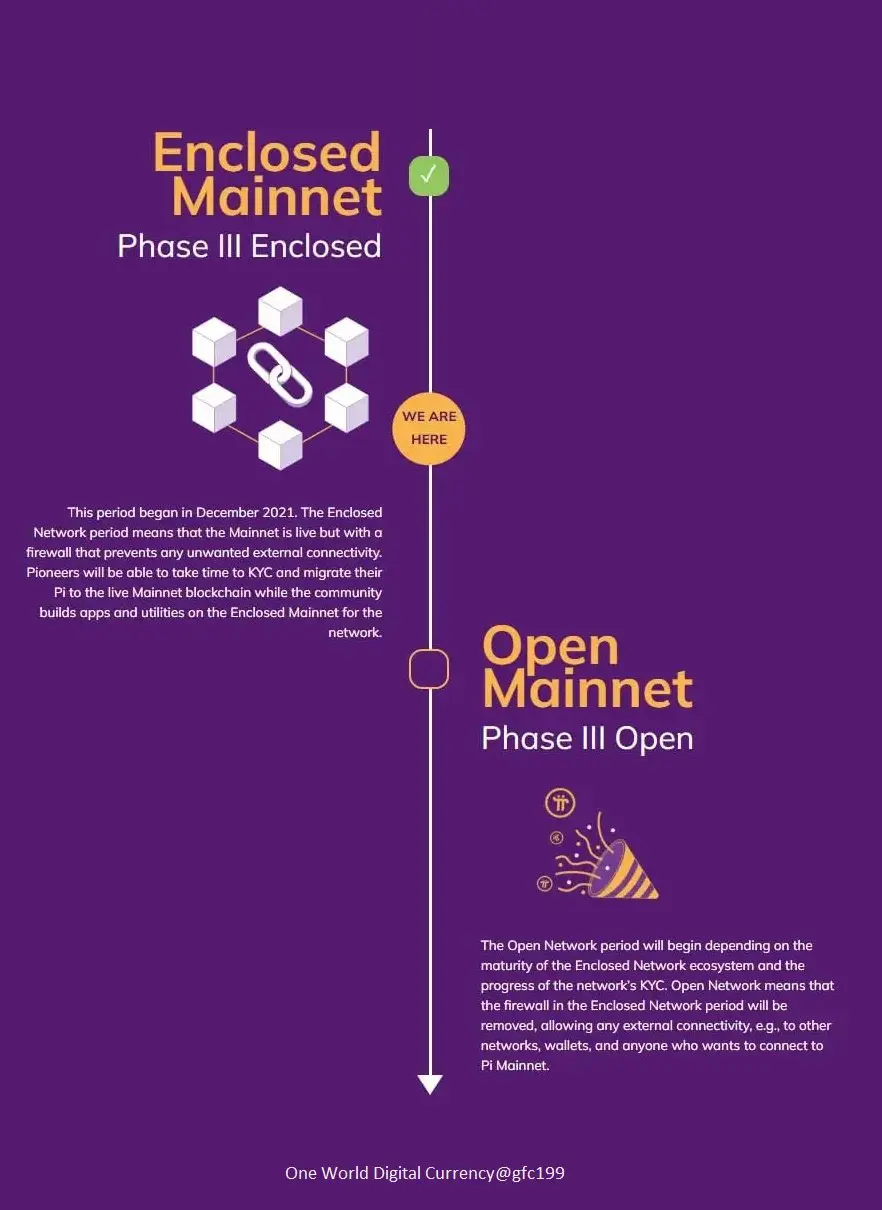
(Source: Pi Network Alerts)
The ultimate goal of the Pi Network ecosystem’s upcoming openness is to launch the Pi Open Mainnet. This phase will realize full decentralization, allowing users to connect freely to external networks, enabling developers with complete cross-chain communication capabilities, and permitting permissionless deployment of smart contracts. This permissionless feature is a hallmark of truly decentralized blockchains, meaning anyone can build applications on Pi network without approval from the core team.
The open mainnet will eliminate centralized control by the core team. This transformation will make network security entirely managed by decentralized validators. Currently, during the Pi Open Network phase, the core team still retains influence over key decisions, but in the Open Mainnet phase, governance rights will be fully handed over to the community and validator network. This transfer of authority is an important milestone indicating blockchain project maturity.
The community is most looking forward to the fact that the open mainnet will introduce global liquidity. Pi Network announced that the open mainnet will complete the final stage of upgrading from the closed network by December 2025. This transition is a significant step after years of gradual development, transforming Pi from merely an internal economy to a global asset.
Five Core Differences Between Pi Open Network and Open Mainnet
Transaction Freedom: Open Network supports only in-app and peer-to-peer transactions; Mainnet allows free trading in global markets
Level of Decentralization: Open Network’s control remains with the core team; Mainnet is governed entirely by validators
Developer Permissions: Open Network requires approval; Mainnet permits permissionless deployment of smart contracts
Cross-Chain Interoperability: Open Network operates in isolation; Mainnet can communicate with other blockchains
Global Liquidity: Open Network has internal pricing; Mainnet’s value is determined by market supply and demand
This phased strategy is designed for risk control. Jumping directly from a closed state to full openness could face multiple risks such as technical vulnerabilities, market manipulation, or regulatory crackdowns. Through the transition phase of Open Network, the team can test system stability, observe user behavior patterns, and gradually build ecosystem resilience in a relatively controlled environment.
Community Reactions: Mixed Expectations and Concerns
This announcement has generated widespread attention among Pi users, with reactions showing clear polarization. Optimistic users say that Pi Open Network has thoroughly changed their way of participating in the ecosystem. They claim that the more refined KYC (Know Your Customer) process makes registration more convenient, and purely digital transactions can create real value. These supporters believe that the ability to use Pi to buy goods or services within apps has proven Pi’s practical utility.
However, some users hold higher expectations for the upcoming open mainnet. They promise that full decentralization will make Pi a mature digital currency. These users believe that only when Pi can be freely traded on external exchanges can its market value be truly validated. Currently, Pi’s IOU market price is about $0.22, which may differ significantly from its real market price after mainnet opens.
Analysts point out that phased transition reduces risks for new users. Pi Network reminds users that continuous learning is crucial during this period. Users need to understand the differences between Open Network and Open Mainnet to avoid unrealistic expectations at different stages.
Nevertheless, delays remain a risk. Since its launch in 2019, Pi Network has repeatedly postponed the mainnet launch. Whether the December 2025 promise can be fulfilled will determine if the community’s confidence is further strengthened or completely shattered.
Disclaimer: The information on this page may come from third parties and does not represent the views or opinions of Gate. The content displayed on this page is for reference only and does not constitute any financial, investment, or legal advice. Gate does not guarantee the accuracy or completeness of the information and shall not be liable for any losses arising from the use of this information. Virtual asset investments carry high risks and are subject to significant price volatility. You may lose all of your invested principal. Please fully understand the relevant risks and make prudent decisions based on your own financial situation and risk tolerance. For details, please refer to
Disclaimer.
Related Articles
Pi Network founder May 7 discussed human identity verification in the AI era at Consensus 2026
Pi Network founder Nicolas Kokkalis will attend the Consensus 2026 conference in Miami on May 7, joining an expert panel to discuss online human identity verification issues in the age of artificial intelligence (AI). According to the official event schedule, this panel discussion will bring together experts in the fields of identity, privacy, and digital trust.
MarketWhisper04-21 06:20
Pi Network issues a node upgrade warning: if you haven’t upgraded by April 27, you risk being disconnected
Pi Network has issued an official notice to node operators, requiring them to complete the mandatory upgrade of the agreement version 22.1 (v22.1) by April 27, 2026; otherwise, they face the risk of their nodes being cut off from network connectivity. According to a Pi Network announcement, this upgrade must be carried out in strict version order. Currently, the system is running on version 21.2; the next step is to upgrade to v22.1, and no versions may be skipped.
MarketWhisper04-20 06:51
Pi Network Requires Protocol 22 Upgrade by April 27 or Nodes Will Disconnect
Pi Network mandates node operators to upgrade to Protocol 22 by April 27, 2026, to ensure network connectivity. The upgrade enhances stability and prepares for future smart contract features. Delaying could result in disconnection and missed opportunities.
GateNews04-20 05:51
Pi Network mainnet unlocks 5.3 million tokens, increasing circulation and drawing market attention
Pi Network completed a token unlock on April 18, releasing about 5.3 million Pi tokens, which boosts market liquidity, but also sparks discussion about supply-and-demand pressure. The unlocking plan is intended to control market supply and support ecosystem development. The long-term impact will depend on how quickly the token’s utility expands through real-world applications. If demand and supply can grow in step, the price impact will be limited; otherwise, it may face pressure.
MarketWhisper04-20 02:50
Pi Network Launches First Smart Contract Feature on Testnet, Enabling Subscription Payments
Pi Network has launched its first Smart Contract feature on Testnet, enabling users to set up automatic subscription payments while maintaining control of their funds. This marks a shift toward ecosystem utility and lays the groundwork for potential mainnet deployment.
GateNews04-18 05:31


