Written by: 0xjs
Kamino Finance and Jupiter (especially its newly launched Jupiter Lend product) are two leading DeFi protocols in the Solana ecosystem, focusing respectively on lending and aggregation/liquidity management.
In early December 2025, they engaged in a public dispute, mainly revolving around risk disclosure, product isolation, and competitive behaviors. This “civil war” has drawn wide attention from the Solana community, even prompting Solana Foundation President Lily Liu to publicly intervene, urging both parties to stop attacking each other and focus instead on ecosystem growth.
Although the dispute is intense, it has not led to significant economic losses (Jupiter Lend’s TVL remains over $1 billion), and is more of a test of ecosystem trust and transparency.
1. Focus of the Dispute: What Are They Really Arguing About?
1. Jupiter Lend’s “Zero Risk” Marketing Controversy:
- Jupiter Lend launched in August 2025, quickly growing to $1 billion TVL. It promoted its “vaults” as having “isolated risk” and “zero contagion risk,” claiming that there was “no cross-contamination” between different trading pairs to attract user deposits.
- Competitors like Kamino accused this of being misleading. The actual mechanism uses rehypothecation: user collateral (such as SOL) is reused across vaults, meaning that a loss in one vault could indirectly affect others and create potential contagion risk. Kamino founder Marius Ciubotariu publicly stated this “undermines confidence in Solana DeFi” and used charts to show “full cross-asset exposure.”
- Jupiter COO Kash Dhanda admitted that earlier statements were “not accurate enough,” deleted the related tweets, and promised to update documentation after the Breakpoint conference. However, they defended that isolation refers only to configuration, and the protocol performed well during the market crash in October.
2. Kamino’s “Blacklist” Behavior:
- Kamino quietly modified its contract to prevent users from directly migrating/refinancing loans from Kamino to Jupiter Lend (via Jupiter’s Refinance tool). Kamino claimed this was to protect users from exposing funds to “insufficiently disclosed risks.”
- Jupiter founder Luca Netz criticized this as “user-hostile behavior,” violating the open principles of DeFi and potentially forcing users into negative APY. The community also accused Kamino of being “anti-competitive,” likening it to traditional bank barriers.
3. Broader Context: Market Competition and Ecosystem Pressure:
- Solana’s lending market TVL is about $5 billion (well below Ethereum’s $50 billion), with liquidity tightening (TVL has continued to fall since the October crash) and rug pull events making users sensitive to security.
- Kamino has long dominated (TVL over $2.3 billion), but Jupiter Lend, as a newcomer, has quickly grabbed market share (from 0 to $1 billion), raising concerns about a “vampire attack.”
- External influence: Tushar Jain, partner at Multicoin Capital (an investor in Kamino), called Jupiter “incompetent or malicious,” intensifying the feud; Fluid (Jupiter Lend’s backend provider) also became involved in the defense.
2. Timeline
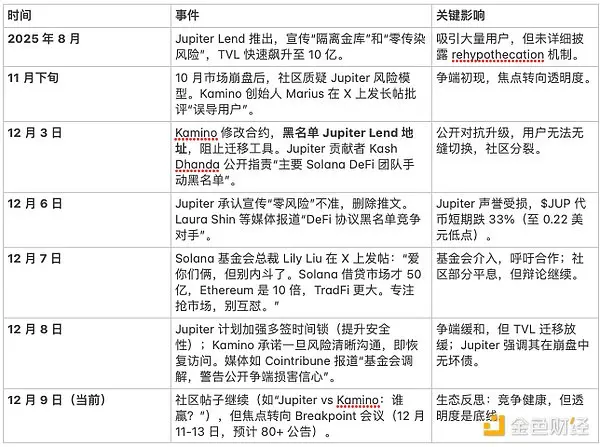
3. Impact and Outlook
- For users: Short-term inconvenience (such as migration barriers), but a reminder to DYOR (do your own research). It’s advisable to diversify liquidity and avoid relying on a single protocol.
- For the ecosystem: Exposes the “growing pains” of Solana DeFi—rapid innovation, but governance relies on social reputation. The Foundation hopes this will drive clearer risk standards and help capture market share from Ethereum/TradFi.
- Who “won”? Currently a tie: Kamino has strengthened its “safe” image (KMNO up 2.5%), while Jupiter is fighting back with growth and product iteration (such as high APY) (JUP rebounded 5%). In the long run, this could spur better protocols, but if infighting continues, it may scare off institutional funds.
This dispute is a microcosm of Solana’s “high growth, low maturity”: fierce competition, but requiring more collaboration.
Disclaimer: The information on this page may come from third parties and does not represent the views or opinions of Gate. The content displayed on this page is for reference only and does not constitute any financial, investment, or legal advice. Gate does not guarantee the accuracy or completeness of the information and shall not be liable for any losses arising from the use of this information. Virtual asset investments carry high risks and are subject to significant price volatility. You may lose all of your invested principal. Please fully understand the relevant risks and make prudent decisions based on your own financial situation and risk tolerance. For details, please refer to
Disclaimer.
Related Articles
Phantom wallet crashes hard! During the airdrop period, token prices get mixed up, balances go to zero—users blast it for “making people lose money”
Phantom wallet in Solana’s ecosystem experienced a service outage during the airdrop period, causing abnormal token prices and account balances to be displayed, which affected users’ transactions. Some users suffered losses as a result and are demanding compensation. Security experts warned of phishing attack risks and advised users to verify on-chain data. Although the issue has been resolved, the trust crisis still needs to be monitored. This incident highlights the challenges self-custody wallets face in terms of system stability and user experience.
区块客8h ago
Standard Chartered Sees Solana Shifting Beyond Memecoins Toward Payments
_Standard Chartered set SOL $250 target for 2026 and $2,000 forecast for 2030._
_Solana stablecoin turnover is 2–3x higher than Ethereum, per report data._
_Bank links Solana growth to low fees and shifts toward payment use cases._
Standard Chartered has revised its Solana outlook as
LiveBTCNews04-11 08:08
Phantom Wallet crashes big time! During the airdrop period, token prices went haywire and balances were reset to zero—users blasted it for “making them pay up.”
Phantom, a wallet in the Solana ecosystem, experienced a service outage during the airdrop, causing abnormal token prices and account balances to be displayed, which affected user transactions. Some users suffered losses as a result and demanded compensation. Security experts warned of the risk of phishing attacks and advised users to verify on-chain data. Although the issue has been fixed, the trust crisis still needs to be monitored. This incident highlights the challenges of self-custody wallets in terms of system stability and the user experience.
区块客04-11 05:50
The U.S. spot SOL ETF had a net inflow of $11.4530 million yesterday
On April 10, the U.S. SOL spot ETF recorded a net inflow of $11.4530 million in a single day. The Bitwise Solana Staking ETF (BSOL) contributed all of the inflow, bringing the historical total net inflow to $789.00 million. The current net asset value (NAV) of the SOL spot ETF’s total assets is $828.00 million, and the historical cumulative net inflow is $975.00 million.
GateNews04-11 05:31
Alchemy Launches $20M Fund To Accelerate Solana Innovation
The race to dominate Web3 infrastructure continues to intensify, and Alchemy just made a bold move. The company launched a $20 million initiative aimed at accelerating innovation within the Solana ecosystem. This step signals a deeper commitment to empowering developers who want to build fast,
Coinfomania04-11 00:10


