Pi Network launches a brand-new self-service KYC unlocking tool, allowing users whose accounts were blocked due to incomplete verification steps or being flagged to resolve their account status issues on their own. At the same time, the standard KYC system integrates AI technology, reducing the manual review queue by 50% and alleviating the shortage of verifiers in many regions. This update, in conjunction with the Testnet2 smart contract upgrade, removes the biggest barrier for Pi Network to move from theory to practice.
Pi Network KYC Backlog Crisis Drives Technological Innovation
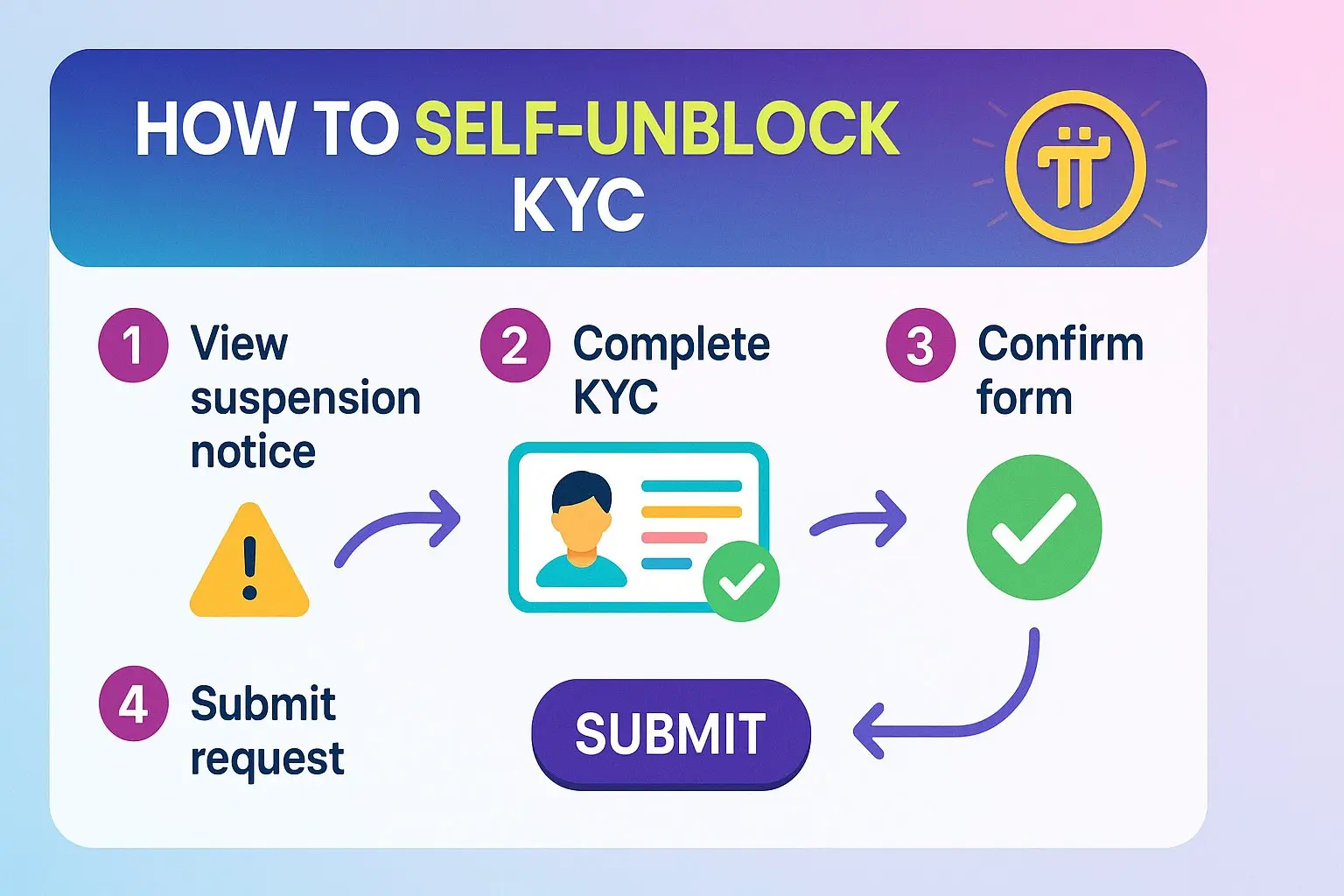
(Source: Dr. Chengdiao Fan)
For a long time, Pi Network’s KYC verification backlog has been the community’s biggest pain point. Millions of users have been flagged by the system due to incomplete submissions, blurry photos, or issues with ID document formats, and could only passively wait for the manual review team to process them. In regions with severe verifier shortages, wait times could last months or even half a year. This inefficiency not only hampers users’ migration to the mainnet but also damages the entire ecosystem’s trust foundation.
The self-service unlocking tool newly launched by Pi Network essentially delegates the authority to diagnose and fix issues to the users themselves. The new process consists of four steps: first, users view their account blocking notification within the app, where the system clearly indicates which verification step has issues. Second, users follow the prompts to complete the missing KYC steps, such as re-uploading clear photos, supplementing ID documents, or completing liveness detection. Third, users confirm that all form information is correct. Finally, they submit an account unlocking request, and the system will prioritize these proactively corrected cases.
The cleverness of this design lies in automating what previously required back-and-forth communication with customer service, greatly reducing labor costs while increasing processing speed. For users blocked solely due to technical errors, this self-help channel could restore their accounts in a matter of hours instead of the weeks-long waits of the past.
AI Dual-Engine Strategy: Balancing Speed and Privacy
Even more revolutionary is Pi Network’s integration of AI technology into its standard KYC system. This technology uses the same algorithm as Pi’s fast KYC system but is now expanded to the main verification process. The results are immediate: the KYC review queue was slashed by almost 50% overnight. This means millions of users waiting to migrate to the mainnet will see their verification speed double.
The AI system operates conservatively. The algorithm first analyzes users’ submitted identity documents, selfie photos, and liveness detection videos, using image recognition to verify document authenticity, facial matching, and liveness features. If the system’s confidence index meets a set threshold, the case is approved directly; if there are any uncertainties, it is automatically referred to a human verifier for secondary review. This hybrid model ensures accuracy while avoiding the risk of misjudgment that could result from relying solely on AI.
From a privacy protection perspective, AI verification reduces the number of human verifiers exposed to sensitive data. In traditional KYC processes, verifiers need to view users’ ID cards, passports, and facial photos—highly sensitive information that, if leaked, could have serious consequences. The AI system processes data in an encrypted environment, does not retain original images after verification, and only keeps the hash value of the verification result. This technical architecture complies with EU GDPR and other major regional privacy laws.
Notably, Pi Network has confirmed that verifier rewards will still be distributed as planned in Q1 2026. The delay is due to the network processing hundreds of millions of historic KYC tasks, which require massive data cleaning, fairness checks, and mainnet security audits. This cautious approach shows the team’s commitment to long-term ecosystem health.
Testnet2 Upgrade Paves the Way for Developers
Pi’s Testnet2 upgrade is now officially live, adding smart contract functionality, Linux support, and an all-new open network system. This update provides developers with a complete toolchain to build and test real-world applications before the open mainnet phase. Testnet2 also improves performance and compatibility, laying the groundwork for more advanced decentralized applications (dApps) and on-chain services.
Currently, over 100 mainnet-ready applications are in development, covering payments, social, gaming, e-commerce, and more. This upgrade marks Pi Network’s shift from the “mining” phase to the “application” phase. Developers can now more clearly deploy real products, and users have greater confidence in the maturing infrastructure behind Pi. The introduction of smart contract functionality means Pi is no longer just a payment token but a programmable blockchain platform, opening up infinite possibilities for ecosystem expansion.
Data Reveals Ecosystem Growth Trajectory
Pi Network Core Data Overview
17.5 million users: Have completed full KYC verification, making it one of the largest verified networks in the Web3 space
15.7 million users: Have successfully migrated to the mainnet, representing about 90% of verified users
3 million users: Have preliminarily passed KYC but still need to complete liveness detection; this is the main target group for the self-service unlocking tool
50% reduction: In manual review queue after AI integration, significantly improving verification efficiency
These numbers show that Pi Network has established the largest real-name verified user base in the crypto space. The 3 million users in pending status are precisely the target for the new self-service unlocking tool. Once these users take action, mainnet migration speed is expected to increase significantly in the short term. The self-service unlocking feature, AI-driven KYC, and Testnet2 upgrades collectively demonstrate a clear trend: less waiting, more building. For a project long criticized for slow progress, this update delivers a rare achievement—tangible progress.
Disclaimer: The information on this page may come from third parties and does not represent the views or opinions of Gate. The content displayed on this page is for reference only and does not constitute any financial, investment, or legal advice. Gate does not guarantee the accuracy or completeness of the information and shall not be liable for any losses arising from the use of this information. Virtual asset investments carry high risks and are subject to significant price volatility. You may lose all of your invested principal. Please fully understand the relevant risks and make prudent decisions based on your own financial situation and risk tolerance. For details, please refer to
Disclaimer.
Related Articles
Pi Network Launches First Smart Contract Feature on Testnet, Enabling Subscription Payments
Pi Network has launched its first Smart Contract feature on Testnet, enabling users to set up automatic subscription payments while maintaining control of their funds. This marks a shift toward ecosystem utility and lays the groundwork for potential mainnet deployment.
GateNews3h ago
Pi Network Requires Mainnet Upgrade to v22.1 by April 27 or Risk Disconnection
Pi Network announced a mandatory upgrade to Protocol version 22.1, requiring completion by April 27, 2026, to maintain network connection. The upgrade is seen positively for enhancing security and performance, with next version expected by May 11, 2026.
GateNews04-17 06:05
Pi Network V23 Upgrade to Launch Smart Contracts, DApp Ecosystem, and DEX Next Month
Pi Network will launch its V23 upgrade next month, featuring smart contracts, a DApp ecosystem, and a decentralized exchange. With over 18 million KYC-verified users, this upgrade moves Pi towards practical applications and utility in its ecosystem.
GateNews04-16 05:41
Pi Network Agreement 23 Targets the Institutional Market, Smart Contracts, and RWA Tokenization to Launch in Early May
Pi Network officially went live with Protocol 23 on May 18, bringing smart contracts, real-world asset tokenization, and the AI App Studio, enabling Pi to transform from a payment token into a programmable blockchain infrastructure. The protocol covers four major functions, similar to Ethereum, and is expected to attract institutional investors. The upgraded node milestones signal market confidence and may affect Pi’s price performance.
MarketWhisper04-15 03:02
Pi Network 18 million users complete KYC, and 26.5 million PI are issued to verifiers
Pi Network distributes 26.5 million PI tokens to more than 1 million community members who have completed KYC verification, to accelerate user identity verification and strengthen the decentralized model. 18 million already-verified users have laid the groundwork for the ecosystem’s development, but the key lies in how to convert these users into active participants. With the protocol upgrade, Pi Network is moving toward the open network phase, and smart contract support signals richer application scenarios.
MarketWhisper04-14 05:07
Pi Network price hits a new 7-week low as a wave of 60 million token unlocks comes in
Pi Network's native token PI fell to $0.165 in April, hitting a 7-week low and leaving market sentiment weak. The unlock peak will release more than 60 million PI, adding downward pressure. Despite the core team recently publishing technical updates, it failed to improve market confidence and instead drew community criticism due to KYC access issues and the ongoing slide in price. Increased future supply could further drive prices lower.
MarketWhisper04-14 02:50


