On December 8, Bitcoin rebounded above $91,000, and on-chain analytics platform CryptoQuant data revealed a key bull market signal. The supply of stablecoins on Ethereum ERC-20 reached a new high of $185 billion and has remained at that level this month. Stablecoin reserves on major global exchanges have surged, in stark contrast to the decline in Bitcoin and Ethereum reserves, indicating that traders are holding a large amount of “dry powder” on the sidelines, waiting for an entry opportunity.
Exchange Anomaly: Divergence Between Stablecoin and Crypto Reserves
Liquidity changes at major centralized exchanges worldwide reveal a key signal. As CryptoQuant pointed out earlier this week, stablecoin reserves at leading trading platforms have “soared,” in sharp contrast to the declining reserves of Bitcoin and Ether (ETH). This kind of divergence is rare in market history and often signals a major turning point.
When stablecoin reserves on exchanges increase, it means users are converting cryptocurrencies into stablecoins and storing them on the platform, maintaining the ability to quickly enter the market. Conversely, when BTC and ETH reserves decrease, it usually means these assets are being withdrawn to cold wallets or other platforms, indicating holders are not interested in short-term trading. When both trends occur simultaneously, they form a clear picture of market psychology: investors are taking profits at highs but have not fully exited, instead converting to stablecoins and staying ready to re-enter at any time.
CryptoQuant contributor CryptoOnChain noted: “This rare combination (declining crypto reserves + soaring stablecoin reserves) shows that traders are taking profits at price highs and are now holding a large amount of ‘dry powder’ on the sidelines.” “Dry powder” is a Wall Street term referring to liquid funds that can be invested at any time. In the crypto market, stablecoins are the most typical form of dry powder, as they maintain stable USD value and can be converted into any crypto asset within seconds.
“So many stablecoins parked on exchanges are like a compressed spring; once prices correct or macroeconomic conditions stabilize, these funds could become the fuel for a new explosive rally. The market is currently in a patient phase, poised for a breakout.” This analogy is highly apt—the compressed spring has built up tremendous potential energy, just waiting for a trigger to be released. In the crypto market, this trigger could be Bitcoin dropping to a key support level, a major positive news event, or an improvement in the macroeconomic environment.
Leading trading platforms, as centers of market liquidity, have highly representative reserve changes. Their users include retail investors, professional traders, and institutional investors, and changes in their stablecoin reserves often reflect overall market sentiment. When exchange stablecoin reserves reach new highs, it means that global investors of all types are synchronously taking a wait-and-see approach, and such consistency itself is a strong market signal.
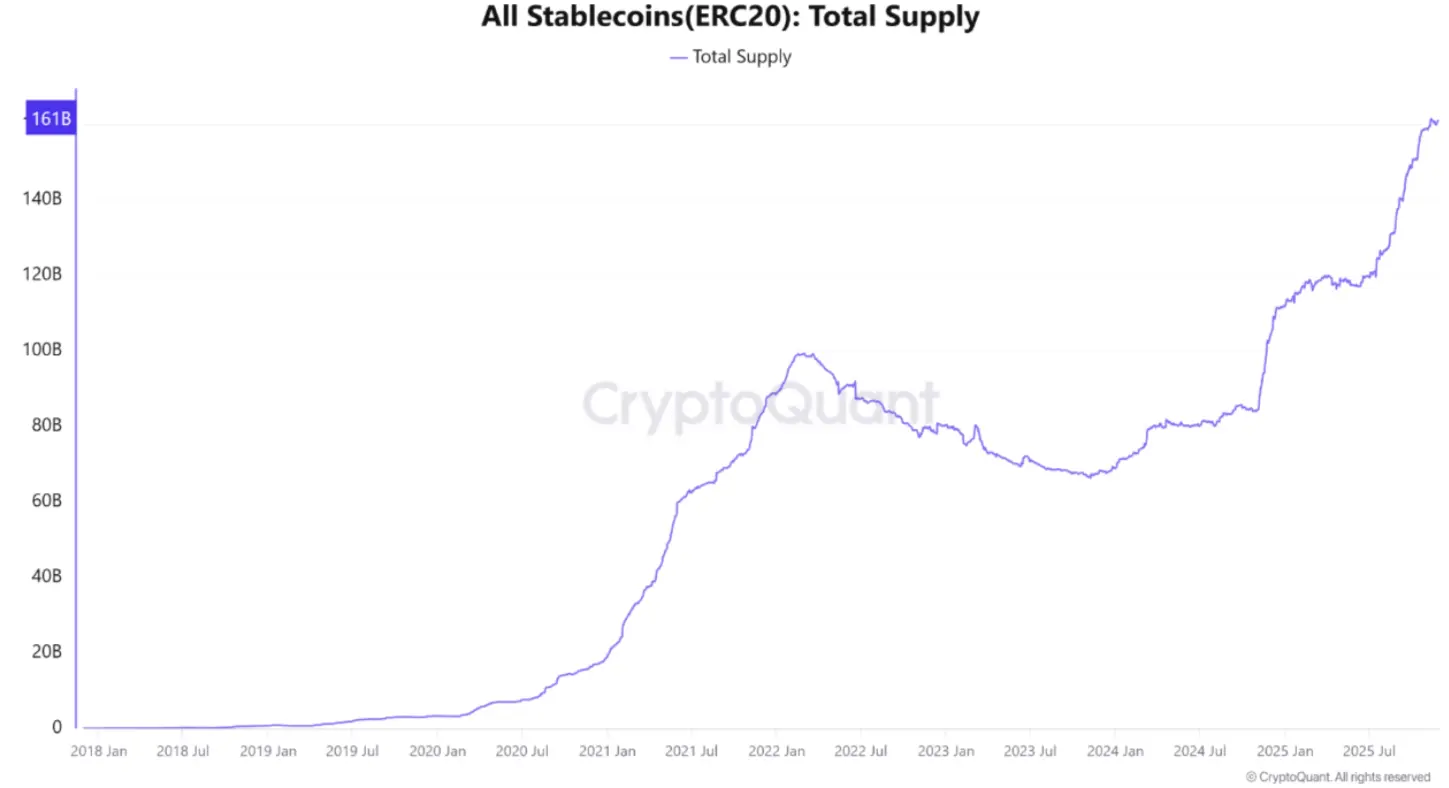
$185 Billion: ERC-20 Stablecoins Hit All-Time High
(Source: CryptoQuant)
Data from on-chain analytics platform CryptoQuant confirms that stablecoin supply hovered at historical highs throughout November. In 2025, the total stablecoin supply on the Ethereum network (ERC-20) alone reached $185 billion—an all-time high, and as of December, it remains at that level. This figure is truly stunning, as it represents massive funds entering the crypto ecosystem but not yet allocated to risk assets.
Why only count ERC-20 stablecoins? Because Ethereum is the main platform for stablecoin issuance, with the majority of leading stablecoins like USDT, USDC, and DAI issued on Ethereum. ERC-20 is Ethereum’s token standard, and all stablecoins issued on Ethereum follow this standard. Although there are stablecoins on other blockchains such as Tron and Solana, Ethereum still dominates absolutely. Therefore, ERC-20 stablecoin supply serves as a reliable indicator of the overall stablecoin market.
“This growth is more stable than Bitcoin prices and directly reflects capital inflows into the crypto ecosystem,” commented CryptoQuant contributor XWIN Research Japan in its Quicktake blog post. This observation is crucial, as it reveals the causal relationship between stablecoin supply and cryptocurrency prices. Bitcoin’s price may fluctuate sharply due to speculative sentiment, technical factors, or macro events, but changes in stablecoin supply reflect real capital inflows and outflows, making it a more reliable trend indicator.
The continued growth of stablecoin supply means new capital is continuously flowing into the crypto market. These funds may come from reallocation within traditional financial markets, new retail investor inflows, or tentative allocations by institutional investors. Regardless of the source, the $185 billion scale shows that long-term confidence in crypto has not wavered. Even when Bitcoin prices pull back from highs, funds do not flee the market but instead switch to stablecoins, waiting for an opportunity.
Threefold Significance of Stablecoin Supply Remaining High
Capital Retention: $185 billion remains within the ecosystem, ready to convert to BTC/ETH at any moment
Confidence Intact: Investors choose to wait rather than fully exit, showing faith in the ongoing bull market
Ample Ammunition: The huge pool of investable funds provides sufficient buying power for the next rally
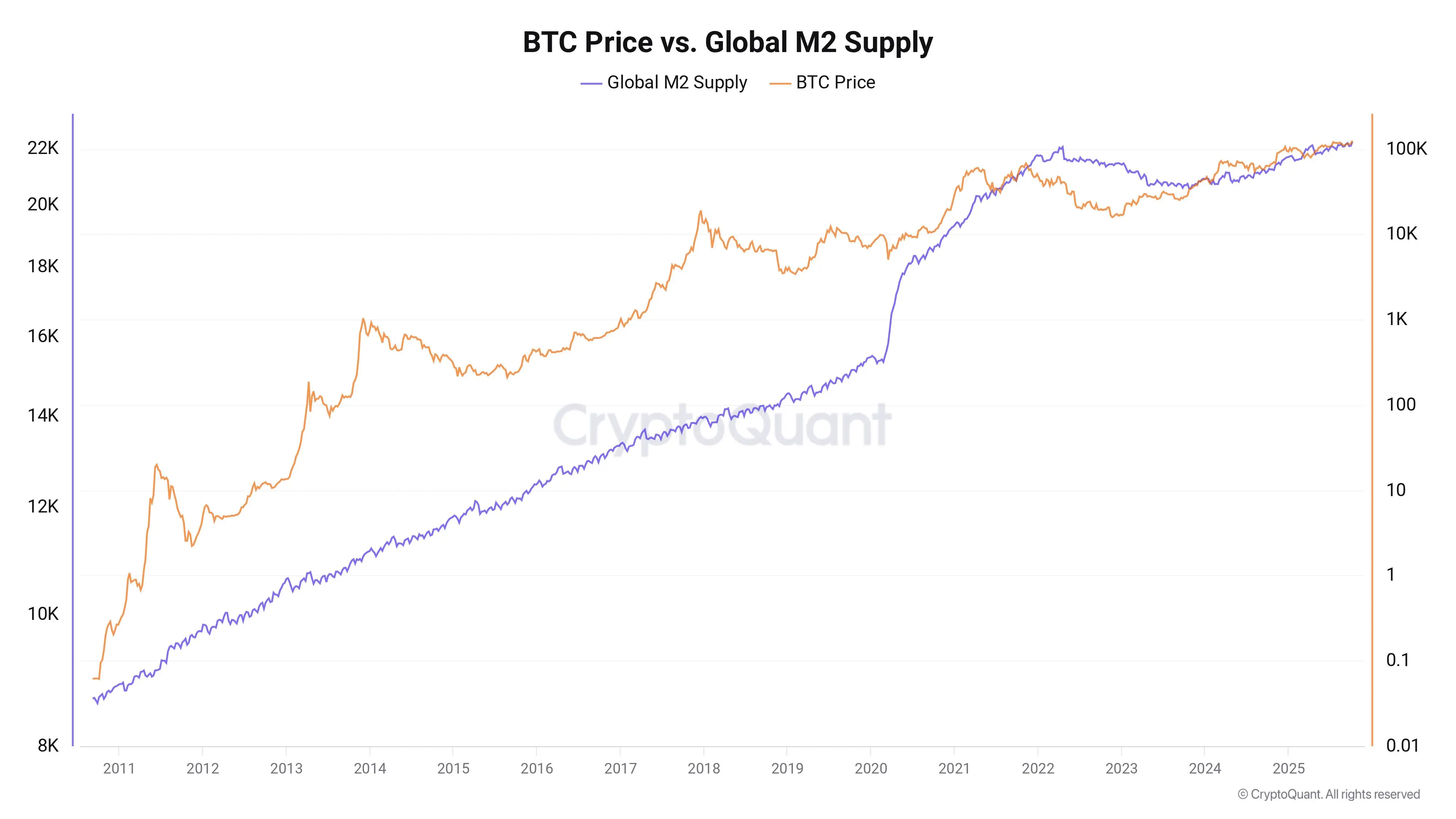
Why Stablecoins Predict Bull Markets Better Than M2
(Source: CryptoQuant)
Cryptocurrency price performance is often correlated with global M2 money supply changes. After this liquidity indicator hit a new high in early 2025, its growth has cooled off. However, XWIN Research Japan believes that stablecoins are a more important benchmark for industry performance.
The reason is that M2 is a macroeconomic indicator, covering the entire economy’s money supply, with only a tiny portion flowing into crypto markets. In contrast, stablecoin supply is a liquidity metric specific to crypto; every dollar of stablecoin is clearly intended to be invested in crypto assets. M2 data is released monthly or quarterly by central banks and has significant lag. Stablecoin supply, on the other hand, is real-time data—every minting and burning is immediately reflected on-chain, allowing investors to track capital flows in real time.
XWIN adds: “Whether in the 2021 bull market or the 2024–2025 recovery, rising stablecoin supply has clearly led Bitcoin’s price surge.” This historical pattern is highly significant, as it means stablecoin supply can serve as a leading indicator for predicting Bitcoin price trends. When stablecoin supply starts to accelerate, it often signals that Bitcoin will enter an upward cycle in the following weeks. When will the $185 billion in stablecoin dry powder turn into actual buying? The market is waiting for technical corrections to complete, for macroeconomic conditions to improve, or for major catalyst events. The market is currently in a patient, poised phase—the $185 billion spring is already compressed and ready.
Disclaimer: The information on this page may come from third parties and does not represent the views or opinions of Gate. The content displayed on this page is for reference only and does not constitute any financial, investment, or legal advice. Gate does not guarantee the accuracy or completeness of the information and shall not be liable for any losses arising from the use of this information. Virtual asset investments carry high risks and are subject to significant price volatility. You may lose all of your invested principal. Please fully understand the relevant risks and make prudent decisions based on your own financial situation and risk tolerance. For details, please refer to
Disclaimer.
Related Articles
Aave Proposes 25,000 ETH for DeFi United Kelp DAO Relief
Aave service providers put forth a governance proposal on Friday that would contribute 25,000 ETH worth nearly $58 million from the protocol's DAO to DeFi United, a coordinated relief effort to restore backing for rsETH following last week's Kelp DAO exploit. The proposed contribution would
CryptoFrontier1h ago
OpenSea CMO Adam Hollander Buys uPEG, Ethereum Token Surges Over 300%
Gate News message, April 25 — OpenSea CMO Adam Hollander purchased a small amount of uPEG, an Ethereum-based token, this evening, stating he was "simply interested in the concept and wanted to experiment." The purchase triggered a sharp rally, with uPEG surging over 300% in a short
GateNews4h ago
Ethereum Foundation Sells 10,000 ETH to Bitmine for Nearly $24 Million
Gate News message, April 25 — The Ethereum Foundation sold 10,000 ether to Bitmine Immersion Technologies on Friday, finalizing an over-the-counter deal at an average price of $2,387 per ETH, totaling approximately $23.87 million. The sale will fund the EF's core operations and activities, including
GateNews4h ago
GSR Debuts BESO ETF With Bitcoin, Ethereum, Solana
GSR debuts BESO ETF with active strategy, adjusting Bitcoin, Ether, and Solana allocations weekly to outperform benchmarks.
ETF records nearly $5M in first-day volume, signaling early investor interest in diversified crypto investment products.
Launch aligns with growing ETF momentum as
CryptoFrontNews4h ago
Fluent Ethereum Layer 2 Mainnet Launches with BLEND Token and $50M Day-One Liquidity
Gate News message, April 25 — Fluent, an Ethereum-based Layer 2 network, activated its mainnet and launched its native BLEND token on Friday, April 25, bringing online a "blended execution" environment that enables applications written for different virtual machines to operate within the same
GateNews6h ago
ETH Liquidation Cascade: $761M in Short Positions at Risk Above $2,424
Gate News message, April 25 — According to Coinglass data, if Ethereum (ETH) breaks above $2,424, cumulative short position liquidations across major CEXs could reach $761 million.
Conversely, if ETH falls below $2,211, cumulative long position liquidations across major CEXs could reach $689 millio
GateNews7h ago


