Author: K3 Kai; Source: X, @kaikaibtc
Tether, from the very beginning of the industry, has been doubted by many who believed it was bound to collapse sooner or later—it was just a matter of time. The reason: USDT is almost entirely issued without sufficient reserves to back it up.
Yet I’ve watched USDT grow from just a few hundred million dollars to today’s nation-level $185.5 billion. It’s been flooded with FUD (fear, uncertainty, and doubt), but Tether has only become stronger.
But recently, something seems off with Tether.
A series of recent moves—from holding 116 tons of gold, to venturing into commodity credit, to the imminent launch of its own Stable public blockchain—all signal something chilling: Tether is undergoing a terrifying “species evolution.” It’s no longer content being a dollar transporter; it’s building a self-sufficient “parallel universe” independent of the traditional financial system.
Today, let’s take a deep dive into what this giant beast, Tether, is really trying to do. What kind of impact will its fangs have on the entire stablecoin sector and the crypto world as a whole?
True “Central Bank-Level” Reserves: Gold and Bitcoin
In the past, we questioned Tether by asking, “Do you actually have US dollars in your accounts?” Now, Tether just slaps its balance sheet on the table and tells the world: I don’t just hold dollars, I’m stockpiling “doomsday hard currency.”
According to the latest analysis report from Jefferies, Tether currently holds 116 tons of physical gold.
What does this mean? This reserve level puts it among the world’s top sovereign central banks—comparable to the central bank gold reserves of South Korea, Hungary, and Greece. Even more astonishing, last quarter nearly 2% of global gold demand and 12% of central bank gold purchases came from just one company: Tether. There are even rumors that, with a projected $1.5 billion in profit this year, Tether plans to buy another 100 tons of gold in 2025.
Add to that its publicly held Bitcoin reserves, and Tether is quietly shifting its balance sheet from being a single “USD credit derivative” to a “gold + Bitcoin” hybrid standard. It’s preparing its own “central bank reserves” for a future de-dollarized world.
Not Just “Printing Money”—Building its Own Stable Public Chain
If stockpiling gold is acting like a central bank, launching its own Stable public chain is Tether’s declaration of independence from reliance on external chains like Ethereum and Tron.
The latest news: The Stable mainnet, which Tether is involved in launching, will officially go live on December 8. This isn’t just another new chain—this is Tether’s “declaration of independence” for its ecosystem.
- Native Integration: In the future, transferring USDT won’t depend on Ethereum’s congestion or have to worry about various Tron controversies.
- Economic Model: The initial token allocation has been set, meaning Tether will have a completely self-owned settlement layer.
With its own currency (USDT/XAUt), its own settlement channel (Stable Chain), and previous investments in censorship-resistant communication software Keet, Tether is building an end-to-end closed digital economy loop.
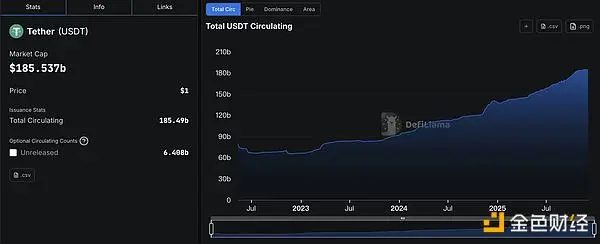
Stablecoin market data (Source: DeFiLlama)
From “Commodities” to “RWA”
Tether’s reach is rapidly extending deep into traditional finance, aiming to become a “shadow bank” in the real world.
1. Commodity Trade Financing (A New Money Printer):
Tether announced it has deployed $1.5 billion in credit to the commodity sector for financing oil, cotton, and wheat trades. As traditional banks have scaled back due to compliance, Tether, with nearly $200 billion in liquidity, is charging straight in. This means USDT is shifting from being just a “trading tool” to becoming a “settlement currency” for international commodity trading.
2. RWA and Compliance Ambitions (Hadron Platform):
Tether launched the asset tokenization platform Hadron and quickly partnered with compliance data firm Crystal Intelligence and asset management giant #KraneShares. Its goal: to tokenize stocks, bonds, and funds.
3. Lending Empire (Investment in Ledn):
Just recently, Tether strategically invested in the Bitcoin-collateralized lending platform Ledn. In Tether’s view, Bitcoin is not just a reserve asset but will be the core collateral of the future.
Compliance Plan
Tether doesn’t just want to rule the gray areas—it also wants to “go legit” in the white world.
Facing Circle’s (USDC) compliance challenge, Tether made a strategic move: dual-track approach.
USDT: Continue to dominate the global offshore market, serving Asia, Africa, Latin America, Eastern Europe, and the aforementioned commodity trading. These markets don’t need much US regulation—just liquidity.
USAT: Tether has hired former White House advisors, supports pro-crypto PACs, partnered with Wall Street giant Cantor Fitzgerald, and may even issue through the Hadron platform.
This is Tether’s open strategy: use the huge profits earned from USDT to fund a compliant USAT, thereby achieving a “Normandy landing” in the US domestic market.
Conclusion: Redefining Tether
When you put all the pieces together (gold reserves, its own public chain, trade financing, compliance platforms), you’ll realize we have to completely refresh our understanding of Tether.
It’s no longer just a “wildcard hero” skirting the gray areas and making money on interest.
- It’s like a central bank: Holding 116 tons of gold, reserves comparable to South Korea.
- It’s like a commercial bank: Providing $1.5 billion in trade financing, investing in Ledn for lending.
- It’s like a tech giant: Developing Keet communication, QVAC AI, and even launching its own public chain on December 8.
For the industry, Tether’s strength is both a shield and a Damocles sword. USDT’s position is unassailable in the short term; as the Stable mainnet launches and RWA business expands, Tether is gradually drawing the entire crypto industry—even parts of traditional finance—into its gravitational field.


