1. The Profit Margin Crisis in Crypto Mining
In November 2025, Marathon Digital Holdings (MARA) revealed a strategic shift in its Q3 financial report, announcing that “from now on, the company will sell a portion of newly mined Bitcoin to support operational funding needs.” This move highlights the current reality that the crypto mining industry is facing constant pressure from shrinking profit margins.
Similarly, another mining giant, Riot Platforms (RIOT), disclosed in its October 2025 production and operations update that it mined 437 Bitcoins that month, down 2% month-over-month and 14% year-over-year, and sold 400 Bitcoins. In April 2025, RIOT also sold 475 Bitcoins—its first sale of self-mined Bitcoin since January 2024.
RIOT has long adhered to a “HODL” strategy, preferring to hold most of its Bitcoin to benefit from price appreciation. However, in the new post-halving cycle, RIOT has begun to adopt a more flexible funding strategy. The company’s CEO explained that selling Bitcoin could reduce the need for equity financing, thus limiting dilution for existing shareholders. This shows that even leading mining companies that previously stuck to a holding strategy must now sell a portion of their Bitcoin output as needed to maintain financial health, based on market and operational conditions.
Looking at Bitcoin price and network hashrate data, mining profits are being squeezed. By the end of 2025, network hashrate had climbed to a record 1.1 ZH/s. At the same time, Bitcoin prices had fallen to around $81,000, hashrate prices dropped below $35/PH/s, while the median hashrate cost soared to $44.8/PH/s. This means increased market competition and compressed profit margins—even the most efficient mining companies are barely breaking even.
As mining marginal revenues fall, fixed power and financing costs remain high. Against this backdrop, even as some mining companies accelerate their transition to AI and high-performance computing (HPC), they still face varying degrees of financial strain and survival pressure. At this point, efficient tax planning becomes a key strategy for easing financial stress and supporting long-term operations. Next, using the United States as an example, we will discuss whether tax planning can effectively reduce the overall operational pressure for mining companies.
2. Tax Burden on Crypto Mining Companies: The US Example
2.1 Corporate Tax Framework
In the US, companies can be classified as pass-through entities or C Corporations (standard stock corporations). Under US tax law, pass-through entities transmit profits directly to shareholders, who pay personal tax rates, resulting in single-layer taxation. C Corporations pay a flat 21% corporate tax at the company level and shareholders are taxed again on dividends, resulting in double taxation.
To elaborate, sole proprietorships, partnerships (Partnership), S Corporations, and most Limited Liability Companies (LLCs) are all pass-through entities and do not pay federal corporate income tax. The income of pass-through entities is treated as ordinary personal income and taxed at ordinary rates, which can reach up to 37% (see chart).
Table 1: 2025 US Federal Ordinary Income Tax Rates and Brackets
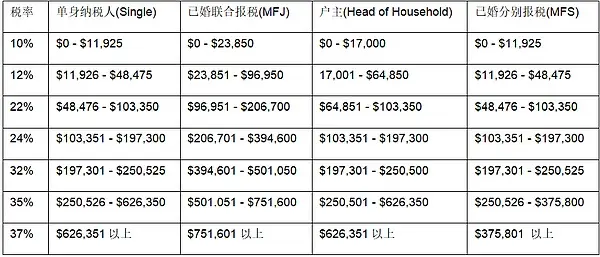
Cryptocurrency is treated as property, so mining income and sale gains remain taxable, but actual tax liabilities may differ depending on the taxpayer:
(1) If the crypto mining company is a pass-through entity, it does not pay federal income tax, but shareholders must declare personal income tax on their share of profits. The tax types involved in acquiring and transacting cryptocurrency include ordinary income tax and capital gains tax. First, crypto earned through mining, staking, airdrops, etc., requires shareholders to declare and pay tax as ordinary income at the personal level (rates from 10% to 37%). Second, when the entity sells, exchanges, or spends crypto, shareholders also pay capital gains tax. If held for one year or less, gains are short-term and taxed as ordinary income (10%-37%). If held for more than one year, gains are long-term and taxed at preferential rates of 0%, 15%, or 20%, depending on taxable income (see chart).
Table 2: US Long-Term Capital Gains Tax Rates and Brackets
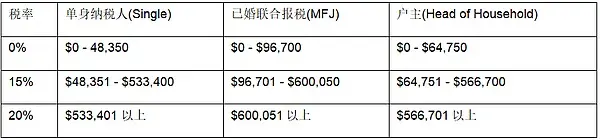
(2) If the mining company is a C Corporation, it pays a flat 21% federal corporate tax and state taxes as well. Crypto obtained through mining, staking, or airdrops is recorded at fair market value as revenue, and capital gains from selling, exchanging, or spending crypto (regardless of holding period) are also included in company revenue. After deducting costs and expenses, profits are taxed at 21% federally, plus state taxes. If the C Corporation pays dividends to shareholders, a second layer of tax is triggered on the dividends.
2.2 The Challenge of Multiple Tax Burdens
Within the US, large, publicly funded, or soon-to-be-listed mining companies like MARA, RIOT, Core Scientific, etc., almost universally operate as C Corporations, while smaller or startup mining companies prefer pass-through structures.
Different companies’ funding needs, cash retention strategies, and tax considerations result in different entity choices. Crypto mining is capital-intensive, requiring strong internal profit retention during expansion, making C Corporation structures favorable for retaining earnings without immediately passing tax burdens to owners, reducing cash outflows due to taxes on undistributed profits. Most LLCs adopt the pass-through structure, which offers early tax flexibility (taxed as partnerships or S Corporations to reduce tax), and can later restructure as C Corporations as they grow and need more capital. Therefore, many startups use the LLC structure early on and shift to C Corporations as they scale up.
Regardless of the structure, crypto mining companies face multiple layers of tax burden. For pass-through entities, business income “passes through” to the owners, so miners are taxed as soon as they receive mined coins, and any appreciation upon disposition is taxed again, resulting in consecutive taxes for owners. In contrast, C Corporations recognize mining and related business income at the company level, calculate profits, and pay corporate income tax; dividends distributed to shareholders incur a second layer of tax. With proper tax planning, however, mining companies can legally reduce tax payments, turning tax burdens into a competitive advantage in an industry with shrinking profit margins.
3. Tax Optimization Possibilities for Crypto Mining Companies
Using the US as an example, crypto mining companies can pursue various tax optimization strategies to reduce tax liability.
3.1 Using Mining Equipment Depreciation to Optimize Current Tax Liability
This year, the US enacted the “One Big Beautiful Bill Act” (One Big Beautiful Bill Act), restoring the 100% bonus depreciation policy under Internal Revenue Code Section 168(k). This allows taxpayers to fully deduct the cost of mining machines or servers as fixed assets in the year of purchase, reducing taxable income. Originally, the bonus depreciation rate was set at 100% from 2018 to 2022, then scheduled to drop each year after 2023 and reach 0% by 2027. The new act restores and extends the 100% bonus depreciation for assets acquired and placed in service between January 19, 2025, and January 1, 2030. It also raises the Section 179 expensing limit from $1 million to $2.5 million. This is significant for mining companies: the cost of mining rigs, power infrastructure, cooling systems, and other fixed assets can be expensed in the first year, directly reducing taxable income and greatly improving cash flow. Besides tax savings, “bonus depreciation” also enhances the present value of cash.
Note that using bonus depreciation should still consider annual cost situations to avoid wasted deductions and carryforward losses. For example, if a US mining company earns $400,000 in 2024 and spends $500,000 on mining equipment, deducting the full $500,000 in one year results in a $100,000 net operating loss (NOL). Although no tax is due for the year, this also means the company cannot extract or distribute profits even if it has cash flow. For tax purposes, NOLs carried forward can only offset 80% of taxable income in subsequent years. Thus, using bonus depreciation indiscriminately in low-profit years is not always wise.
( 3.2 Structuring Cross-Border Arrangements and Capital Gains Planning
Crypto tax policies differ across jurisdictions. In the US, whether selling coins occasionally, trading frequently, or operating as a business, any taxable transaction with profit must be reported and taxed, creating significant tax pressure for US-based miners. By contrast, Singapore and Hong Kong have more favorable crypto tax policies—neither currently taxes capital gains from non-regular crypto investments for individuals or businesses; only frequent traders or businesses pay corporate or personal tax, with corporate rates of about 17% in Singapore and 16.5% in Hong Kong. Although frequent traders still pay tax, these rates are more competitive than the US federal corporate tax of 21%.
Table 3: Tax Rate Comparison: US, Hong Kong, Singapore
![])https://img-cdn.gateio.im/webp-social/moments-2aa6475e418942315b57c712e7d2c70a.webp###
Given these differences, US crypto mining companies can legally reduce crypto tax burdens by planning cross-border structures. For example, a US Bitcoin mining company could set up a subsidiary in Singapore, sell mined Bitcoin at market prices to the subsidiary, which then sells to the global market. With this “internal-then-external” arrangement, the US parent company only pays tax on the initial mining income, while the Singapore subsidiary’s capital appreciation may qualify for Singapore’s capital gains tax exemption, thus avoiding capital gains tax. This structure clearly saves tax by shifting crypto appreciation from high-tax to low- or no-tax jurisdictions to maximize retained earnings.
( 3.3 Using Mining Equipment Hosting-Leasing Structures to Plan Economic Substance and Tax Liability
The hosting-leasing structure is widespread in crypto mining, separating asset ownership from mining operations to improve capital and resource allocation. This model naturally distributes profits based on commercial roles. For example, an overseas entity in a low-tax jurisdiction buys, owns, and leases mining equipment, while the US entity focuses on mining operations and pays rent or hosting fees to the overseas entity. The low-tax entity’s equipment income may qualify for lower tax rates. While hosting-leasing structures are not solely tax-driven, their commercial basis provides scope for cross-border tax planning.
Of course, when using this structure within the same group, certain compliance requirements must be met. For example, the overseas entity must have economic substance and actually own the mining assets, and rental fees must be set at arm’s length, i.e., at fair market rates.
4. Conclusion
With mining profits under continuous pressure from multiple factors, the global crypto mining industry is quietly entering a new cycle. At this turning point, tax planning is no longer just an optional financial tool, but may become the key for mining companies to maintain capital health and strengthen competitiveness. Mining companies can combine their business models, profit structures, and capital investment situations to develop systematic tax planning—provided all arrangements comply with regulatory and tax requirements—turning tax burdens into competitive advantages and laying the groundwork for long-term, stable growth.


