Charles Schwab has announced that it will offer Bitcoin and Ethereum trading services to clients in early 2026. Managing $12 trillion in assets, Schwab is the world’s largest brokerage and custodian, with liquidity levels comparable to BlackRock and Vanguard. ETF expert Eric Balchunas notes that many of Schwab’s services are commission-free, and Bitcoin trading may adopt the same model.
The $12 Trillion Giant’s Zero-Fee Trump Card
Schwab manages $12 trillion in assets, placing it at the top tier of the global financial industry. Yet, many of Schwab’s services, whether ETF or stock trading, are commission-free. ETF expert Eric Balchunas suggests this could disrupt the status quo. He states that this may lead to liquidity flowing out of centralized crypto exchanges (CEXs), which currently charge trading fees of 0.05% to 0.6% based on monthly volume.
This zero-fee model isn’t charity—it’s a sophisticated business strategy. Schwab profits through other means: interest income (from clients’ idle cash), securities lending, premium account subscriptions, and payment for order flow (routing client orders to specific market makers for rebates). As zero-fee trading attracts a surge of clients, these indirect revenues more than offset the loss from direct trading fees.
For native crypto exchanges, this is an existential threat. The business model of the largest US-regulated crypto exchange relies heavily on trading fees—their primary source of revenue. If Schwab truly offers zero-fee Bitcoin and Ethereum trading, many cost-conscious traders will migrate to Schwab’s platform. The largest US-regulated crypto exchange may be forced to lower its fees, directly impacting its profitability.
However, Schwab’s Bitcoin trading business doesn’t just have the potential to attract clients from native crypto exchanges—it can also expose more traditional investors to this asset class. This mirrors how, after Vanguard launched crypto ETF trading, it reportedly drove capital inflows into Bitcoin funds. Opening up this incremental market may be more important than poaching clients from the largest US-regulated crypto exchange, as it represents the creation of new demand rather than just a redistribution of the existing market.
Schwab vs. Largest US-Regulated Crypto Exchange: Competitive Comparison
Assets Under Management: Schwab $12 trillion vs. Largest US-regulated crypto exchange ~$130 billion
Client Base: Schwab 34 million accounts vs. Largest US-regulated crypto exchange ~100 million users
Trading Fees: Schwab expected zero fees vs. Largest US-regulated crypto exchange 0.05%-0.6%
Product Range: Schwab: stocks/ETFs/crypto all-in-one vs. Largest US-regulated crypto exchange: pure crypto specialty
Regulatory Status: Schwab fully SEC-compliant vs. Largest US-regulated crypto exchange: frequent regulatory disputes
This comprehensive competitive advantage gives Schwab the upper hand in direct competition with the largest US-regulated crypto exchange. The only variable is how well native crypto users will accept a traditional brokerage.
Four Wall Street Giants Enter in Ten Days
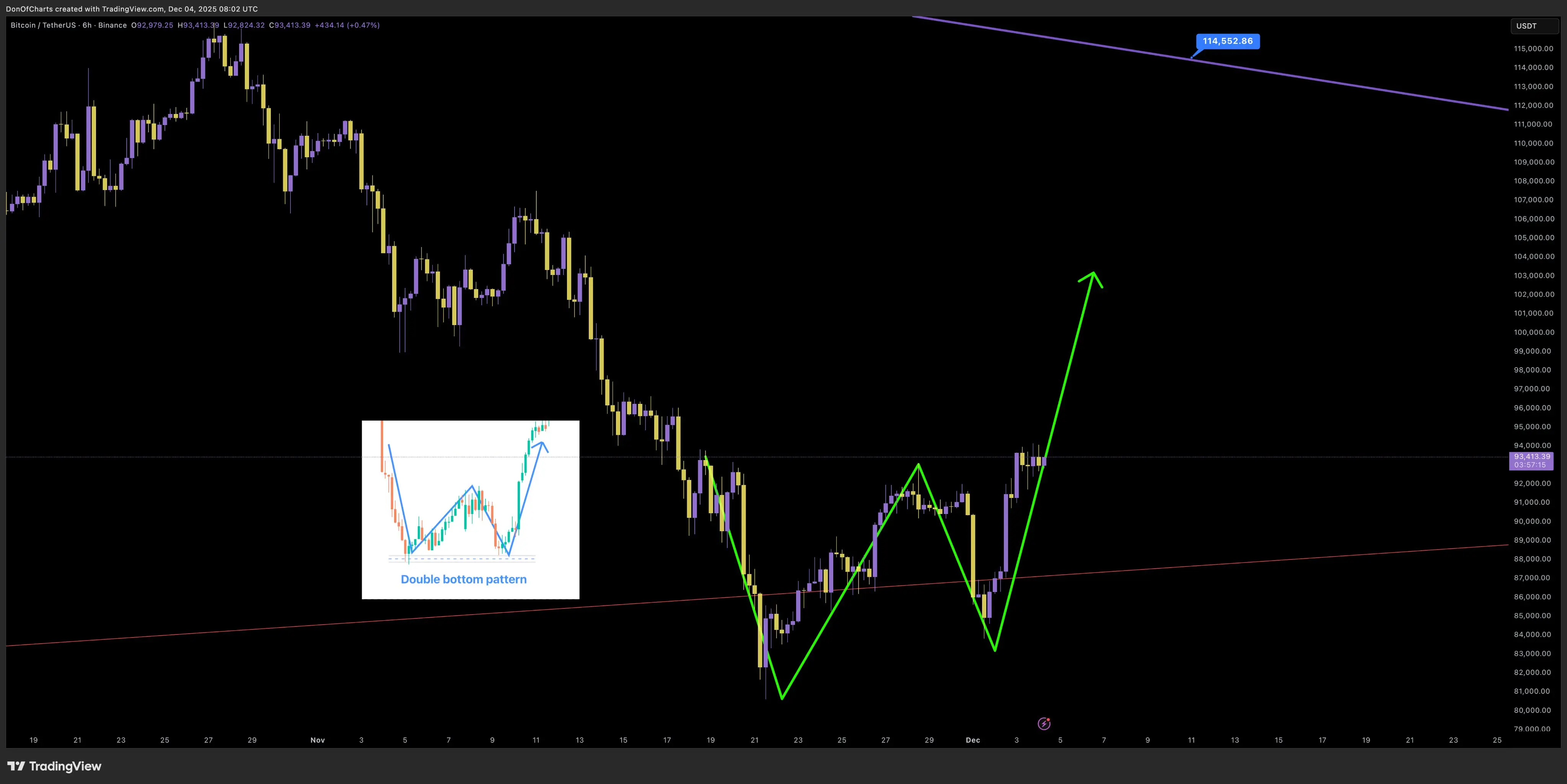
(Source: Trading View)
Wall Street’s demand for Bitcoin shows no sign of abating. In the past ten days, JPMorgan, Vanguard, Bank of America, and now Schwab have all committed to, launched, or recommended Bitcoin investment to clients. Such coordinated action is extremely rare in Wall Street history, as these conservative financial giants typically don’t reach consensus so quickly on emerging asset classes.
JPMorgan released a Bitcoin price forecast in November, targeting $170,000, and argued that Bitcoin is undervalued relative to gold—hence, the bank’s experts believe “Bitcoin has significant upside potential in the next 6 to 12 months.” More importantly, JPMorgan is developing Bitcoin derivative products, which will provide institutional clients with hedging and leverage tools.
After Vanguard recently announced that its 50 million-plus clients can purchase crypto ETFs, it reportedly spurred capital inflows into Bitcoin funds. Vanguard has long been skeptical of crypto; its founder Jack Bogle criticized Bitcoin repeatedly during his lifetime. However, client demand and market realities have ultimately led this conservative asset management giant to change its stance.
Although Bank of America has yet to launch direct Bitcoin trading services, its research division has begun publishing positive reports on crypto and advising some clients to consider allocating Bitcoin as part of their portfolio. This shift is highly unusual for a traditional bank.
Schwab has also revealed it is exploring strategic acquisitions, including potentially acquiring a crypto exchange. This again shows that demand for crypto products is growing among the world’s largest financial institutions. If Schwab does acquire a crypto exchange, it may choose a more compliant platform such as Kraken or Gemini, quickly gaining technology, licenses, and a user base through acquisition.
ETF Inflows and Institutional Demand Validation
BlackRock’s IBIT fund saw $120 million in inflows on Tuesday, the largest single-day inflow since November 11. This figure validates sustained institutional interest in Bitcoin. Since launch, IBIT has become one of the fastest-growing ETFs in history, with assets under management nearing $40 billion—an unprecedented achievement in ETF history.
However, as Ark Invest’s ARKB fund sold $90 million that day, overall ETF momentum was dampened. This divergence in flows shows that even at the institutional level, there are differing views on Bitcoin. BlackRock represents a conservative long-term allocation strategy, while Ark Invest’s selloff may be for tactical rebalancing or short-term market concerns.
Nevertheless, institutional demand persists—and is growing. This paints an exciting picture for Bitcoin’s future, especially as emerging macroeconomic tailwinds like the end of quantitative tightening and upcoming interest rate cuts come into play. The Federal Reserve’s aggressive rate hikes and balance sheet reduction from 2022 to 2024 were the main macro drivers of the 2022 crypto bear market. Now, with inflation under control and a rate-cutting cycle beginning, the environment is becoming favorable for risk assets.
Double-Bottom Pattern and the $170,000 Ultimate Target
Analyst Don Wedge recently published a new Bitcoin chart, noting that BTC has formed a double-bottom pattern, which signals an imminent rebound. The double bottom is one of the most reliable reversal patterns in technical analysis, showing that the price found support at a certain level twice before bouncing, indicating the support is strong and selling pressure has been exhausted. Don’s chart also shows a trendline resistance between $112,000 and $114,000, which could be the first target.
Given that Bitcoin rose around $9,000 in just two days this week, reclaiming the $112,000 level by year’s end is clearly reasonable. This rapid rebound demonstrates strong buying interest and a renewed investor confidence in Bitcoin’s long-term prospects. From the current price of around $92,000 to $112,000, there’s about 22% upside—an entirely achievable gain within a month.
Looking ahead, JPMorgan published its price forecast for Schwab and Bitcoin in November, targeting $170,000 and arguing BTC is undervalued relative to gold. The bank’s experts believe “Bitcoin has significant upside potential in the next 6 to 12 months.” From $92,000 to $170,000 is about an 85% gain—a target that’s ambitious but not impossible.
In fact, by then, JPMorgan’s Bitcoin derivatives may already be live, Schwab’s BTC trading could be launched, and Vanguard’s clients will be fully on board. In other words, all the major players will be participating—so a $170,000 Bitcoin is not out of reach.
That forecast was published in early November, so it may have been somewhat premature at the time. Nevertheless, macroeconomic and institutional catalysts are now closely aligned, Bitcoin has regained the crucial $90,000 support, and the $170,000 target seems within reach. Bitcoin’s reactions around $90,000 and $112,000 will give us deeper insight into whether its upward trend will continue toward historical highs and ultimately reach JPMorgan’s target.
2026 Bitcoin Institutional Adoption Timeline
Early 2026: Schwab launches Bitcoin trading
H1 2026: JPMorgan Bitcoin derivatives go live
Full Year 2026: Vanguard’s 50 million clients fully participate
Target Price Forecast: JPMorgan $170,000
When these traditional financial giants fully participate in the Bitcoin market, they will inject hundreds of billions or even trillions of dollars in new demand. This scale of demand is incomparable to the previous market, which was driven mainly by retail and native crypto institutions. Schwab’s entry may become the key turning point in this wave of institutional adoption, as its vast retail client base and zero-fee strategy will truly popularize Bitcoin investment.


