Bitcoin whales have returned to buying after months of distribution, indicating a rebound in confidence at key support levels. According to Glassnode's cumulative trend scores categorized by generation, entities holding 10,000 BTC or more have shifted to net accumulation over the past week, with these large holders currently having a cumulative trend score of 0.8, indicating strong buying activity. After a 35% drop from October's peak, Bitcoin is currently bottoming out around $80,000 and shifting towards accumulation.
Whale accumulation trend score reaches 0.8 marks a turning point
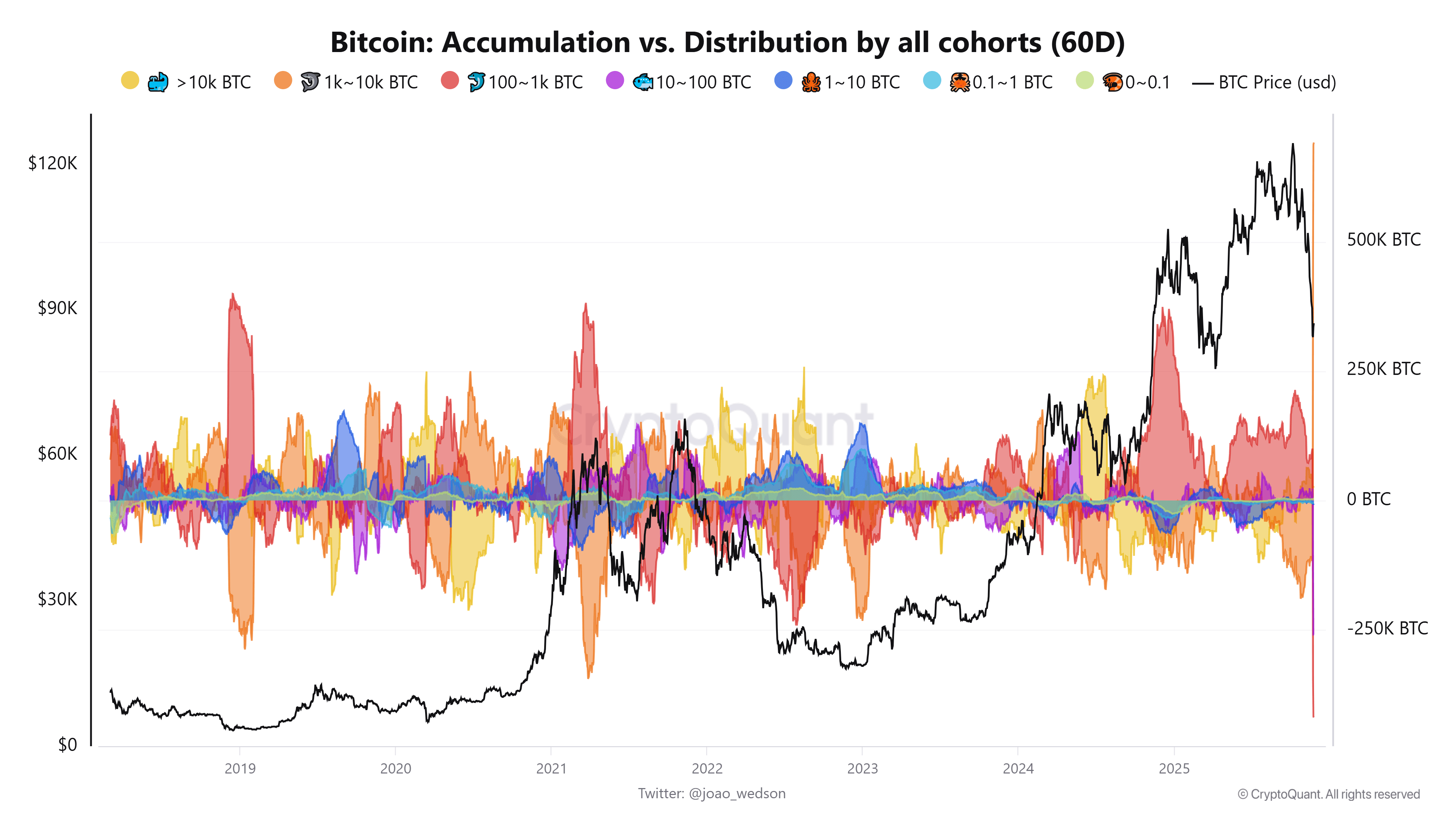
(Source: CryptoQuant)
Whales holding over 10,000 BTC have become strong accumulators of assets, with a trend score of 0.8, marking the first appearance of such a strong buying signal since August. The cumulative trend score measures the relative strength of purchases by balance groups based on the size of the actual wallets and the accumulated coin amount over the past 15 days. The net accumulation value of the signal is close to 1, and the signal distribution is close to 0. Exchanges and mining entities are not included in this methodology.
A cumulative trend score of 0.8 indicates that these Whale holders are buying Bitcoin in a very aggressive manner. This score is close to the maximum value of 1, showing that buying activity significantly exceeds selling activity. In contrast, in 2025, especially since August, large holders have drastically reduced their holdings, taking advantage of prices exceeding 100,000 USD to significantly decrease their positions. The cumulative trend score during that period may be close to 0 or even negative, indicating that these Whales are distributing rather than accumulating.
However, the situation is beginning to change now. After months of distribution, large entities holding over 10,000 BTC have started to buy back in. This behavior shift usually signals the formation of a market bottom. Whale holders have deeper market insights and a longer investment horizon, and their buying often indicates that prices are about to enter a new round of upward cycles.
1,000 to 10,000 BTC holders have also turned positive for the first time since September. This group is commonly referred to as “secondary whales” or “institutional-level holders,” and their behavior falls between that of ultra-large whales and medium-sized investors. This group has turned to net accumulation, further confirming the shift in market sentiment. When multiple holder groups of different sizes simultaneously shift to buying, it usually indicates that the market has reached a consensus: the current price is attractive.
The Comprehensive Buying Wave from Retail Investors to Whales
The Bitcoin market is experiencing a rare wave of comprehensive buying, with multiple groups from retail to medium holders also buying into this fall. At the same time, the batch of 100 to 1,000 BTC has been continuously accumulating actively since October and has continued to buy throughout the correction period. Retail holders holding less than 1 BTC are now showing the strongest accumulation since July.
This kind of cross-group buying behavior is extremely rare and significant. Typically, at the market bottom, different-sized investor groups will have different reaction timings. Retail investors often panic and sell off, medium-sized holders tend to wait and see, while only the most foresighted Whales will buy at the bottom. However, the current situation is that almost all groups are turning to buy simultaneously, indicating that the $80,000 price level has gained widespread recognition in the market.
Accumulation Status of Each Holder Group
Super Whale ( >10,000 BTC ): Accumulation trend score 0.8, first turned into strong buy since August.
Secondary Whales (1,000-10,000 BTC): For the first time since September, they have turned positive and joined the buying camp.
Whales (100-1,000 BTC): Have been continuously and actively accumulating since October, and have not stopped buying throughout the entire correction period.
Retail investors (<1 BTC): Show the strongest accumulation since July, indicating a return of retail confidence.
The continuous accumulation of the group holding 100 to 1,000 BTC is particularly noteworthy. They never stopped buying throughout the correction period, demonstrating that these medium to large investors have a strong belief in the long-term value of Bitcoin. This “buying on the dip” strategy has proven to be wise in hindsight, as Bitcoin has quickly rebounded from its lows.
Retail holders have shown the strongest accumulation since July, which is another important bottom confirmation signal. Retail investors are often seen as the “last to enter” and “first to exit” group, and their behavior is often a contrarian indicator. However, when retail investors start to actively buy after prices have already fallen significantly, it often means that market panic has peaked and a bottom is forming.
The key significance of the 80,000 USD support and the ETF cost base price
The continuously accumulated amount corresponds to the cost base of the US spot Bitcoin ETF at $82,000, indicating that the market sees the $80,000 range as a reasonable value. This price anchoring effect plays an important role in the Bitcoin market. When the price falls to or approaches the average cost of large institutional investors, these investors often choose to increase their positions rather than sell, as they believe the long-term value is higher than the current price.
Since the launch of the Bitcoin spot ETF in the United States at the beginning of 2024, it has become one of the most important participants in the Bitcoin market. These ETFs manage hundreds of billions of dollars in assets, and their cost basis represents the entry price for a significant amount of institutional funds. A cost basis of $82,000 means that when the price of Bitcoin falls to around $80,000, the ETF's positions are close to being at a loss or only slightly profitable. In this situation, ETF managers and their institutional clients are more motivated to increase their allocation rather than cut their positions.
The support level in May is located in the 80,000 USD low price range, and this historical price memory further reinforces the status of 80,000 USD as an important support level. There is an important principle in technical analysis: previous support or resistance levels often play a role again in the future. 80,000 USD was a support level in May, and when the price falls back to this level again, market participants will remember this historical price and position themselves around this area.
Data shows that the market has identified value in the $80,000 range, and Bitcoin has quickly rebounded to $90,000. This rapid rebound is a typical characteristic of a bottom formation. When the price touches a true support level, a “V-shaped reversal” often occurs, where the price stays at the bottom for a very short time before quickly rebounding. This is different from a “U-shaped bottom” or “arc bottom,” which requires a longer bottoming process. Bitcoin's rapid rebound from $80,000 to $90,000 shows that buying pressure is very strong and selling pressure has been fully released.
Distribution from 100,000 USD to 80,000 USD accumulation cycle conversion
After falling 35% from the October high, Bitcoin has currently bottomed out at around $80,000. Over the past week, the trend has shifted from distribution to accumulation. This transition from distribution to accumulation is one of the most important turning points in the market cycle. The distribution phase typically occurs at high price levels, where holders choose to take profits and distribute their chips to new buyers. The accumulation phase occurs at low price levels, where smart money begins to absorb cheap chips.
In 2025, especially since August, large holders have significantly reduced their holdings, taking advantage of prices exceeding $100,000 to greatly decrease their positions. This strategy of distributing at high levels is typical behavior of successful investors. When the price of Bitcoin broke through $100,000 and continued to rise, these whales chose to gradually reduce their holdings to realize profits. This behavior is not a lack of confidence, but a rational choice for risk management and profit locking.
A 35% drop is not uncommon in the Bitcoin market, but it remains a painful experience for many investors. Falling from a high of around $125,000 to $80,000, this magnitude is enough to wipe out a large number of leveraged positions and weak-willed holders. However, it is precisely this kind of deep adjustment that creates conditions for a new round of increases. When weak hands are washed out and chips are redistributed to long-term holders, the market structure becomes healthier.
The trend over the past week has shifted from distribution to accumulation, and the speed of this change is impressive. This indicates a strong consensus in the market around the price level of $80,000. When the price reached this level, buying pressure surged, pushing the price to rebound 12.5% in a short period (from $80,000 to $90,000). This rapid shift in sentiment is an important signal for the recovery of the bull market.
Related Articles
HIVE Digital shifts to the GPU computing sector: exits Bitcoin mining and invests in AI data center cash flow
HIVE Digital is accelerating business restructuring, reducing bitcoin mining in Sweden and pivoting toward Canadian AI data centers and high-performance computing to address tax pressures and market volatility. The new business model will shift revenue generation from block rewards to computing power service fees to improve cash flow stability, though it also faces intensifying competitive challenges. This transformation reflects industry trend shifts and may reshape the profitability logic of the mining ecosystem.
GateNews21m ago
France's Capital B, TOBAM, and UTXO Management Complete €3 Million Financing Round, Plan to Increase Holdings by Approximately 36 BTC
Gate News reports that on March 17, French listed companies Capital B, TOBAM, and UTXO Management jointly completed a 3 million euro financing round. At the same time, the three parties adjusted the conversion prices of the A-03, A-04, and A-05 convertible bonds subscribed by TOBAM to accelerate the implementation of the bitcoin treasury company strategy. Upon completion of this transaction, the company is expected to additionally hold approximately 36
GateNews26m ago
Bitcoin Breaks Through $75,000: Capital Inflow and Supply Tightening Create Momentum, Probability of Reaching $80,000 Rises to 56%
Bitcoin surged during Asian early trading, breaking through $75,000 and reaching new highs, with gains extending to an eighth consecutive trading day, signaling recovery in market sentiment. Declining exchange inflows and heightened whale trading activity reinforce the upward momentum. Capital is shifting from gold to Bitcoin, though macro uncertainty remains. $75,000 has become key support, and future trends face testing.
GateNews30m ago
SEC Plans to Cancel Quarterly Earnings Report System: US Stock Transparency May Be Reshaped, Bitcoin and Ethereum Face New Variables
The US SEC plans to abolish the requirement for listed companies to publish quarterly financial reports, replacing it with two reports per year, expected to be implemented in April 2026. This measure may lower compliance costs for companies but has also sparked controversy, as it could increase information asymmetry and market volatility, affecting stock and digital asset markets.
GateNews35m ago
Why Did MSTR Stock Surge? Strategy Splurges $1.57 Billion to Buy Bitcoin, BTC May Surge to $100,000
Strategy purchased 22,337 bitcoins at an average price of $70,194 between March 9-15, bringing its total holdings to 761,068 bitcoins and strengthening its position as the world's largest publicly listed bitcoin holder. This increase in holdings drove MSTR stock price up approximately 6%. Market sentiment toward bitcoin has turned more optimistic, with analysts pointing out that if bitcoin maintains above $72,500, it has the potential to challenge higher price levels, while macroeconomic factors will also impact the market.
GateNews39m ago
ETF Inflows Push Crypto Market Higher: Bitcoin Approaches $75,000, ZEC Surges 18% in a Single Day
On March 17, the cryptocurrency market rebounded significantly due to substantial ETF inflows, with total market capitalization breaking through $2.50 trillion and reaching a six-week high. Bitcoin price briefly approached $75,000, potentially facing pullback risks in the short term. Privacy asset Zcash performed exceptionally well, with gains reaching 18%. OpenSea delayed its token issuance plan to address market uncertainty. The U.S. SEC is considering easing corporate financial disclosure requirements, which could benefit risk assets. The market still faces headwinds and profit-taking pressure.
GateNews42m ago


