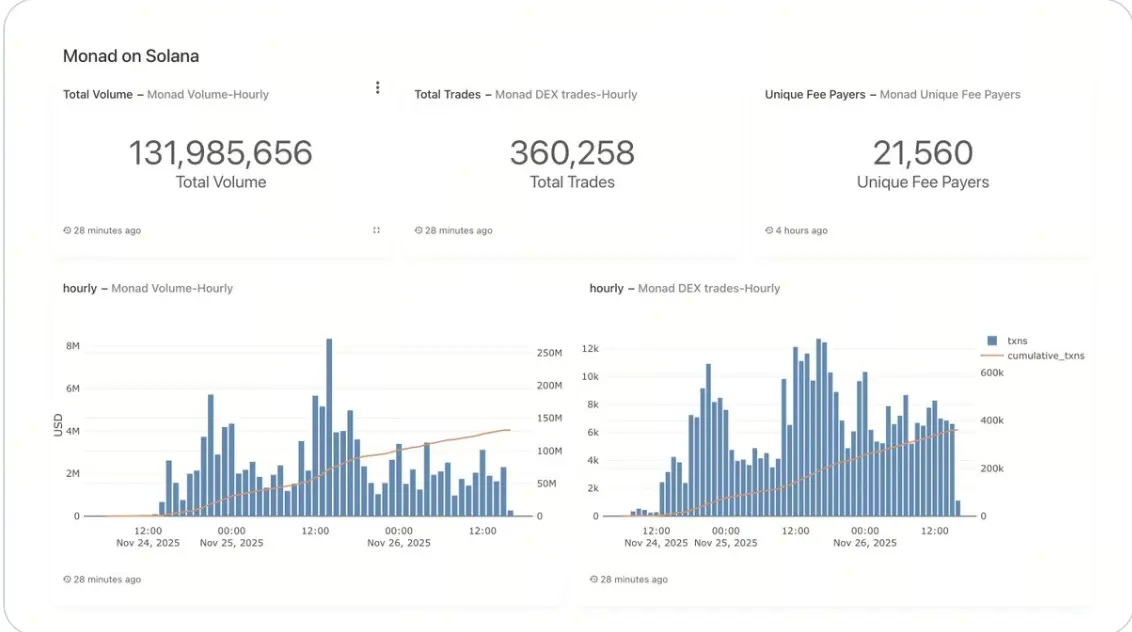
Arthur Hayes is publicly optimistic about the new public chain project Monad (MON), which has risen against the trend by 55% after the token went live on the Mainnet, currently trading around $0.041. Monad has attracted market attention due to its technical advantages of 10,000 TPS throughput, full EVM compatibility, and nearly zero Gas fees, but its token economic model has sparked controversy due to a team allocation of up to 27%. At the same time, the Sunrise liquidity gateway launched by Wormhole provides on-chain liquidity for MON on the first day, generating a trading volume of $131 million within 48 hours, demonstrating strong market demand.
The Endorsement Effect of Big Shots: Hayes' Prophecy and Market Divergence
Arthur Hayes, a well-known figure in the cryptocurrency world, has recently turned his attention to the new public chain project Monad, openly admitting that he has purchased MON tokens and predicting that their price may reach $10. This endorsement comes at a special moment when the Monad Mainnet has just launched—the token has rebounded strongly after an initial drop, with an increase of over 55% in just a few days, quickly attracting attention from the entire market. Hayes's statement on the X platform is simple and direct: “I have purchased MON,” and he subsequently added an optimistic outlook on the long-term value of the token, a style of unabashed support that is consistent with his previous promotion of other tokens.
However, the market shows significant divergence regarding Hayes's endorsement. Some investors view it as a rare accumulation signal, believing that Hayes, as an industry veteran, has unique insights and can identify potential projects early. On the other hand, some traders adopt a cautious attitude, seeing his promotion as a potential local top signal. This skepticism stems from Hayes's recent trading record: he has prominently promoted tokens like Ethena (ENA), Hyperliquid (HYPE), and Ethereum this year, which sparked short-term price rises, but subsequently reduced some holdings in certain cases. This pattern has led some market participants to develop a conditioned reflex of “Hayes's shout means sell signal,” increasing the uncertainty of MON's price trend.
From the perspective of market psychology, Hayes's endorsement indeed creates a self-fulfilling prophecy effect. His large fan base and industry influence can bring instant attention and capital inflow to the project, as evidenced by the price performance during the early listing of MON. However, the sustainability of this influence depends on whether the fundamentals of the project itself can support the initial hype. Cryptocurrency analyst CoinMamba pointed out on the X platform: “The key question is whether Hayes's endorsement is based on in-depth technical analysis or simply creates opportunities for short-term market manipulation. Investors need to judge the long-term value support of MON for themselves.”
Monad Token key data overview
Current price: around 0.041 dollars
Recent rise: 55% (after Mainnet launch)
Total Supply: 100 billion MON
Circulating Supply: 10.8% (unlocked)
Public offering price: 0.025 USD (Coinbase Token Platform)
Public offering scale: 269 million USD (oversubscribed by 1.43 times)
Number of participants: 85,820 investors
Technical Indicators: Rising channel support, resistance level 0.048 dollars
Technical Architecture Analysis: EVM Compatibility and Performance Breakthrough
The core value proposition of Monad lies in solving the long-standing “decentralization, security, scalability” trilemma in the blockchain space. The project achieves a transaction processing capacity of up to 10,000 TPS through an innovative technological architecture while maintaining full compatibility with the Ethereum Virtual Machine (EVM). This technological combination is of great strategic significance—developers can seamlessly migrate existing Ethereum smart contracts and dApps while enjoying significantly enhanced performance and transaction fees that are almost near zero, effectively eliminating the core barriers that hinder blockchain technology from reaching mainstream users.
From the perspective of technical implementation details, Monad's breakthroughs stem from multiple innovations. Its 0.4-second block time and 800-millisecond finality far surpass the performance metrics of the Ethereum Mainnet, providing users with an experience close to traditional Web2 applications. The project team claims that this performance enhancement is achieved without sacrificing decentralization or security, but rather through genuine technological breakthroughs that optimize parallel execution, consensus mechanisms, and network transmission within the underlying architecture. Notably, Monad has redesigned state storage and transaction processing flows while maintaining EVM bytecode compatibility, allowing Ethereum transactions, which originally executed serially, to be processed in parallel on Monad.
Comparisons with similar high-performance public chains show that Monad has adopted a balanced strategy in its technical route selection. Unlike new public chains like Aptos and Sui that use the Move language, Monad chooses to fully embrace the Ethereum ecosystem, lowering the migration barrier and learning costs for developers. Compared to Solana, Monad emphasizes more robust finality and a lower failure transaction rate. In contrast to Layer 2 solutions like Polygon and Arbitrum, Monad, as a Layer 1 public chain, maintains complete sovereignty and independence. This positioning allows Monad to find a differentiated space for survival in the highly competitive public chain arena—enjoying the network effects of Ethereum while providing native high performance.
Token Economic Model: Controversies and Potential Coexist
The token allocation plan of Monad has sparked intense discussions within the community, especially the fact that the team's allocation accounts for as much as 27%, which has been flagged by many analysts as “predatory token economics.” According to project disclosures, the total supply of MON is 100 billion tokens, of which only 10.8% are currently in circulation. Among them, 7.5% were completed through the Coinbase Token Platform at a price of $0.025 per token, raising $269 million, with over 85,000 participants. Additionally, 3.3% were distributed through airdrops, while nearly 90% of the tokens will be gradually released over the next few years.
The specific allocation ratio of the tokens has become a focal point of controversy. In addition to the team receiving 27%, venture capital firms were allocated 20%, the ecosystem development fund accounted for 38.5%, the community and growth fund made up 10%, and liquidity supply constituted 4.5%. Critics pointed out that the combined share of the team and venture capital is close to 50%, and the early investment price is significantly lower than the public offering price, which may lead to significant selling pressure in the future. Anonymous analyst CoinMamba bluntly stated on the X platform: “Monad has one of the most predatory token economics. The team allocation is at the highest level in the industry, venture capital receives tokens at prices far lower than retail, and the ecosystem development fund accounts for 38.5%, which is reminiscent of the outcome of Plasma.”
Analyzing the unlock schedule, the potential selling pressure faced by MON cannot be ignored. According to the official documentation, the team's and venture capital tokens have a 12-month lock-up period, followed by a linear release over 36 months. This relatively long lock-up period establishes an early protection mechanism for the project, but investors still need to pay attention to the market impact that the initial unlock in early 2026 may bring. On the other hand, if the gradual release of the ecosystem fund is used to incentivize developers to build and user participation, it may create a positive supply-demand balance. The ultimate effect of the token economics depends on whether the project can effectively utilize these resources to drive ecosystem growth, rather than simply selling on the market.
Market Performance Analysis: Opportunities and Risks in the Price Discovery Phase
MON, as a newly listed asset, is currently still in the price discovery phase, which is characterized by high volatility and uncertain direction. From a technical analysis perspective, MON has formed an ascending channel pattern on the 1-hour chart, currently finding support around 0.041 dollars. If this technical pattern holds, the token may break through the recent resistance level of 0.048 dollars and move towards the target of 0.064 dollars. However, any technical pattern is relatively fragile during the price discovery phase and is easily disrupted by changes in fundamentals or shifts in market sentiment.
The trading volume data provides deeper market insights. Through the Wormhole Sunrise gateway, MON achieved its first-day liquidity on the Solana blockchain, generating a total trading volume of 131 million dollars, 360,000 transactions, and active participation from 21,000 independent traders within 48 hours. This strong initial trading activity demonstrates significant market interest in MON, but it also raises the risk of price manipulation and excessive speculation. Especially in the context of cautious sentiment in the overall cryptocurrency market, whether MON's independent strong performance can be sustained depends on the transition from being viewed as a “trading target” to a “store of value.”
(Source: X)
Risk dimension analysis shows that MON investment faces multiple uncertainties. In addition to the aforementioned concerns about token economics, the project faces significant competitive pressure as a new public chain. The ongoing upgrades of Ethereum, the ecological expansion of Solana, and the rapid development of other emerging high-performance public chains make the competition in the public chain track exceptionally fierce. Monad needs to attract enough developers to build influential dApps on its platform to prove the actual value of its technological advantages. From the perspective of the investment cycle, MON may be more suitable for advanced investors who can withstand high volatility and understand the investment logic of public chains, rather than risk-averse ordinary retail investors.
Ecological Development Prospects: Wormhole Integration and the Future of Cross-Chain
Wormhole's newly launched Sunrise Liquidity Gateway provides important infrastructure support for the development of the Monad ecosystem. This gateway utilizes Wormhole's Native Token Transfer (NTT) technology to directly bring tokens from external blockchain ecosystems into the Solana network, ensuring that these assets have liquidity on the first day of listing on Solana's decentralized exchanges and other DeFi venues. MON, as the first major asset supported by Sunrise, reflects Wormhole's confidence in the Monad project and creates conditions for the synergy between the two ecosystems.
From the perspective of cross-chain interoperability, the integration of Monad and Wormhole is strategically significant. As the multi-chain landscape solidifies, the value of new public chains largely depends on their ability to connect with mainstream ecosystems. Through Wormhole, Monad users and developers can access a wider range of assets and liquidity, while participants in the Solana ecosystem can seamlessly access MON Token and future Monad ecological projects. This interoperability design significantly enhances Monad's starting position, avoiding the liquidity fragmentation issues faced by early public chains due to isolated development.
In terms of ecological development path, the Monad team revealed that the ecosystem development fund accounts for 38.5% of the total token supply, a proportion higher than many competitors. If managed properly, this substantial resource can be used to incentivize developers to migrate or create high-quality dApps, attract users to participate in the network, and establish strategic partnerships. The core of public chain success lies in network effects—more developers bring more applications, more applications attract more users, forming a positive cycle. Monad's technical advantages provide a starting point for this cycle, but execution capability and resource allocation efficiency will determine whether it can ultimately stand out in the fiercely competitive public chain arena.
The strong performance of Monad under the endorsement of Arthur Hayes reflects a typical pattern of the cryptocurrency market's intertwined response to technological innovation and celebrity effect. When the high-performance promise of 10,000 TPS coexists with the controversial tokenomics of a 27% team allocation, and when a 55% price rise dances with market concerns of “pump and dump,” investors are faced with a complex risk-reward calculation. The competition in the public chain track has never been just a contest of technical indicators; it is a comprehensive struggle of ecosystem construction, token models, community governance, and market positioning. Monad's journey is filled with both halos and shadows, and its ultimate fate will not depend on initial price fluctuations, but on whether it can convert its technological advantages into lasting ecological value. In the coming months, as the token unlock schedule progresses and the mainnet ecosystem gradually takes shape, the market will use capital to vote on the final answer to this question.


