The U.S. Producer Price Index (PPI) for September rose by 0.3% month-on-month after seasonal adjustment, meeting expectations, but the core PPI was lower than market estimates. Retail sales in September grew by 0.2% month-on-month, slightly below the expected 0.3%. The market has priced in an 85% probability that The Federal Reserve (FED) will cut rates again before the December meeting. After the data was released, Bitcoin received support from buying, currently reported at $87,000.
Core PPI rose only 0.1%, significantly below expectations
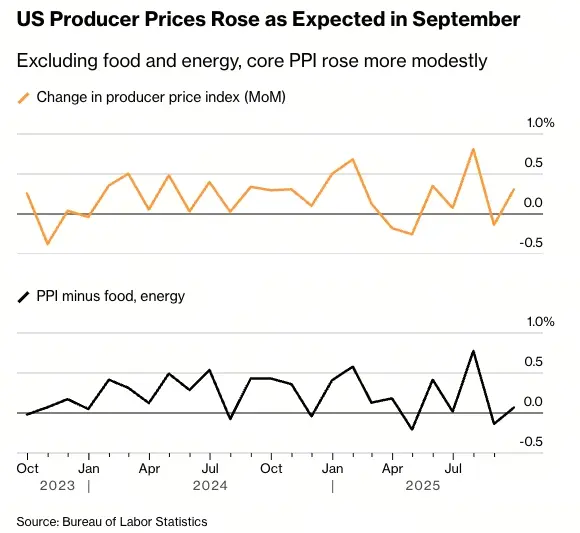
(Source: Bloomberg)
The Producer Price Index (PPI) is an indicator that measures the prices received by businesses for their final demand goods and services. In September, the overall PPI rose 0.3% month-over-month after seasonal adjustment, in line with Dow Jones' consensus expectations. However, the core PPI, which excludes food and energy, only rose 0.1%, below the market estimate of 0.2%. Previously, both the core and overall PPI recorded a decline of 0.1% in August. Year-on-year, the overall PPI increased by 2.9%, while the core rose by 2.6%.
The significance of core PPI far exceeds that of overall PPI, as it excludes the more volatile prices of food and energy, making it a better reflection of real inflationary pressures. The 0.1% month-on-month increase is significantly lower than market expectations, indicating that inflationary pressures at the wholesale level are rapidly easing. This has important implications for the Federal Reserve's policy decisions, as wholesale prices often lead retail prices by several months, and the cooling of core PPI suggests that CPI may also soften in the coming months.
In the context of tariffs raising import costs, the PPI increase in September was mainly driven by commodity prices, with the commodity index rising 0.9% month-on-month, marking the largest increase since February 2024; service prices remained flat. Final demand energy prices increased significantly by 3.5% month-on-month, while food prices rose by 1.1%. The upward movement in energy prices was primarily due to gasoline prices soaring by 11.8%.
In the services category, transportation and storage prices rose by 0.8%, and air passenger costs increased by 4%. This structural feature indicates that the overall rise in the PPI is primarily concentrated in volatile items such as energy and food, while core inflation is actually cooling down. This divergence provides the Federal Reserve (FED) with room to cut interest rates, as the FED is more focused on core inflation rather than short-term fluctuations in energy prices.
Key Highlights of September PPI Data
Core PPI MoM: 0.1% (expected 0.2%, previous value -0.1%)
Overall PPI MoM: 0.3% (in line with expectations, previous value -0.1%)
Energy prices month-on-month: 3.5%, gasoline surged 11.8%
Service Price: Flat, showing relief of inflationary pressure in the service industry.
Retail sales slowdown shows weak consumer momentum
Other economic data released on the same day further strengthened expectations for a rate cut by The Federal Reserve (FED). The U.S. Census Bureau reported that retail sales in September rose 0.2% month-over-month, slightly below the expected 0.3%. However, excluding auto sales, retail sales grew by 0.3%, in line with expectations. This performance indicates that consumer spending in the United States is slowing down, even though the overall economy is still expanding.
In the retail sector, sales at general retailers rose by 2.9%, while gas stations grew by 2% driven by rising fuel prices. Sales of sporting goods, hobby stores, and music shops fell by 2.5%, and online retail declined by 0.7%. This divergence indicates that consumers are adjusting their spending patterns in a high inflation environment, with stable consumption of necessities but a contraction in discretionary spending.
Retail sales (seasonally adjusted but not inflation-adjusted) rose by 4.3% year-on-year, higher than the 3% increase in CPI during the same period. This means that after excluding inflation, actual retail sales grew by about 1.3%, indicating that the momentum for consumer growth is relatively weak. In the continued high-interest-rate environment, the borrowing costs for consumers are rising, which is gradually eroding spending power.
Online retail fell by 0.7%, which is particularly noteworthy as e-commerce has always been the most vibrant part of the U.S. retail sector. This decline may reflect a decrease in consumer confidence or the fact that promotional activities from the previous months have exhausted purchasing power. The 2.5% drop in sales at sporting goods and hobby stores indicates that when the economic outlook is uncertain, consumers prioritize cutting back on non-essential spending.
The weak retail sales data combined with the cooling of the PPI provides a dual reason for the Federal Reserve (FED) to cut interest rates: the easing of inflationary pressures allows for a rate cut, while the slowdown in consumption necessitates a rate cut to stimulate the economy. This combination of “both can and should be lowered” is key to driving a dramatic change in market expectations.
The logic behind the expectation of interest rate cuts skyrocketing from 50% to 85%
As of Tuesday morning, the CME FedWatch tool showed that the market has priced in an 85% probability that the Federal Reserve will cut interest rates again before the December meeting, while a week ago this probability was only about 50%. This dramatic shift in expectations occurred in just a few days, indicating that the market's interpretation of economic data is rapidly turning dovish.
This expected change is not solely based on the PPI and retail sales data. Background factors include: news that Trump confidant Kevin Hassett may take over the Federal Reserve (FED) is gaining traction, and the market believes that if Hassett takes office, it will promote more aggressive rate cuts; signs of a global economic slowdown are increasing, and economic data from Europe and China both show weakening growth momentum; signs of loosening in the U.S. labor market, with the unemployment rate rising from 3.7% to 4.1%.
More importantly, due to the government shutdown, the release of September PPI and other important economic data has been delayed. The Bureau of Labor Statistics has canceled the release of October CPI, so the October PPI may also be canceled. As scheduled, the November CPI will be released on December 18, and typically the PPI is released close to the CPI. This data vacuum has resulted in extraordinary attention on the September data, amplifying its impact on market expectations.
From a technical perspective, the 85% probability of a rate cut is already very close to the “nailed down” level. The futures market typically begins to fully price in that scenario when the probability exceeds 80%. This means that if The Federal Reserve (FED) really does cut rates in December, the market will not be too surprised; however, if there is no rate cut, it will trigger a drastic revision of expectations and market volatility.
The Federal Reserve (FED) December interest rate cut expectation changes
One week ago: The probability of interest rate cuts is about 50%, with the market in a wait-and-see state.
Tuesday morning: The probability of a rate cut skyrocketed to 85%, nearing certainty.
Key catalysts: Core PPI lower than expected, retail sales slow down, Hassett's nomination fermenting.
Market Reaction: Gold Short-term Rise, Bitcoin Receives Support
After the data was released, spot gold briefly rose and then fell back, currently reported at $4,141.58 per ounce. The reaction pattern of gold indicates a complex interpretation of the market's expectations for interest rate cuts. The initial reaction was a rise in gold, as lower interest rates mean a reduced opportunity cost of holding gold (gold does not earn interest, and a low-interest-rate environment is more favorable for it). However, the subsequent decline may reflect profit-taking or concerns over economic slowdown.
The US dollar index clearly came under pressure after the data was released, falling below the 100 mark. The rise in expectations for interest rate cuts directly weakens the dollar's attractiveness, as lower rates reduce the yield on dollar-denominated assets. This weakening of the dollar provides support for global risk assets, with emerging market currencies and commodities often performing better when the dollar is weak.
The U.S. stock market showed a mixed reaction. Tech stocks benefited from expectations of interest rate cuts (lower rates boost growth stock valuations), but cyclical sectors were under pressure due to concerns over economic slowdown. The S&P 500 index rose slightly after the data was released, indicating that the market is seeking a balance between “the benefits of rate cuts” and “economic worries.”
Bitcoin is currently reported at around 87,000 USD, supported by the bullish expectations of interest rate cuts, similar to risk assets, but has not fully escaped the panic sentiment.
The reaction in the bond market is the most direct. The yield on the 10-year U.S. Treasury bond fell by 8 basis points to 4.32%, and the 2-year yield dropped by 10 basis points to 4.18%. The degree of inversion in the yield curve has slightly eased but remains inverted. The decline in bond yields reflects the market's downward adjustment of future interest rate path expectations, while also indicating a flow of safe-haven funds into the bond market.
The Federal Reserve (FED) December meeting key considerations
Faced with an 85% expectation for a market interest rate cut, the Federal Reserve (FED) will face a delicate decision at the December meeting. If they choose to lower interest rates, it will align with market expectations and help stabilize the financial market and support economic growth. The cooling of core PPI and the slowdown in retail sales provide data support for an interest rate cut. In addition, the Trump administration's preference for rate cuts may also exert political pressure on the Federal Reserve (FED).
However, if the choice is made not to lower interest rates, there will be a risk of severe market reactions. When the market's expectation probability reaches 85%, not lowering interest rates will be seen as a significant policy surprise, potentially triggering a stock market crash, a surge in the dollar, and turbulence in the financial markets. The Federal Reserve (FED) needs to adjust market expectations through official statements before the meeting to avoid a huge gap between policy decisions and market expectations.
The key variable is the November CPI data, which will be released on December 18, after the Federal Reserve's December meeting. This means that the Federal Reserve must make decisions without the latest inflation data, relying only on the data from September and earlier. This increases the uncertainty of the decision-making.


