According to cryptocurrency entrepreneur and investor Anthony Pompliano, institutional investors new to the crypto space may be caught off guard by Bitcoin’s volatility, putting downward pressure on its price. He noted that Bitcoin typically drops about once every 1.5 years, and the recent decline to a low of around $82,000 is unlikely to surprise long-term holders.
Wall Street Newcomers’ Year-End Bonus Panic Triggers Sell-Off
“These newcomers are very, very scared. The end of the year is approaching, and everyone is thinking about bonuses, such as whether I should sell this asset I was once so bullish on. I think this puts some downward pressure on the price,” Pompliano added. This perspective highlights a fundamental difference between institutional investors and crypto-native investors.
Wall Street’s bonus culture is key to understanding the current selling pressure on Bitcoin. For fund managers and traders at traditional financial institutions, year-end bonuses often make up 50-80% of their total income, and the size of the bonus is directly tied to annual performance. When Bitcoin pulls back 30% from its highs, these institutional investors face a dilemma: continue holding and risk further losses that could affect year-end evaluations, or cut their losses to lock in remaining gains.
This kind of short-term performance pressure is almost non-existent among crypto-native investors. Long-term Bitcoin holders typically adopt a “HODL” strategy, viewing Bitcoin as a long-term store of value rather than a short-term trading vehicle. For them, a 30% pullback is just part of the journey to higher prices. Pompliano’s “21 times with 30% drops” statistic perfectly illustrates this mindset: if you’ve been through 21 similar drops and witnessed new all-time highs, the 22nd pullback naturally won’t trigger panic.
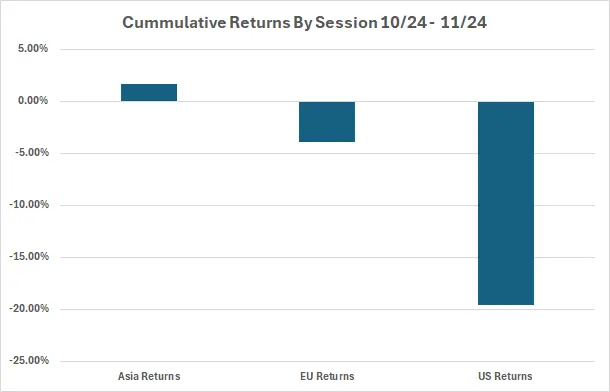
Matthew Sigel, head of digital asset research at investment management firm VanEck, stated on Monday that Bitcoin’s recent sell-off “primarily took place during U.S. trading hours.” He pointed out that tightening U.S. liquidity and widening credit spreads were the main drivers, as concerns over massive AI-related capital expenditures clashed with a more fragile financing market. This observation further confirms that the selling pressure is mainly coming from U.S. institutional investors rather than global retail or Asian markets.
U.S. Session Sell-Off and Liquidity Tightening
(Source:
Matthew Sigel’s analysis sheds light on the macroeconomic pressures currently facing Bitcoin. U.S. liquidity tightening means there’s less capital available for investment, usually occurring when the Federal Reserve maintains high interest rates or reduces its balance sheet. When liquidity tightens, risk assets are the first to be affected, as investors move money from high-risk investments into safer assets.
Widening credit spreads are another key signal. Credit spreads refer to the difference between corporate bond yields and risk-free government bond yields. When this spread widens, it signals rising concerns about corporate default risk and increasing financing costs. Such an environment is extremely unfavorable for risk assets like Bitcoin, as institutional investors tend to reduce leverage and risk exposure when financing costs rise.
Concerns over massive AI-related capital expenditures are colliding with a more fragile financing market, highlighting the core contradiction in today’s market. Tech giants’ astronomical investments in AI — with companies like Microsoft, Google, Amazon expected to spend over $200 billion on AI capex in 2025 — have sparked doubts about investment returns. When these doubts combine with a deteriorating financing environment, capital naturally flows out of risk assets.
(# Three Major Drivers of U.S. Session Sell-Offs
Liquidity Tightening: The Fed’s high interest rate policy reduces market capital, putting pressure on risk assets
Widening Credit Spreads: Corporate financing costs rise, institutional investors reduce leverage and risk exposure
AI Investment Doubts: Tech stock valuation pressure spills over to crypto markets as capital seeks safety
The regional pattern of this sell-off is also clear. If the selling primarily occurs during U.S. trading hours, while Asian and European sessions remain relatively stable, it suggests the pressure comes from U.S. institutional behavior rather than global panic selling. This distinction provides important information for long-term investors: the current decline is more about technical adjustments and institutional position management than fundamental deterioration.
) Rising Volatility Is a Precursor to Price Increases
According to Bitwise market analyst Jeff Park, Bitcoin’s price volatility has surged sharply over the past two months, climbing back to around 60 as of Monday, which could trigger significant market swings. Pompliano told CNBC that those who follow crypto long-term understand that volatility is a powerful indicator.
“This isn’t a bad thing. If Bitcoin’s volatility were near zero, then I’d be worried. Price appreciation requires volatility.” This view challenges the traditional finance perception of volatility as a negative. In conventional portfolio theory, volatility is synonymous with risk, and investors usually want to minimize it to protect capital. However, in the crypto market, volatility is closely linked to price discovery and liquidity.
Rising volatility means market participants are deeply divided on price direction, creating trading opportunities and a price discovery mechanism. When volatility is low, it usually means the market lacks new catalysts or participants and prices stagnate. In contrast, rising volatility often signals the formation of a new trend, either up or down.
Historically, Bitcoin’s major rallies have often been accompanied by spikes in volatility. During the 2021 bull market, when Bitcoin surged from $10,000 to $69,000, volatility broke above 80 multiple times. In 2017, when it climbed from $1,000 to $20,000, volatility stayed above 60 for extended periods. So, the current rebound in volatility to 60 may not signal the start of a bear market, but rather the prelude to a new round of major price moves.
24,000% Gain in Ten Years—Outlook Remains Promising
“You know, Bitcoin has gone up 240-fold in the past ten years, with an annual compound growth rate of about 70%. But it’s impossible for us to maintain this growth rate going forward,” Pompliano said. This honest assessment offers a realistic perspective on Bitcoin’s long-term outlook. From about $300 in 2015 to around $87,000 today, Bitcoin has indeed delivered about a 240x return—an astonishing growth rate for any asset class.
However, as Bitcoin’s market cap grows to around $1.7 trillion, maintaining a 70% annualized return becomes mathematically extremely difficult. To achieve such growth, Bitcoin’s market cap would need to reach about $400 trillion over the next decade—approaching the scale of total global wealth. So, Pompliano’s adjustment of future growth expectations is both rational and necessary.
“But if over the next ten years we achieve a 20%, 25%, 30%, or even 35% annual compound growth rate, its performance will still outpace stocks. I think that’s why so many Bitcoin holders are excited about adding this asset to their portfolios,” Pompliano added. This outlook is still highly attractive, considering the S&P 500’s long-term annualized return is about 10%, and bonds about 5%.
If Bitcoin achieves a 25% annualized return over the next decade, it would rise from the current $87,000 to about $800,000. Even at a 20% compound return, Bitcoin would exceed $500,000. While these targets aren’t as wild as the 240x gains of the past decade, they remain extremely appealing for investors seeking to outperform traditional assets.


