Spot Bitcoin ETFs have just experienced the toughest week on record, losing nearly $1.2 billion in assets—marking the third-largest weekly outflow since these products launched 22 months ago. The hardest hit was BlackRock’s iShares Bitcoin Trust (IBIT), which was cashed out for over $1 billion in a single week.
Severity of the Third-Largest Outflow in History
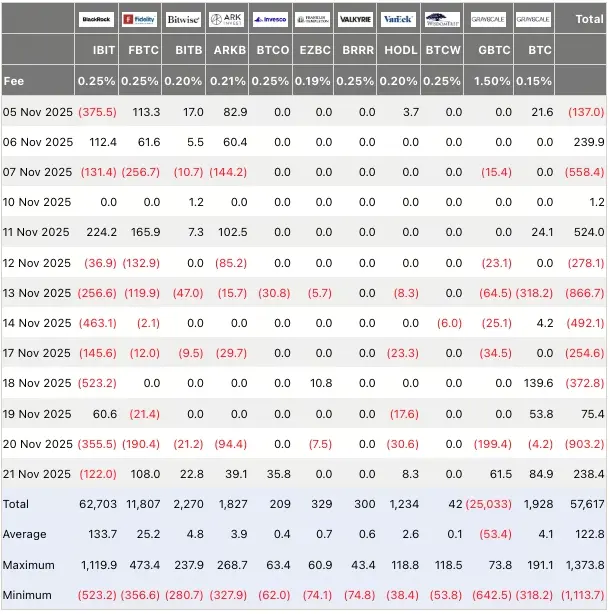
(Source: Farside Investors)
Spot Bitcoin ETFs saw outflows of nearly $1.2 billion, the third-largest on record since inception. Farside Investors data shows that as of Thursday (November 20), November’s total outflows reached $3.79 billion—matching the previous monthly record set in February. The severity of this figure lies in the fact that, since launching in January 2023, Bitcoin ETFs have seen unprecedented inflows, yet now a single month’s outflow can rival historical records, signaling a fundamental shift in market sentiment.
On Thursday alone, redemptions exceeded $900 million, the second-highest single-day redemption amount for the category. Such massive daily outflows typically occur during periods of market panic selling, indicating that institutional investors and large holders are rapidly exiting. Although risk assets saw a brief rebound on Friday, pressure persisted, indicating the selling has not been fully absorbed.
The large-scale outflows from Bitcoin ETFs have created a negative feedback loop with Bitcoin’s plunging price. Bitcoin has fallen for six consecutive weeks, dropping about 33% from a peak above $126,000 in October to as low as $81,000 earlier on Friday. This volatility is driven by changing macro expectations—including fading hopes for a third Fed rate cut in 2025 and renewed concerns over high valuations in the AI industry.
As Bitcoin’s price falls, the net asset value of Bitcoin ETFs declines, triggering stop-loss sales from some investors. These sales force ETF managers to sell underlying Bitcoin assets to meet redemption demands, which in turn puts additional pressure on spot Bitcoin prices. This vicious cycle—ETF redemptions → Bitcoin selling → price declines → more redemptions—has been a key driver behind this week’s massive outflows.
BlackRock IBIT Leads Outflows with $1 Billion Loss
The biggest hit came to BlackRock’s iShares Bitcoin Trust (IBIT), which saw over $1 billion in redemptions in a single week. This is especially striking since IBIT has been the top-performing Bitcoin ETF since launch, with assets under management once approaching $100 billion. A weekly outflow of $1 billion represents about a 1% shrinkage of its asset base—a rare scale for such a large fund.
As the world’s largest asset manager, BlackRock’s IBIT is seen as the go-to vehicle for institutional exposure to Bitcoin. The scale of outflows here reflects not just retail panic, but more importantly, a withdrawal of institutional capital. Hedge funds, pension funds, and family offices generally take a longer-term view, so their exit often signals concerns about Bitcoin’s medium-term outlook.
Grayscale’s GBTC and Fidelity’s FBTC followed, with outflows of $172 million and $116 million, respectively. GBTC, as the earliest Bitcoin trust product, has long faced issues with premium/discount swings, while FBTC is Fidelity’s flagship entry into the crypto market. The fact that all three giants suffered major outflows shows that pressure in the Bitcoin ETF market is broad-based, not limited to individual products.
Top Three Bitcoin ETF Outflows This Week
BlackRock IBIT: Over $1 billion outflow, about 83% of total outflows
Grayscale GBTC: $172 million outflow, continued pressure on the veteran trust product
Fidelity FBTC: $116 million outflow, Fidelity’s flagship product not spared
This concentration of outflows in leading products suggests that large institutional investors are systematically reducing Bitcoin ETF exposure, rather than scattered retail panic selling. The withdrawal of institutional capital has a more profound long-term market impact, as these funds typically require clearer catalysts and longer decision cycles to return.
Friday’s Reversal Signals a Potential Turning Point
But Friday saw a shift. Fidelity’s FBTC fund received $108 million in new inflows, making it the largest single-day inflow in the sector. Grayscale’s Bitcoin Mini Trust (BTC) and GBTC also rebounded, posting inflows of $61.5 million and $84.9 million, respectively. While this reversal doesn’t offset the week’s outflows, it provides an early sign the market may be bottoming.
FBTC’s $108 million single-day inflow is particularly noteworthy. This suggests that after Bitcoin touched the $81,000 low, some investors saw a buying opportunity. As a traditional financial giant, Fidelity’s client base tends to be more conservative and rational—so contrarian inflows may represent “smart money” entering.
Simultaneous inflows into both Grayscale products are also symbolic. GBTC has long been criticized for high fees and discount trading, yet still attracted $84.9 million on Friday, indicating some investors are willing to accept disadvantages for Bitcoin exposure. The Bitcoin Mini Trust’s $61.5 million inflow suggests investors are seeking lower-cost alternatives.
Despite the market slump, some analysts remain optimistic. Bloomberg’s Eric Balchunas, commenting on Bitcoin ETFs, dismissed pessimistic forecasts, noting Bitcoin’s long history of recovering from deep pullbacks. He wrote: “This asset has already been through six drops worse than this—and each time it hit new highs.” He compared Bitcoin’s resilience to top performers like Apple and Amazon.
Altcoin ETFs Rise to Steal the Spotlight
The turmoil in Bitcoin ETFs coincides with a wave of new altcoin ETF launches. Over the past month, issuers have launched products tied to Solana, XRP, and Dogecoin, with more XRP and Dogecoin funds set to debut next week. The timing is telling—issuers are seeking to capture investor interest in emerging crypto assets.
The Canary Capital XRP ETF (XRPC) saw $58 million in net inflows on its first day—the highest first-day net inflow for any ETF this year, slightly edging out the Bitwise Solana Staking ETF (BSOL)’s $57 million. BSOL has quickly become one of 2025’s early success stories, amassing over $660 million in assets in three weeks and avoiding a single day of outflows.
The contrast is stark: Bitcoin ETFs lost $1.2 billion in a week, while new altcoin ETFs are rapidly attracting capital. This reflects a subtle shift in market sentiment—some investors may feel Bitcoin is already overextended, while assets like Solana and XRP still offer more upside. Reportedly, the New York Stock Exchange has approved the listing of Grayscale’s XRP and Dogecoin ETFs, both set to begin trading on Monday and likely to further siphon capital from Bitcoin ETFs.
Disclaimer: The information on this page may come from third parties and does not represent the views or opinions of Gate. The content displayed on this page is for reference only and does not constitute any financial, investment, or legal advice. Gate does not guarantee the accuracy or completeness of the information and shall not be liable for any losses arising from the use of this information. Virtual asset investments carry high risks and are subject to significant price volatility. You may lose all of your invested principal. Please fully understand the relevant risks and make prudent decisions based on your own financial situation and risk tolerance. For details, please refer to
Disclaimer.


