
Futures
Access hundreds of perpetual contracts
TradFi
Gold
One platform for global traditional assets
Options
Hot
Trade European-style vanilla options
Unified Account
Maximize your capital efficiency
Demo Trading
Introduction to Futures Trading
Learn the basics of futures trading
Futures Events
Join events to earn rewards
Demo Trading
Use virtual funds to practice risk-free trading
Launch
CandyDrop
Collect candies to earn airdrops
Launchpool
Quick staking, earn potential new tokens
HODLer Airdrop
Hold GT and get massive airdrops for free
Launchpad
Be early to the next big token project
Alpha Points
Trade on-chain assets and earn airdrops
Futures Points
Earn futures points and claim airdrop rewards


More





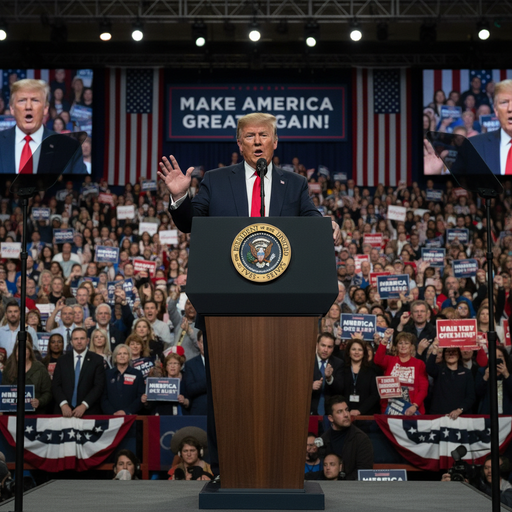
Trump says "Winning big," but five "Gray Rhinos" are rushing toward him, and a "Perfect Storm" has already formed!
The Country Is a Direct Line
On April 1, U.S. President Trump claimed that the war against Iran was “nearing completion,” and that the strategic objectives had “basically been achieved,” while multiple media reports believe that the conflict is still accelerating into a further escalation. At the same time, on April 3, the White House submitted a major increase in its proposed defense budget for fiscal year 2027. All signs suggest that the so-called “victory” in the United States is far from settled; yet the war is bringing systemic risks—five “gray rhinos” are speeding closer.
A “gray rhino” is a concept proposed by U.S. economist Michel Wuck, referring to those systemic risks with extremely high probability, massive impact, and clear prior warnings that are nevertheless ignored—major threats such as financial bubbles, debt crises, and more.
The first gray rhino: Oil-price shocks spilling over — the global economy “playing out of tune into a passive recession”
After President Trump delivered his “victory speech,” investors and analysts did not respond positively. Most believe that threats to key shipping lanes such as the Strait of Hormuz remain, and that they affect global energy and commodity markets, creating pressure that transmits between economic growth and inflation. Diane Swonk, chief economist at KPMG, warned that the U.S.-Iran war has triggered multiple supply shocks, pushing up the risk of global stagflation, and that a deep recession may become the only way out for the global economy.
The second gray rhino: The midterm election trap + a pincer of fiscal budgets
An analysis by The Washington Post on April 2 said that about six months before the midterm elections, U.S. President Trump delivered a nationwide speech intended to “respond to political turmoil, ease public concerns, and reshape the political narrative,” but the effect was limited and it did not clearly demonstrate strategic objectives.
The fiscal year 2027 budget submitted by the White House on April 3 would raise defense spending to about $1.5 trillion (an increase of roughly 40–50%), “nearing the historic levels of growth seen before World War II.” At the same time, it would cut non-defense discretionary spending by about 10%, covering public livelihood areas such as education, housing, research, and climate. This “strong-military, weak-people” arrangement sharply contrasts with the promises made during Trump’s campaign; it leaves the U.S. government forced to choose between “war spending” and “people’s livelihood protection.” This move is pushing the United States toward two cliffs—political and economic risks—and a gray rhino that tears society apart is already clearly in view.
The third gray rhino: NATO is already headed toward an “accelerated collapse” phase
In his April 1 remarks, U.S. President Trump criticized NATO allies for their stance in the conflict with Iran. According to statistics from the American Broadcasting Company, among NATO’s 32 member countries, fewer than 16% have explicitly supported U.S.-Iran/Israeli actions. France, Germany, Spain, and Italy chose not to cooperate, while the United Kingdom sought to strengthen cooperation with European allies. French President Macron publicly criticized the United States’ unstable behavior, and the Pentagon took an ambiguous position on NATO’s Fifth Article collective defense commitment. Former U.S. Ambassador to NATO Ivo Dald wrote that this round of conflict and the erosion of trust between the United States and its allies makes it “very hard to imagine any European country believing the U.S. would provide it with defensive support now.”
The fourth gray rhino: Potential changes in international monetary and energy settlement
The war also brings potential impacts on the international energy settlement system. Some market analyses and institutional observers believe that amid instability in global energy supply, calls for energy transactions denominated in currencies other than the U.S. dollar are rising.
A report by Deutsche Bank earlier pointed out that the U.S.-Iran conflict may become a major test for global oil markets and the dollar’s dominant position. Through negotiations with multiple countries, Iran would adjust the oil export settlement mechanism, which would push countries to become even more self-sufficient in energy and defense.
The report argues that for the United States, this means the dollar system that has long supported global oil trade faces potential shocks: the oil-dollar gray rhino is closing in on the United States. However, for most other countries, it may instead provide more diversified choices for energy and reserves.
The fifth gray rhino: The war may become a “bottomless pit”
Analysts believe that in his April 1 speech, U.S. President Trump claimed that “the fighting is nearing completion,” but did not propose a clear exit mechanism. Historical experience shows that conflicts lacking strategic objectives and exit criteria easily evolve into a prolonged, high-cost war of attrition, with fiscal pressure and social divisions increasing in tandem.
Asymmetric costs: According to a report by The Wall Street Journal, the U.S. military must intercept Iranian drones with air-defense missiles worth hundreds of millions of dollars, at a cost of less than $100,000 per drone. High-cost consumption war against low-cost inputs is intensifying fiscal and military pressure.
Unclear path: John Mearsheimer, a professor of political science at the University of Chicago, said that the United States has fallen into a “escalation ladder” dilemma, and the lack of an exit plan makes it difficult to balance tactics and strategy; every additional military commitment could trigger new retaliation and further escalation of the conflict. Western media analyses believe that this situation is likely to drag the United States into a quagmire similar to the Vietnam War—long-term fighting, massive resource consumption, and high difficulty of exiting.
High-cost asymmetric wars of consumption paired with the lack of an exit strategy form a closed loop, and a gray rhino of a “bottomless pit” war is rushing toward the United States.
The five “gray rhinos” do not exist in isolation. They reinforce one another and form a closed loop. When the United States becomes engrossed in the “victory” narrative, a “perfect storm” of intertwined multi-dimensional crises—military, economic, political, and financial—has already taken shape. Historical experience suggests that the cost of ignoring gray rhinos is often systemic collapse, and the window of time the United States can use to adjust strategy may already be becoming increasingly urgent.
A huge volume of information and precise analysis—right in the Sina Finance App
责任编辑:凌辰