On December 3, Ethereum’s price surged above $3,000, but the derivatives market remained skeptical about further upside due to weak demand for Ethereum derivatives and growth from competing blockchains. Both ETH futures premiums and put option skews indicate that, despite an 8% rebound in price, traders are still actively hedging. With activity on decentralized exchanges (DEXs) declining, Ethereum’s weekly transaction fees dropped by 49%.
Ethereum Derivatives Market Reveals Cautious Trader Sentiment
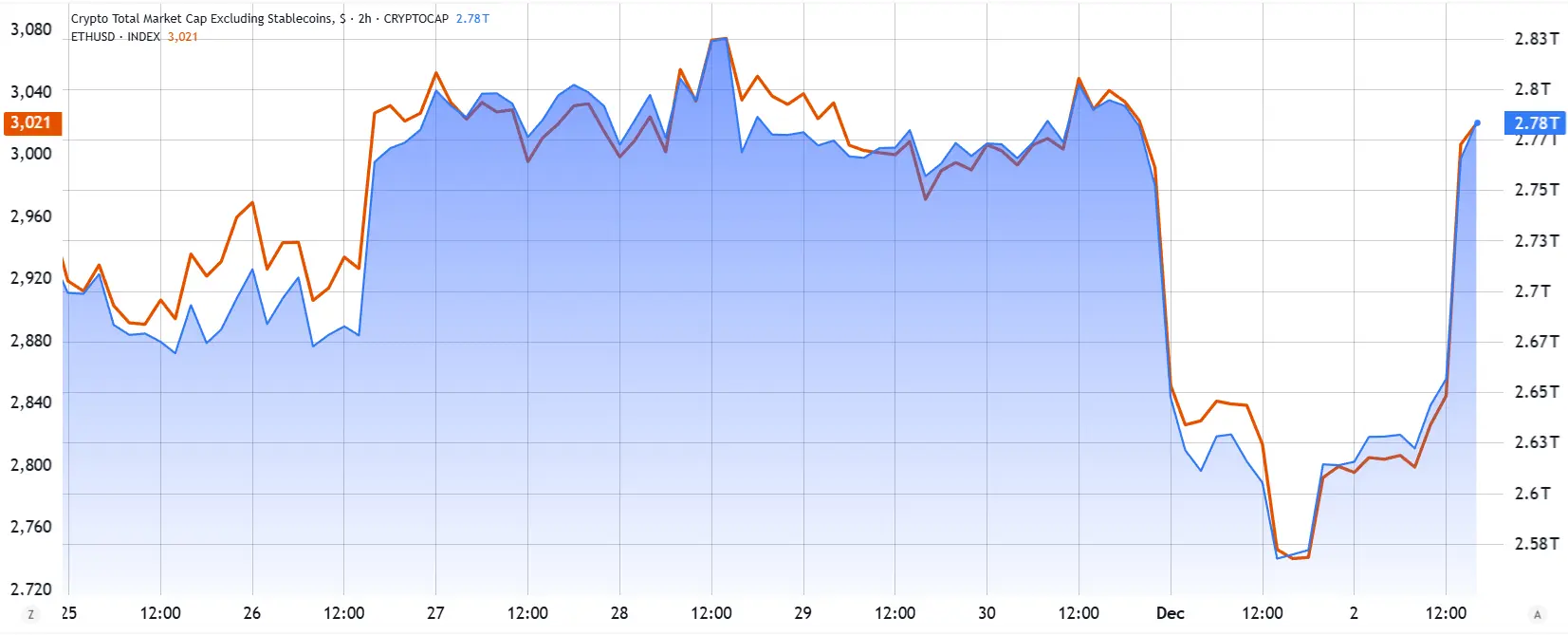
Ethereum rose 8% on Tuesday but stalled near $3,000, with derivatives markets remaining doubtful about further gains. This move aligns with the broader cryptocurrency rally, as traders increasingly expect new economic stimulus measures, especially following stress in the Japanese bond market. As investor confidence in a more dovish US monetary policy grows, market sentiment has improved.
The Federal Reserve ended its balance sheet reduction program on December 1, and traders anticipate a rate cut from the Fed on December 10. More importantly, major US financial institutions have significantly increased their use of repurchase agreements, injecting liquidity into short-term funding markets. The Nasdaq index, dominated by tech stocks, has recovered most of its November losses and is now only about 3% below its all-time high. Nevertheless, positioning in Ethereum derivatives remains tight, suggesting limited confidence among bullish traders.
(Source: Laevitas)
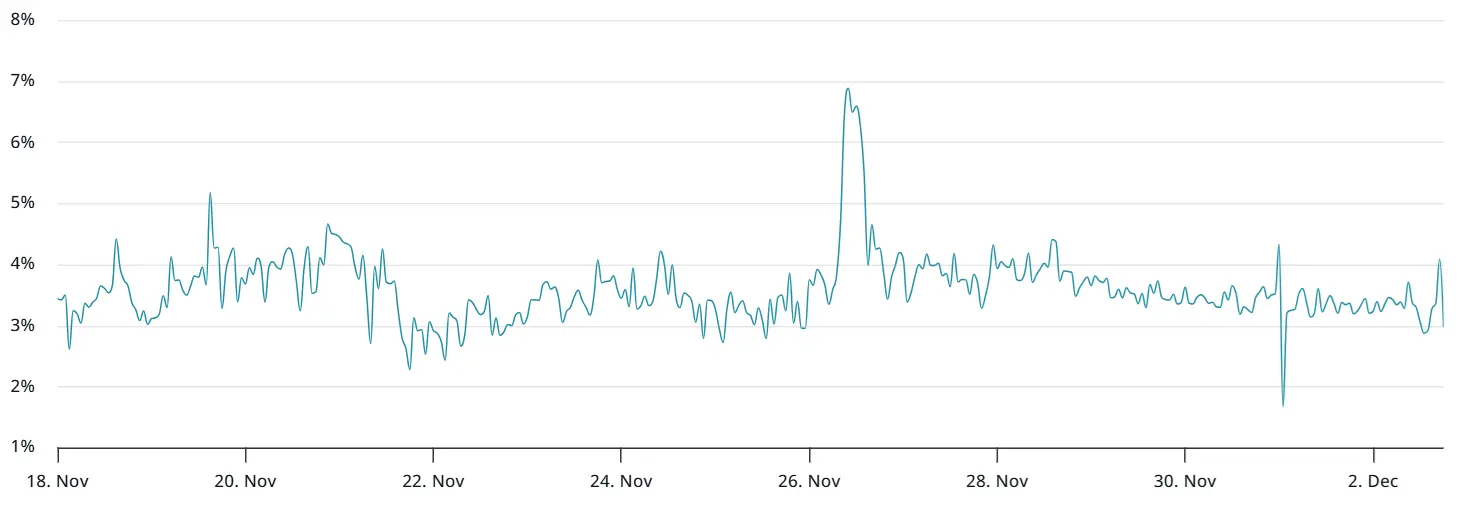
On Tuesday, the annualized two-month futures premium for Ethereum over the spot market held steady at 3%, unchanged from the previous week. A reading below 5% indicates very weak demand for leveraged long positions, which is understandable given Ethereum’s 22% decline over the past 30 days. The futures premium is a key indicator of market sentiment; when traders are bullish, they are willing to pay a higher premium to hold futures contracts. A 3% premium means that even after an 8% price rebound, the market lacks strong confidence in further upside.
(Source: Laevitas)
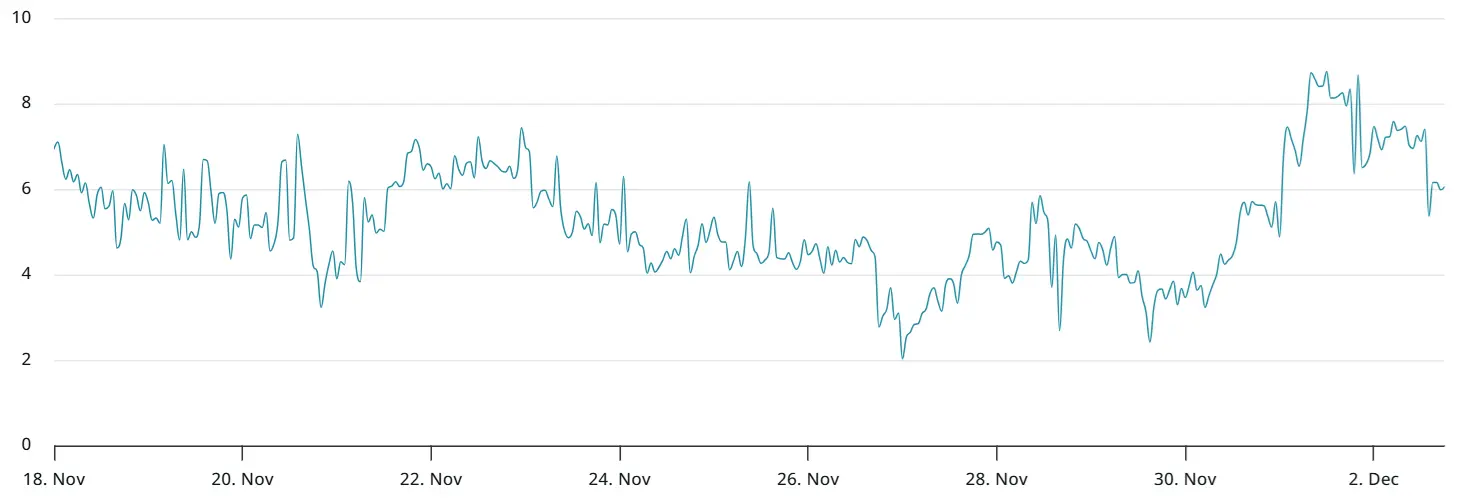
Ethereum put options (rights to sell) are trading at a 6% premium over comparable call options (rights to buy), a pattern typically associated with bearish markets. For reference, last Friday’s skew indicator was at a neutral level of 4%. This change indicates that, despite gains in US equities signaling improved risk appetite in traditional markets, there remain factors holding back trader optimism. The increase in put option skew shows that professional traders are actively buying downside protection, anticipating that prices could fall again.
Network Fees Hit Three-Year Low, Highlighting Weak Demand
(Source: Nansen)
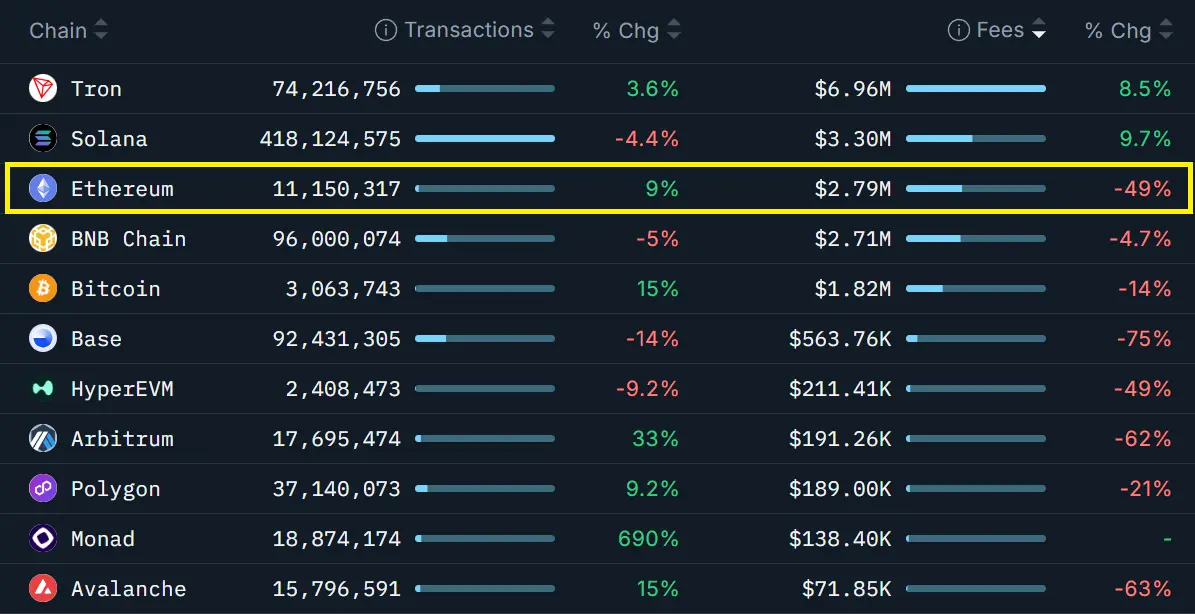
Ethereum network fees have fallen to their lowest level in over three years, dropping to $2.6 million over the past seven days, down from $5.1 million four weeks ago—a 49% weekly decrease. Part of the reason is a decline in DEX trading volume, which dropped to $13.4 billion in the same period, down from a peak of $36.2 billion in August. This plunge in fees not only reflects reduced on-chain activity but also underscores Ethereum’s struggles to attract users and applications.
Network fees are a key indicator of blockchain health. Fees are generated by user demand for block space; when many transactions compete for limited block space, users pay higher fees for priority. Conversely, when on-chain activity falls, fees naturally decrease. Ethereum’s network fees hitting a three-year low means on-chain activity remains in a prolonged slump, sharply contrasting the apparent prosperity as prices touch $3,000.
The collapse in DEX trading volume further highlights the issue. From $36.2 billion in August to $13.4 billion now—a drop of over 60%—Ethereum’s status as the center of DeFi is being challenged. DeFi was once Ethereum’s proudest use case, but now users and liquidity are migrating to other blockchains.
Three Main Reasons for Ethereum’s Declining Fees
Layer-2 Diversion Effect: Layer-2 networks like Arbitrum and Optimism have diverted significant transaction volume, reducing demand on the mainnet.
Rising Competitors: High-performance blockchains such as Solana and Tron offer lower costs and faster speeds, attracting user migration.
Weak Market Sentiment: Overall crypto market activity has declined, with reduced speculative demand leading to less on-chain activity.
Even more concerning, according to Nansen data, competitor Tron and Solana saw their seven-day fees increase by 9%. This contrast shows the issue isn’t a lack of demand in the overall crypto market but rather Ethereum losing market share. Tron has attracted a large user base with extremely low fees and stablecoin transfer advantages, while Solana has become a hot spot with high performance and a thriving meme coin ecosystem.
Ethereum’s Underperformance vs. Equities Raises Concerns
Ethereum’s poor performance relative to US equities has sparked concerns, especially as central banks around the world signal more expansionary economic measures. On December 1, the Federal Reserve injected $13.5 billion via overnight repos—the second-highest level in more than five years. As a liquidity backstop, this mechanism once held over $2.5 trillion in idle funds in 2022, thanks to economic stimulus measures and ultra-low interest rates.
The Nasdaq index is only about 3% below its all-time high, while Ethereum has dropped 22% over the past 30 days. This divergence suggests Ethereum is losing its appeal as a risk asset. Historically, Ethereum’s price action has been highly correlated with tech stocks, as both are high-growth, high-risk asset classes. When equities rise, Ethereum typically outperforms due to increased investor risk appetite. However, with stocks near all-time highs and Ethereum struggling at the lows, this decoupling is concerning.
Other factors may also be weighing on crypto demand, including concerns about overinvestment in AI infrastructure and renewed regulatory pressure on stablecoins. China’s central bank has also pledged to step up its crackdown on money laundering and illegal cross-border transfers involving digital assets. These regulatory developments could further limit Ethereum’s use cases, especially in cross-border payments and stablecoin settlements.
On Sunday, a transfer from a long-dormant Ethereum whale account heightened investor anxiety. An account active since Ethereum’s genesis block in 2015 moved 40,000 ETH to a new address, sparking speculation about a potential sale. At the current price of $3,000, this transfer is worth $120 million. If the whale chooses to sell on the open market, it could put significant pressure on the price.
Can the Fusaka Upgrade Reverse the Downtrend?
Ethereum’s Fusaka upgrade is scheduled for Wednesday, marking an important step in improving scalability and wallet management experience. The Fusaka upgrade includes several technical enhancements aimed at boosting network efficiency and user experience. However, weakening demand for decentralized applications has led to lower transaction fees. For now, there is insufficient evidence that Ethereum is poised to outperform the broader crypto market.
Can technical upgrades change market sentiment? Historically, major Ethereum upgrades have usually brought short-term price boosts, but long-term impacts depend on whether the upgrades truly address user pain points. The Fusaka upgrade focuses on scalability and user experience, which are the right directions, but the question is whether the market still cares about Ethereum’s technical progress. With Solana and other high-performance chains already offering a better user experience, Ethereum’s incremental improvements may no longer be enough to reverse its competitive disadvantage.
For traders, Ethereum currently presents a contradictory picture: the price touching $3,000 shows there’s still buying support, but the cautious tone in the derivatives market, plunging network fees, and underperformance relative to equities all warn that this rebound may lack sustainability. Until the Fusaka upgrade and broader market catalysts emerge, Ethereum may continue to struggle amid skepticism.
Related Articles
NYSE Fully Removes Bitcoin and Ethereum ETF Options Restrictions! 25,000 Contract Limit Cancelled, Institutional Capital Gets Wide Room to Operate
The U.S. crypto ETF market is experiencing significant regulatory relaxation. NYSE Arca and NYSE American have removed position and exercise limits on Bitcoin and Ethereum spot ETF options, which received immediate SEC approval. This adjustment promotes market liquidity, allowing institutional investors to employ more flexible strategies and further advancing the maturity of the crypto ETF market.
ChainNewsAbmedia12m ago
USDC Treasury destroys 50 million USDC on the Ethereum chain
Gate News, on March 23, according to Whale Alert monitoring, USDC Treasury executed a burn operation on the Ethereum chain, destroying a total of 50,000,000 USDC.
GateNews14m ago
Last week, Ethereum spot ETF saw net outflows of $59.94 million, with BlackRock's ETHA experiencing net outflows of $69.5865 million.
Last week, Ethereum spot ETFs experienced net outflows of $59.94 million, with BlackRock's ETF ETHA seeing the largest outflow of $69.5865 million, and Fidelity's FETH also recording outflows of $61.6216 million. Grayscale's Ethereum Mini Trust ETH saw net inflows of $6.8702 million. Currently, the total assets under management for Ethereum spot ETFs stands at $1.233 billion.
GateNews14m ago
How Can Retail Investors Invest in OpenAI? Analysis of Indirect Positioning Before IPO
OpenAI is expected to launch its initial public offering (IPO) in 2026, with a potential valuation of 8,500 million dollars. Retail investors can make indirect investments through its major shareholders (such as Microsoft and SoftBank) or Eightco Holdings. Eightco holds 9,000 million dollars in OpenAI equity and is also a major cryptocurrency holder, providing investors with an alternative option.
ChainNewsAbmedia22m ago
An early ETH holder from 2016 who has been dormant for a year deposited 15,000 ETH to a certain CEX, with an average cost basis of approximately $11.61.
Gate News reported that on March 23, according to on-chain analyst Ai Yi's monitoring, an early ETH holder from 2016 (address 0xa2F...F85A) who had been dormant for a year deposited 15,000 ETH to a certain CEX, valued at $30.97 million. The address has been accumulating ETH since 2016 with a cost basis of $11.61 per coin. If this sale goes through, it will generate a profit of $30.79 million, representing a return rate of 17680%.
GateNews34m ago
ETH 15-minute Rally 0.91%: On-chain Liquidity Enhancement and Short Covering Drive Market
Between 2026-03-23 02:15 and 02:30 (UTC), ETH price rallied rapidly within the 2047.53 to 2070.28 USDT range, with 15-minute returns reaching +0.91% and volatility of 1.11%. Market fluctuations intensified during this time window, with increased attention, synchronized expansion in spot and derivatives trading volumes, and evident short-term long/short positioning battles.
The primary driver of this price movement was recent on-chain large-scale stablecoin (USDC/USDT) minting events boosting liquidity, particularly approximately $1.6 billion in capital inflows on-chain around March 16, supporting mainstream
GateNews1h ago


