Sam Bankman-Fried stated that FTX always had enough assets to repay customers, claiming that the exchange faced a liquidity crisis rather than a true balance sheet gap. In a document dated September 30, 2025, SBF and his team argued that the 8 billion dollars owed to customers when FTX filed for bankruptcy in November 2022 “never disappeared.”
SBF rewrites history, claiming that the 8 billion has never disappeared
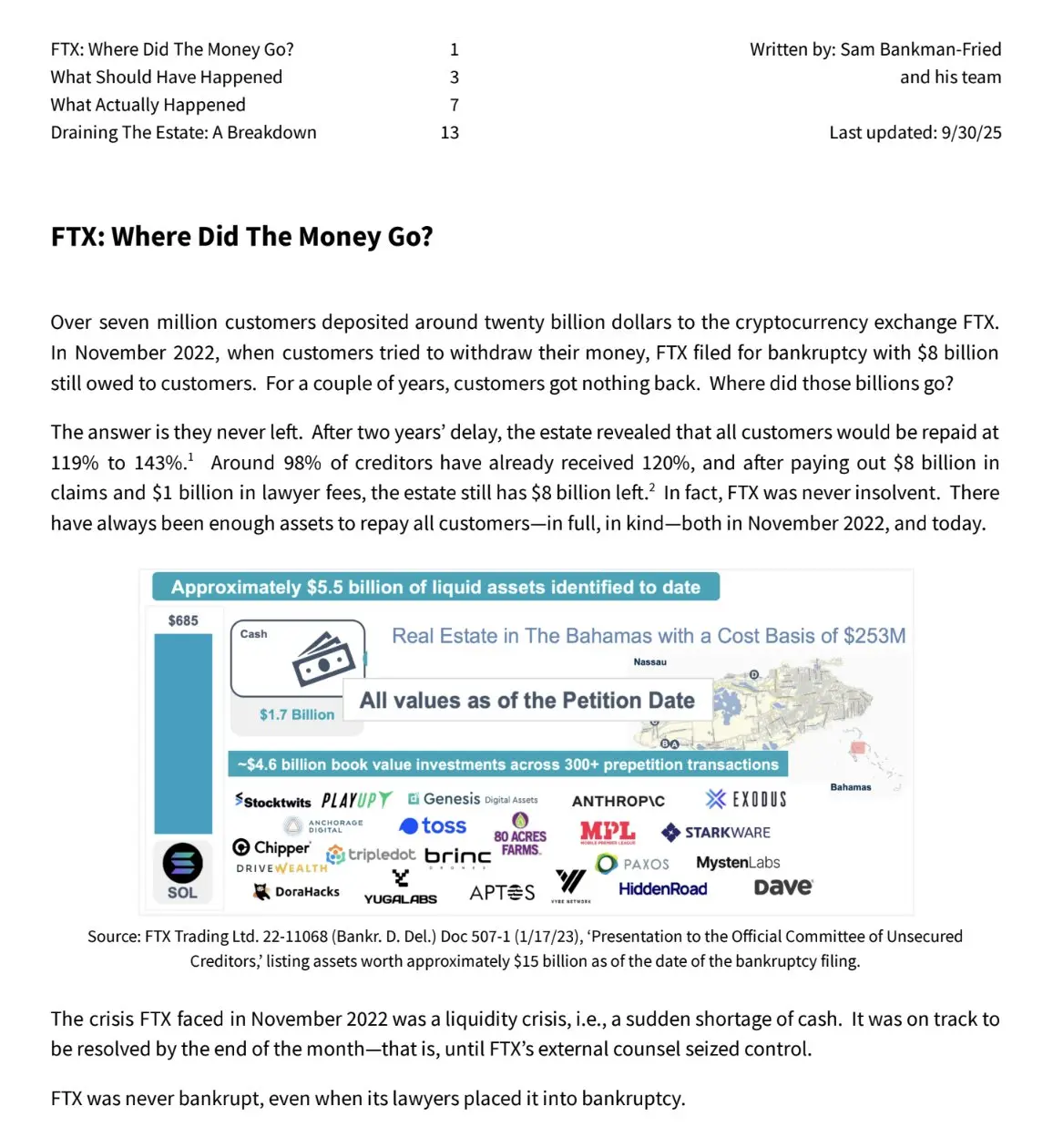
(Source: X)
“Whether in November 2022 or today, we have enough assets to fully and physically repay all customers,” Bankman-Fried wrote. He described the collapse as a typical bank run. Reports indicate that within a few days, withdrawal amounts surged to billions of dollars, while the company was seeking to sell assets and raise funds, continuing to charge transaction fees. The author claims that by the end of November 2022, related transactions were underway to cover the funding gap, and customer withdrawals had also resumed.
The report refuted the bankruptcy team's earlier claims about a funding gap. It pointed out that the assets of FTX and Alameda exceeded liabilities in mid-2021 and 2022, and the data submitted by the bankruptcy administrator in January 2023 showed that as of the application date, their assets were roughly equal to or exceeded customer claims. This argument attempts to redefine the collapse of FTX from “fraud” to “liquidity management error.”
SBF's argument is based on a key assumption: if FTX had not entered bankruptcy proceedings and instead continued operations, selling assets when the market rebounded, customers could have recovered their funds more quickly and completely. The logic chain of this argument is that the assets held by FTX (such as tokens like Solana, FTT, Serum, and equity in companies like Anthropic) were at a low value in November 2022, but had significantly appreciated by 2024-2025. The bankruptcy proceedings forced the administrators to sell these assets prematurely, missing out on subsequent appreciation opportunities.
However, this argument overlooks a core issue: the fundamental reason for the FTX collapse was not market timing choices, but rather the misappropriation of customer funds for high-risk investments. Even if these investments ultimately yield profits, it does not change the illegal nature of the misappropriation. It is akin to a thief stealing your money to buy a lottery ticket, and after winning, returning your principal plus interest, and then claiming “I never stole; I just borrowed temporarily.”
The Miracle of 120% Repayment Behind Asset Surge
Customers will receive between 119% to 143% of the amounts owed at the time of FTX's bankruptcy, with approximately 98% already paid back, equivalent to 120%. After paying out $8 billion in claims and $1 billion in legal fees, there remains about $8 billion in the bankruptcy estate. This figure is indeed astonishing, as being able to fully repay customers is already a rare achievement in cryptocurrency exchange bankruptcy cases, let alone over-repayment.
The realization of this excess repayment is mainly attributed to the surge in the value of the assets held by FTX after its bankruptcy. Solana, Sui, and Anthropic are listed as assets whose stock prices skyrocketed after the FTX liquidation. The Bankman-Fried camp pointed out what they called the improper timing of asset sales. Currently, the valuation of these tokens and shares in private companies is far higher than the valuations mentioned by the author at that time.
The Astonishing Surge in FTX Held Assets
Solana (SOL): Approximately $10 in November 2022, about $200 in 2025 (an increase of 1,900%)
Sui (SUI): The early investment cost is extremely low, and its value skyrocketed after going online.
Anthropic: AI company's valuation skyrockets from hundreds of millions to billions of dollars.
Other Token Assets: Most will achieve 5-10 times growth during the bull market in 2024-2025.
They listed stocks such as Solana, Sui, and Anthropic, stating that holding these stocks during a market rebound would increase their value; at the same time, they also claimed that the insider-favored pricing and high professional fees have drained the company's assets. This criticism points to the decisions made by the bankruptcy managers in asset disposal. From a purely investment return perspective, if FTX holds these assets until 2025, it could indeed achieve a value far exceeding that of bankruptcy liquidation.
However, this argument has a clear hindsight bias problem. When FTX collapsed in November 2022, no one could have predicted that Solana would rise from $10 to $200, nor did anyone know that Anthropic would become a star company in the AI field. The responsibility of the bankruptcy trustee is to liquidate assets as quickly as possible and repay creditors, rather than making high-risk market timing bets. If the trustee holds onto the assets while the market continues to decline, they will face more severe legal liabilities.
Depriving Customers of Crypto Bull Market Gains in USD
They also criticized the payment method denominated in US dollars. Creditors received the US dollar value of the cryptocurrency as of November 11, 2022, rather than the cryptocurrency itself. The report argues that this practice deprives customers of the opportunity to benefit from subsequent price increases and points out that the years-long wait has exacerbated the gap between the application date price and the current price.
This criticism touches on the core controversy in bankruptcy law: should crypto assets be considered property (to be returned in kind) or commodities (to be returned only in equivalent dollars)? U.S. bankruptcy law has traditionally viewed cryptocurrencies as commodities, meaning creditors can only receive the dollar value on the petition date. This practice has indeed resulted in significant opportunity cost losses for FTX customers.
For example, if a customer deposits 1 Bitcoin at FTX, the value on the application date is approximately $16,000. According to the current bankruptcy proceedings, the customer will receive about $19,200 (120% repayment rate). However, if 1 Bitcoin is returned, based on the current value of $107,000, the customer should receive approximately $107,000. This gap exceeds 5 times.
25 years imprisonment sentence and the irony of shouting injustice
Background is very important. FTX was once valued at over $30 billion, with more than a million users. Previous reports revealed intertwined risks between the exchange and Alameda, which led to a massive wave of redemptions, and the rescue efforts ended in failure. After a trial in 2023, Bankman-Fried was convicted on seven charges and sentenced to 25 years in prison in March 2024, with $11 billion in assets ordered to be forfeited; he is appealing the verdict.
SBF submitted this document stating that “FTX never went bankrupt” during his prison sentence, which is quite ironic. His core convictions include wire fraud, securities fraud, and money laundering, with the court ruling that he misappropriated customer funds for high-risk investments and lied to investors and lenders. Now he argues that “the funds never disappeared,” but whether this argument can convince the appellate court is fraught with uncertainty.
The estate management has stated that it has maximized the recovery of losses and pointed out that asset liquidation and litigation victories have provided funding for the continuously rising payout expectations. Creditors, particularly small account holders, are more concerned about the speed and certainty of cash receipts, even if it means giving up the gains brought by cryptocurrencies. In contrast, shareholders can only recover a small portion of their invested capital.
For the cryptocurrency market, it is rare to be able to recover almost all customer funds (based on the value on the application date) during the collapse of a large exchange. FTX Recovery has set a rare precedent for global cryptocurrency bankruptcy cases. Bankman-Fried's documents attempt to rewrite this history, but the court will decide whether this claim holds.


